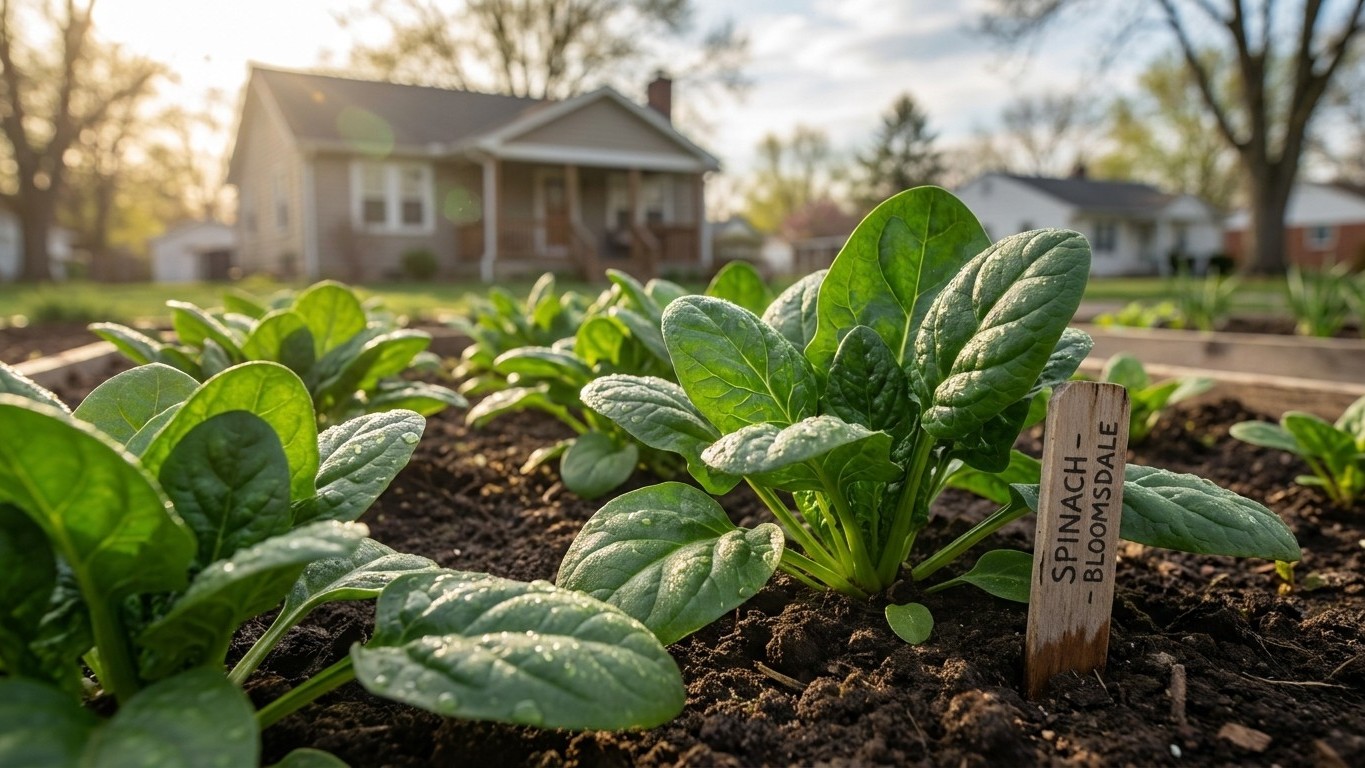

In New Hampshire, spinach runs into trouble from two directions at once: the long daylight hours of a New England June trigger bolting no matter how mild the summer feels, and the state’s own heat, modest as it is, pushes the crop past its comfort zone before July even gets going. That gives you a spring window of roughly six to eight weeks and a narrower, trickier fall window that opens only once the soil cools down, a window covered in detail in When to Sow Autumn Spinach in New Hampshire.
The short answer
Spinach bolts, meaning it stops making leaves and shoots up a flower stalk, when day length gets long and temperatures climb. That’s not a maybe. It’s the trigger, and it raises the obvious question of Will Spinach Bolt Early in New Hampshire? On the longest day of the year, the reference city for this region sees 15 hours and 10 minutes of daylight. That’s an enormous amount of light exposure for a plant that starts flowering the moment days stretch past its comfort threshold, and it means a cool summer here buys you nothing. The days themselves are the problem, independent of the thermometer.
Heat piles on top of that. Spinach grows best where temperatures stay under 75 degrees Fahrenheit, and above that ceiling the leaves turn bitter even before the plant fully bolts. The Manchester reference station averages 10.9 days a year at 90 degrees or hotter, which sounds mild next to a place like Texas or Arizona, but it’s more than enough heat to stack on top of June’s long daylight and finish off a spring planting fast.
So which one actually limits you here: the day length or the heat? Both, but they arrive in a particular order. Day length climbs steadily from the spring equinox onward and peaks at the solstice regardless of what the weather is doing. Heat tends to lag behind it by a few weeks in most years, since New Hampshire’s early summer air can still carry a chill even as daylight hours are already near their peak. That means day length usually calls the end of the spring crop first, then heat finishes the job for anything that tried to hang on.
This is also where a lot of gardeners moving from farther south get confused, because they’re used to thinking of long days as an ally. For onions, long summer days are exactly what triggers bulb formation, and northern gardens with 15-plus hours of June daylight are prized for growing long-day onion varieties well. Spinach runs the opposite script entirely. The same long day that helps an onion bulb up is what pushes spinach into flowering mode and ends your harvest. If you’re gardening both crops in the same New Hampshire yard, it helps to remember that the calendar treats them like opposites, not cousins.
None of this means spinach is a bad fit for the state. It means the window is real but bounded on both ends, and once you know the shape of that window, you can plant around it rather than fighting it.
How long the spring window really is
- Start with the frost date at the reference station: the last spring frost falls somewhere between April 16 and April 27 in a typical year, based on 1991-2020 NOAA climate normals for that airport weather station.
- Spinach seed goes in the ground 2 to 3 weeks before that last frost date, since the seed tolerates cold soil far better than the seedling tolerates a late heat spike. That puts a realistic sowing window somewhere from late March into the middle of April for most of the state.
- Growth stays productive only while conditions stay under that 75 degree ceiling and before daylight climbs toward its June peak. In practice that gives you roughly six to eight usable weeks of real growing time from a late-March or early-April sowing before quality starts sliding.
- That puts a realistic spring harvest window somewhere from mid-May through early June, tapering off as the solstice approaches and daylight closes in on that 15-hour-10-minute peak.
- Utah State University Extension names four spinach varieties commonly grown, Bloomsdale, Melody, Teton, and Olympia, but it doesn’t publish days-to-maturity figures for any of them, so picking a variety here comes down to what your seed source recommends rather than a fixed number of days you can count on.
The practical upshot: if you’re sowing in New Hampshire, earlier beats later almost every time in spring. A planting held back to early May instead of late March isn’t just losing a few weeks, it’s losing the cooler half of the window and running straight into the part of the calendar where daylight and heat gang up together.
The autumn crop, and when the soil lets you sow
A fall crop flips the problem. Instead of racing daylight, you’re racing the calendar backward from the first frost, and instead of worrying about long days, you’re waiting for soil to cool down enough for the seed to even sprout.
The soil is still too warm to germinate
Utah State University Extension notes that spinach seed germination drops off once soil temperatures climb above 80 degrees Fahrenheit. That’s the real obstacle to an early fall sowing here, not heat stress on the growing plant. New Hampshire’s summer soil, warmed by a season that includes those 10.9 days a year at 90-plus air temperature, typically stays too warm for reliable spinach germination well into August. Sowing straight into hot August ground usually means spotty, disappointing germination, whatever the seed packet promises. Waiting until soil temperatures have started dropping toward the end of the month, or watering a bed heavily to cool it before sowing, gives the seed a fairer shot.
The frost that ends the season
The other boundary is the first fall frost, which arrives at the reference station somewhere between October 13 and October 26, again based on NOAA’s 1991-2020 climate normals. Utah State University Extension’s guidance for a fall planting is to sow 50 to 75 days before the date you actually want to harvest, no more specific maturity figure than that. Counting backward from a realistic harvest target in mid-October, before that frost window opens, a 50-day count lands sowing in late August, while the fuller 75-day count pushes it back to the start of August.
Put those two obstacles together and the practical fall window in New Hampshire is narrow: sow too early and warm soil ruins germination, sow too late and you’re racing a frost that can land as soon as mid-October. Most years, the safest bet lands in the second half of August, giving the soil time to cool while still leaving close to 50 days of growing time before frost risk climbs.
Checking this against your own county
Every figure above comes from a single airport weather station, and NOAA’s own data shows that suburban and rural gardens routinely see their last spring frost run later, and their first fall frost run earlier, than the airport does, sometimes by one to two weeks and more if you’re gardening at elevation. That’s not a small margin when your spring window is only six to eight weeks long to begin with.
Before you commit to a sowing date, check your actual frost history with UNH Extension, which is the New Hampshire land-grant university extension service, at extension.unh.edu. County-level frost data and local growing advice will tell you whether your particular spot runs closer to the airport numbers or needs an earlier fall sowing and a later spring one.
Common questions
Can I grow spinach through a New Hampshire summer?
Not really, and not because summer here is scorching. The long daylight hours around the June solstice trigger bolting on their own, and once temperatures climb toward and past 75 degrees, whatever leaves remain turn bitter fast. Plan for a spring crop and a fall crop instead of one long summer run.
Why does the same long day help onions but hurt spinach?
Because the two crops use day length as opposite signals. Long days trigger bulb formation in onions, which is why northern gardens with long summer daylight grow long-day onion varieties well. Long days trigger flowering, not growth, in spinach, so the exact same 15-hour-10-minute June day that helps one crop shuts the other down.
Is there a way to stretch the spring harvest a little longer?
Sowing as early as the soil allows, 2 to 3 weeks ahead of the last frost date, is the main lever you have. There’s no published days-to-maturity figure to plan against for varieties like Bloomsdale or Melody, so the safest approach is simply getting seed in the ground at the front edge of that window rather than trying to squeeze extra time out of the back end, since the back end is where long days take over regardless.
What’s the biggest mistake gardeners make with a fall spinach crop here?
Sowing too early into soil that’s still hot from summer. Germination drops off once soil passes 80 degrees, and New Hampshire soil often stays warmer than that well into August. Waiting for the soil to cool, even if it means sowing later in the month, usually beats an early sowing that never germinates evenly.