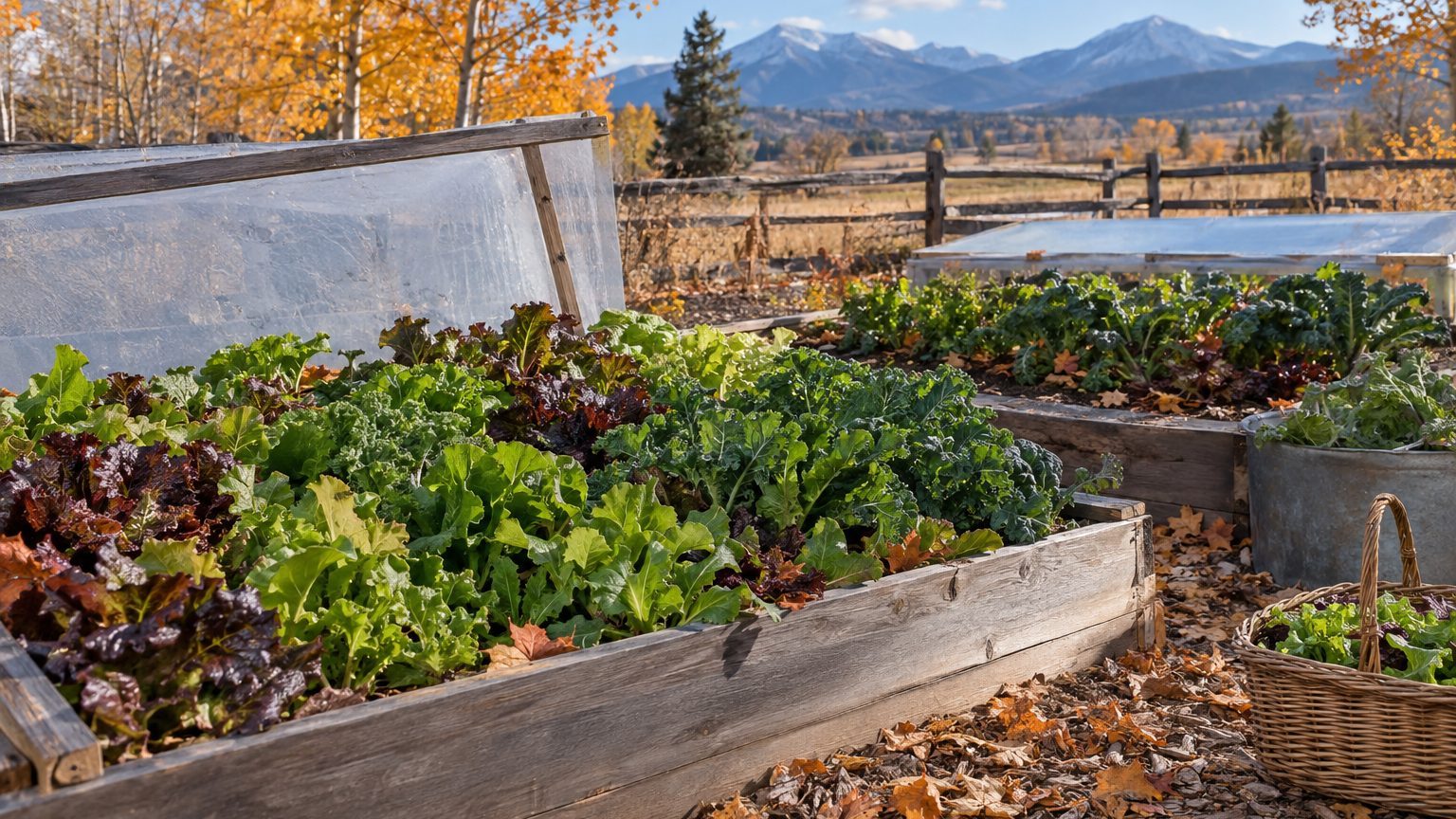

Ohio’s winter salad harvest is decided before winter begins. Once the days shorten, greens barely grow, so what you cut in January is only what reached size in the fall and then held. Work backward from your own first fall frost, and sow early enough that each planting is close to full size when that frost arrives.
When the soil is warm enough in Ohio

Where the frost date sits
The Ohio State University Extension’s Ohio Gardening Calendar puts the last spring frost at May 5 to May 15 for zone 6a. Those dates are measured near Columbus. The lake counties along Erie, the hill country of the southeast and the river counties in the south all run differently, so treat the range as a starting point for your own address. A frost date is a probability, not a promise, and a late freeze after that window is always possible.
Winter salads are sown in the back half of the year, so the spring date does a quieter job here. It tells you when a spring crop will be occupying the bed you plan to reuse, and it marks the point after which the ground is reliably free of hard freezes. That is useful for planning. It is not the date to sow by.
Why frost is only a proxy
Air warms faster than soil. Ohio ground comes out of winter cold and wet, and it keeps holding that cold for some time after the last frost has passed. Frost risk ending and soil being ready are two separate events, and the second one comes later. Judge the bed by the soil, not by the calendar.
For cold-season salad crops the problem flips in late summer. Ohio beds are still hot when the fall sowing window opens, and warm soil can stop lettuce and spinach seed from germinating at all. Brassica greens such as mizuna and tatsoi shrug off the same conditions and come up in a few days. Check the soil before you sow, not after the seed fails:
- Push a soil thermometer to seed depth in the morning, when the reading is at its lowest.
- Look for the germination range printed on the seed packet or listed by OSU Extension for that crop.
- Squeeze a handful. If it crumbles after a light squeeze, it is ready to work. If it stays in a wet ball, wait.
If the soil reads too hot, shade the row and water it before and after sowing. A board laid over the seeded row for a couple of days, lifted daily to check for sprouts, keeps the surface cooler. Sowing in the evening helps too.
Everything here assumes a cultivated bed or a container. Grow these greens in raised beds, in-ground rows or pots that you filled yourself. The overall approach, from bed prep to the first cut, is set out in Winter Salads: What Grows When Lettuce Will Not, and this page builds on it for Ohio conditions.
How long the season lasts here
The arithmetic
OSU Extension’s Ohio Gardening Calendar gives a first fall frost of October 5 to October 15 for zone 6a, again measured near Columbus. Set that against the last spring frost of May 5 to May 15 and the frost-free stretch runs from a shortest case of May 15 to October 5 to a longest of May 5 to October 15. Counting the days gives about 143 to 163 days, roughly 20 to 23 weeks. It is a range because both ends are ranges, and any single day you pick inside it would be invented precision.
That is a comfortable window compared with a northern state, and a modest one compared with the Deep South. It is long enough for one full spring or early summer crop to finish and still leave the beds free for a fall planting. It is not so long that you can be casual about the fall sowing.
What that length allows
A window of this size allows a second sowing, and often a third. The first goes in for the fall cut, timed so the plants are nearly full size at the first fall frost. The next one, sown a couple of weeks later, is your insurance. It will not reach full size before the light drops, but small plants that sit in the bed through winter under cover often put on a flush of leaves when growth resumes in late winter. Our succession sowing guide covers the spacing of these plantings in detail.
The length of the window also settles the transplanting question. In a short season the first sowing is the only one, and losing a week to root disturbance can cost the whole crop. Here you have some slack. Raising seedlings in flats, out of the hot bed soil, works well for kale, endive, escarole and radicchio, and it lets you clear the previous crop first. It works poorly for mâche, claytonia and spinach, which sulk after root disturbance and are easier to sow directly.
Pitfalls at the edges
Gardeners in the northeast corner of Ohio, and anyone up near the lake, will find the fall end of the window arrives sooner than the Columbus range suggests. Gardeners in the south may get a longer stretch. A neighbor’s garden across the state line is a poor proxy as well. The Winter Salads for Pennsylvania Gardens page is a useful comparison for the cooler, hillier east side of Ohio, but it should be used for ideas and not for dates.
The real trap is treating October 5 to October 15 as a deadline for sowing. It is the first frost, and the plants should already be at or near harvest size by then. Count backward from it by the time the crop needs to mature, using the days-to-maturity figure on your seed packet (catalogue figures are usually counted from transplant and vary by a week or two with the season). Then add extra time, because growth slows as the days shorten and the same variety takes longer in October than it did in August.
Heat and water in Ohio

Summer conditions
This page has no count of 90 F days and no summer rainfall figure for Columbus, so it does not print one. NOAA’s climate normals for the Columbus station carry both, and you can pull them up for the station nearest you. What the region does have is a humid summer. Warm, damp weather is the pattern that brings powdery and downy mildew, slugs and slow, uneven growth to seedlings, and a cool wet stretch in early fall does the same. Give the fall bed more room than you would for spring, keep leaves off wet mulch, and water at the base in the morning so foliage dries before night.
Hot weather is not a strong theme for Ohio, but it does matter for one thing: seedlings sown in late summer face a hot start. Shade cloth over the seeded bed or a spot with afternoon shade from a fence keeps the crop through the first weeks. Compare that with Winter Salads for Florida Gardens, where heat is the main obstacle for the whole season. Ohio’s obstacle is on the other end.
The cold decides the rest
NOAA’s 1991-2020 climate normals from NCEI, measured at Columbus, put the mean daily minimum of the coldest month at 22.0 F. That is an average of nightly lows, so individual nights run colder. The USDA Plant Hardiness Zone Map 2023 places Ohio in zones 5b to 6b, which is a range across the whole state and not a single value. Your county sits somewhere inside it.
With winters like that, the crops sort into three groups:
- Stand uncovered: mâche, claytonia, kale and spinach, though spinach growth largely stops in the coldest weeks.
- Need a cover to stay in edible condition: arugula, mizuna, tatsoi, endive, escarole and most leaf lettuce. A low tunnel, cold frame or row cover keeps the leaves from freezing and thawing until they are ruined.
- Cannot manage at all: full heads of butterhead lettuce that were still tender at the first hard freeze, and anything sown too late to have roots.
This is a general pattern for these crop types, not a local trial result. The first frost then sets the last useful sowing date, as described above. Past that point the light is too weak for plants to grow much, and no cover will fix that. Cover protects what is already there. It does not manufacture growth.
Which winter salads suit Ohio
Choose by type
Ohio’s frost window is generous but not endless, so the hardiest and fastest types should carry the plan. Its summers are humid, so disease resistance should be the first thing you check on the seed packet. And its winter lows are cold enough that anything tender needs a cover. Those three facts sort the field.
| Type | Cold behavior in Ohio | Best for |
|---|---|---|
| Mâche (corn salad) | Stands uncovered | Late fall to early spring cutting, direct sown |
| Claytonia | Stands uncovered | Shady beds, steady winter picking |
| Kale | Stands uncovered | Big plants, cut a few leaves at a time |
| Spinach | Stands uncovered, slow in deep cold | Early fall sowing, late winter flush |
| Mizuna and tatsoi | Needs cover in hard cold | Fast fall growth, cut-and-come-again |
| Endive, escarole, radicchio | Needs cover in hard cold | Bitter, sturdy heads for a cold frame |
| Arugula and leaf lettuce | Needs cover, damage quickly | Early fall cutting under a tunnel |
Why this page names no varieties
You will not find a cultivar name here, and that is deliberate. A variety recommendation is only worth anything if it was trialled in the conditions where you will grow it. This page has no Ohio trial results, so any name it offered would just be a guess dressed up as advice. Ohio also covers a wide range of growing conditions, from the lake shore to the Ohio River valley, and a variety that performs well in one may not in another.
OSU Extension is the place to go for that answer. Your county office can tell you which varieties of each type above have been grown locally, and which ones handled mildew and cold in your part of the state. Bring the type you want, such as spinach or a hardy kale, and ask which named varieties they have seen perform.
Where a packet gives a disease resistance code, read it before the price or the photograph. In a humid region that code is the closest thing to a guarantee that the crop will get through a damp October. Sow in beds, rows or containers you control, and buy seed from a catalogue or garden center, not from any plant you find growing outside. Cut-and-come-again greens should be harvested with clean scissors, a few leaves at a time, leaving the growing point intact.
Common questions
Do I need a cold frame in Ohio, or is row cover enough?
Row cover alone is enough for the hardy types and for most of the autumn. A cold frame or a low tunnel with a firm cover earns its place from the deepest cold onward, because it also shields the leaves from wind and from heavy wet snow. For the tender types in the table above, plan on a rigid cover, not just fabric.
Can I still sow after the first fall frost?
You can sow, but do not expect a harvest that winter. Seed sown after the first frost may germinate, yet the plants stay tiny while the light is weak. Some of them, mâche especially, will sit in the bed and grow once the days lengthen again. Treat it as an early spring crop and not a winter one.
Why won’t my lettuce germinate in August?
Warm soil is the usual culprit. Lettuce seed often refuses to sprout when the seed bed is hot, even if it is kept wet. Shade the row, water it in the evening, and try again with a type that tolerates warmth, such as mizuna or arugula, or wait for the soil to cool.
Do winter salads keep growing in January?
Very little. In midwinter the days are too short for real growth, so leaves you pick then are ones that grew in the fall. Pick a few from each plant and leave the rest, since the plants cannot replace what you take until late winter. The days begin to lengthen just after the winter solstice, but the noticeable regrowth usually waits for late February or March.