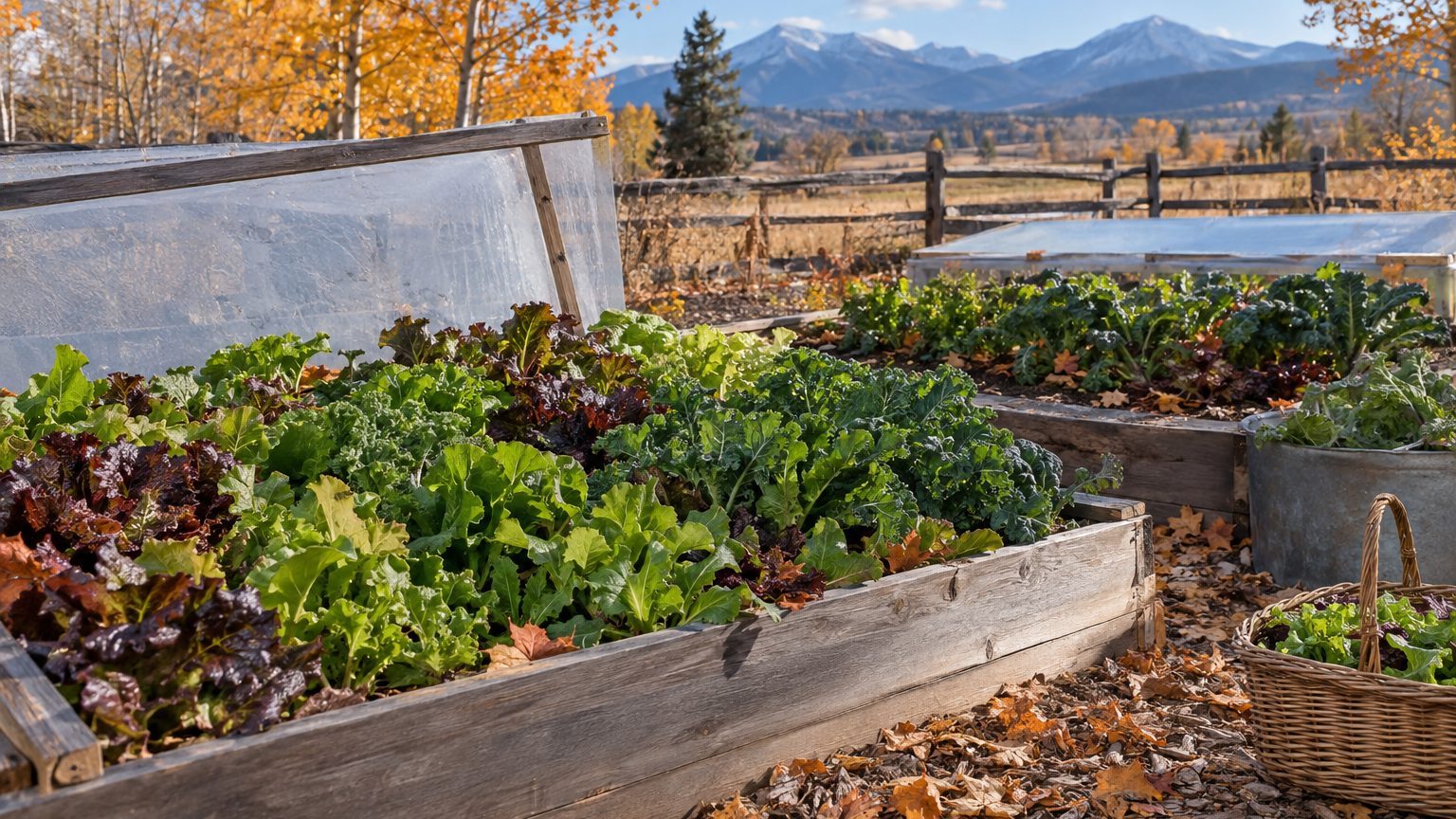

Pennsylvania winter salads are sown in late summer and early fall, not in winter, and the frost date that matters most is the first one, not the last. By the time the ground freezes, the plants need to be near full size, because from then on they hold rather than grow. Count backward from your first fall freeze and get the main sowing in while the days are still long.
When the soil is warm enough in Pennsylvania

The date most readers want is the one when seed will sprout and the seedlings will keep going, and no calendar gives it directly. NOAA’s 1991-2020 climate normals for the Philadelphia station put the last spring freeze between March 29 and April 6 (that is the 30 to 70 percent probability band for a 32 F reading). Philadelphia is the mildest corner of the state. The northern tier and the Alleghenies run two to four weeks later, so shift the whole window accordingly if you garden there. A frost date is a probability, not a promise, and a late freeze after the window is always possible.
Treat that window as a proxy. Winter salads wait for warm soil, and soil warms after the frost risk ends, not at the same moment. Air can turn mild for a week in March while a bed stays cold and wet underneath. Seed sown into that bed sits, and seed that sits in cold, saturated soil rots or gets eaten. A cheap soil thermometer pushed a couple of inches into the bed tells you more than the date does.
Two soil problems, not one
Spring sowing is the easy half. The cold-tolerant types, such as spinach, arugula, mizuna, tatsoi and mâche, germinate in cool soil and can go in as soon as the bed is workable and no longer waterlogged. That gives you a spring salad and a chance to learn how your particular bed behaves. It is not the winter crop.
The winter crop is sown when the problem reverses. In late summer the soil is too hot, not too cold, and lettuce seed in particular may refuse to sprout in it. Sow in the evening, water the row before and after, and shade the bed with cloth or a board laid over the row until the first seedlings show. Lift the cover at the first sign of green, or the seedlings stretch and flop.
Penn State Extension is the place to ask which named varieties have been grown and evaluated in your part of the state. Everything here assumes salad grown from packet seed in beds, cold frames and containers. Nothing here involves picking from the wild, and that includes watercress from streams, which is not a garden crop and not something to gather.
For the overall approach to the crop, including what winter salads are and how they differ from summer lettuce, start with Winter Salads: What Grows When Lettuce Will Not. That page covers the steps this one assumes you have already taken, such as preparing the bed and choosing between direct sowing and trays.
How long the season lasts here
NOAA’s 1991-2020 normals for Philadelphia give a first fall freeze between November 5 and November 16. Set that against the last spring freeze of March 29 to April 6 and the frost-free stretch works out as a range, not a single number. The subtraction is below.
| Case | From (last spring freeze) | To (first fall freeze) | Days between |
|---|---|---|---|
| Shortest | April 6 | November 5 | about 213 |
| Longest | March 29 | November 16 | about 232 |
So the Philadelphia window runs roughly seven to seven and a half months. That count is the gap between the ends of two probability bands, so treat it as a guide to the shape of the year rather than a guarantee for any single one.
What a window that long allows
A window of this length allows a real second sowing. You can start greens in spring, clear them when heat arrives, and still have the whole late-summer to early-fall stretch for the winter crop. It also allows staggering the winter crop itself. Sow some in one week, more a couple of weeks later, and the bed holds plants at different sizes when growth stops. The smallest ones get through winter as insurance, the largest ones get cut first. The succession sowing guide on this site lays out the spacing between sowings.
A long window also makes transplanting a choice, not a necessity. Lettuce, escarole and radicchio handle transplanting well, and starting them in cell trays in a shaded spot while the beds are too hot gives you a head start. Spinach, mâche, arugula and most Asian greens resent root disturbance, so those go in as seed. Skipping the root check is what a long window buys you.
Where the window narrows
Elsewhere in the state the arithmetic changes. NOAA’s figures put the northern tier and the Alleghenies two to four weeks later in spring than Philadelphia, and the fall freeze in those areas is likely to arrive sooner, check the station nearest you. Take that much away from the window and the first sowing becomes the only one. There is then no room for a spring crop followed by a winter crop from the same bed. You commit the bed to the late-summer sowing and skip the spring one.
In a short window, transplanting stops being worth the root check for anything that takes a week to recover. Direct sowing loses nothing in that time, so it wins for most types. Reserve transplants for the few crops that need the head start, and set them out while there is still time to root before the light fails.
Heat and water in Pennsylvania

The numbers differ a great deal between Philadelphia and the northern counties, so pull the figures for the station closest to your garden. What can be said honestly is that summers across the state are humid, and that humidity, not peak heat, is the problem for a salad sown in August.
Warm and wet, or cool and damp
In the warm southeast, the trouble is hot soil at germination, as covered above, and then muggy weather that pushes fungal leaf disease as seedlings crowd together. In the cooler northern tier and the higher ground, a damp summer brings powdery and downy mildew, damping-off in seedlings, slugs and slow growth that leaves plants small when fall arrives. Neither region needs a hot-climate strategy. Both need airflow.
- Thin seedlings to the spacing on the packet so leaves dry between showers.
- Water at soil level in the morning, never over the foliage late in the day.
- Use raised beds or mounded rows so heavy rain drains away from the roots.
- Pull and bin any leaf showing mildew rather than composting it.
- Rotate the bed so the same family does not follow itself.
The winter low sorts the crop
Once the season turns, everything is decided by the cold. NOAA’s 1991-2020 normals for Philadelphia give a mean daily minimum of 26.0 F in the coldest month. That is an average night, not the worst one, and individual cold snaps go well below it. The USDA Plant Hardiness Zone Map (2023) places the state across zones 5a to 7b, so a bed in the north is in a different world from one in the southeast. That figure sorts the crop into three groups.
Some types stand uncovered at Philadelphia-type lows, mâche and claytonia among them, and spinach and baby kale in most winters. Others survive but need cover to stay in edible condition. Arugula, mizuna, tatsoi, lettuce and escarole can be damaged by hard freezes and drying wind, and a low tunnel or cold frame keeps the leaves clean and picking possible. A third group cannot manage at all. The tenderest lettuces will not get through a hard winter, and neither will any sowing made too late to reach useful size.
The first fall freeze, November 5 to November 16 at Philadelphia, sets that last limit. Growth slows as the days shorten, well before the freeze arrives. A sowing that is still small by then will sit small until spring. Sow early enough that the plants are close to cutting size when the light fades.
If your winters are drier and sunnier than Pennsylvania’s, the problem shifts from damp to desiccation, and Winter Salads for Colorado Gardens shows how the same plan bends there. If your winters look more like the colder, more exposed Midwest, Winter Salads for Illinois Gardens is the closer comparison.
Which winter salads suit Pennsylvania
Choose by type, and choose by what this state does to a crop: humid summers, a long window in the southeast that shortens northward, and winter lows that range from mild to severe depending on where you garden.
| Type | Uncovered in a mild winter | Best with cover | Main risk here |
|---|---|---|---|
| Mâche | Usually | Optional | Slow to sprout in warm soil |
| Claytonia | Usually | Optional | Wet, crowded beds |
| Spinach | Usually | In harsh cold | Downy mildew in damp weather |
| Baby kale and mustards | Often | In harsh cold | Slugs and flea beetles |
| Arugula, mizuna, tatsoi | Sometimes | Yes | Leaf damage in freezing wind |
| Lettuce, escarole, radicchio | Rarely | Yes | Rot and mildew under cover |
Let the season length pick the type
Where the window is short, favor the earliest, fastest types. Mizuna, tatsoi, arugula and baby mustards reach cutting size quickly from seed, so a late sowing still has a chance. Heading types such as radicchio and escarole need more time and more light. In the cooler north, save them for a sowing made with days to spare.
Where summers run hot, favor types you can give shade and airflow, and sow them into soil you have cooled and moistened. That is a practice more than a type, but it decides which lettuces germinate at all.
Humidity makes disease resistance the first criterion
In a humid state, disease resistance comes before flavor. Read the packet for downy mildew resistance on spinach and lettuce, since that is the disease the damp weather encourages. Two packets of the same type can differ on this point, and it is the difference that decides whether a bed survives a wet October.
Why no variety names here
A variety that thrives in Philadelphia can fail in the Alleghenies. Penn State Extension, and your county extension office, know which varieties have actually been grown in your zone. Ask them for the current list, and note your sowing dates on the packets so next year’s count starts from your own results.
Common questions
Can I still sow in December for a winter harvest?
No. By December growth has nearly stopped, and seed sown then will sit until the light returns. What is in the bed by late fall is what you will be picking, so use December for covering and tidying, not sowing.
Will a cold frame keep salad greens alive in northern Pennsylvania?
Often, for the hardy types, but not reliably for all of them. NOAA’s 26.0 F coldest-month minimum comes from Philadelphia, and the north runs colder. A cold frame with a second layer of fabric inside gives more margin, and mâche, claytonia and spinach are the safer choices.
Why did my lettuce not come up in August?
The soil was probably too hot. Lettuce seed can go dormant in warm ground. Sow in the evening, water the row, shade it until sprouting, or start the seed in trays somewhere cooler and transplant.
Do I need to vent a cold frame or low tunnel?
Yes, on any mild or sunny day. Trapped humidity encourages mildew and rot, and a closed frame on a bright winter afternoon can overheat the plants. Open it in the morning and close it before the temperature drops in the evening.