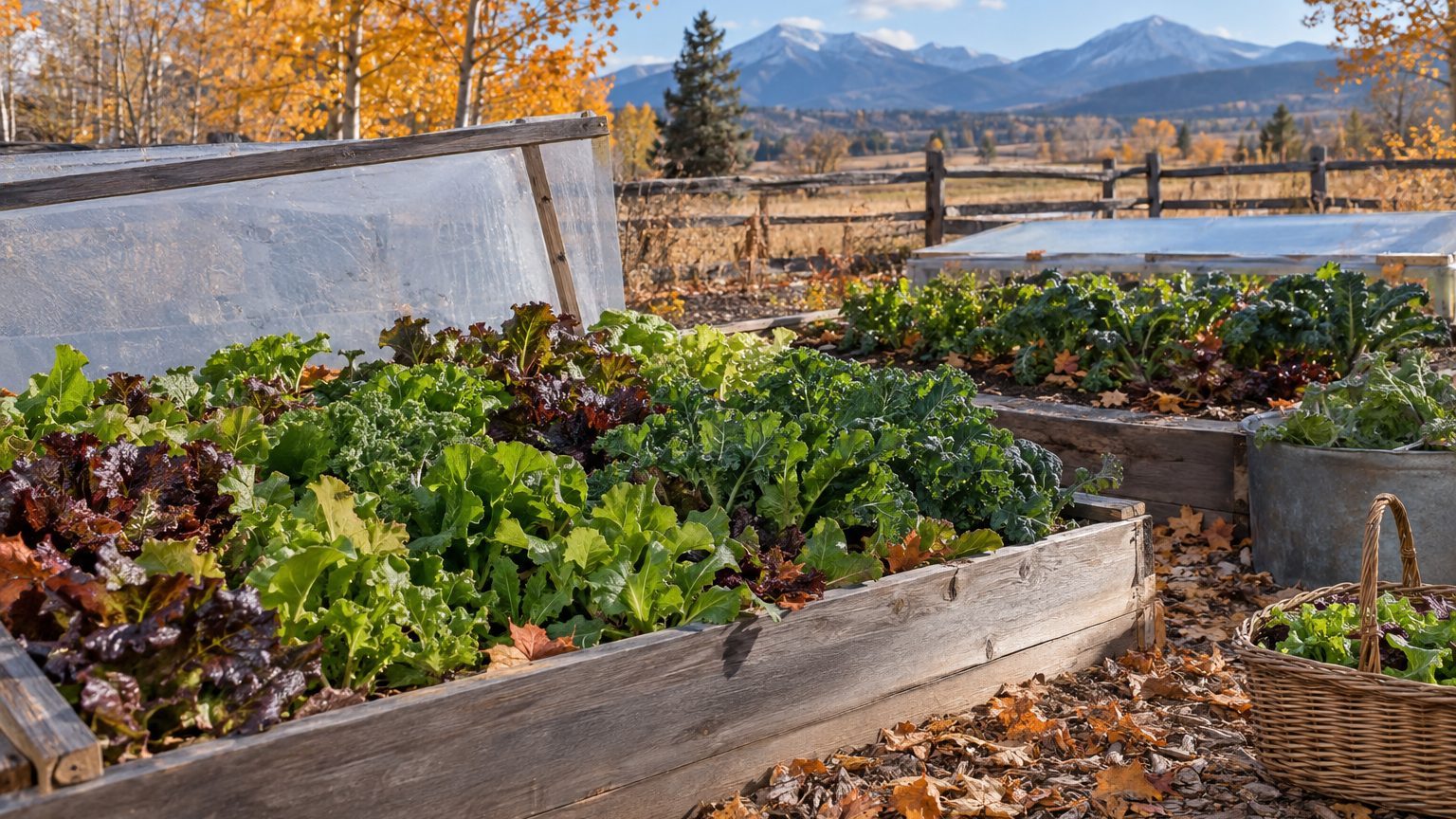

Ontario winter salads go in the ground in the heat of late summer, long before anyone talks about frost, so the spring date printed in every seed catalogue is the wrong clock. The clock that matters runs backward from your first fall frost, and it has to leave the plants at full size before the light fails. Look up the first fall frost for your own town this week, then mark the day a month or more ahead of it as your last sowing.
When the soil is warm enough in Ontario

Frost date first, soil second
Environment and Climate Change Canada’s 1981-2010 Canadian Climate Normals put the average last spring frost at April 30 at Toronto Lester B. Pearson International Airport (climate ID 6158733). That is a mean, not a safe date. In one year out of two the last frost falls later than April 30, so treat it as the middle of a window that runs on into May. It is also one station. Northern and upland parts of Ontario run weeks behind Toronto, and the lakeshore districts can run ahead. These are Canadian 1981-2010 normals, so they will not line up exactly with the 1991-2020 US figures you may see elsewhere on this site.
Frost is only a proxy for what a salad crop needs. Seed wants warm, workable soil, and the soil warms after the frost risk ends, not on the same day. A bed can be frost-free in the first week of May and still be cold and sodden at seed depth. Push a soil thermometer in to the depth you will sow and read it in the morning, when it is at its lowest. Then squeeze a handful. If it holds as a wet lump, wait. If it crumbles, you can sow.
Hardy leaf types tolerate cold soil far better than lettuce does. Corn salad (mâche), spinach, arugula and the mustard-family greens such as mizuna will germinate while the ground is still cool, so a spring sowing of these can go in as soon as the bed is workable. Tender lettuce and endive should wait for the soil to warm. Spring sowing gives you a spring salad, though, and it is not the winter crop. It will bolt as the days lengthen and the beds heat up.
The other sowing: late summer
The crop that actually eats through the cold months is sown in late summer, when soil is warm and the spring frost date no longer matters. The trouble is the opposite one. Lettuce-family seed sown into hot, dry soil can refuse to germinate, and the mustards and spinach come up patchy. Sow in the evening, water the drill before you cover it, and lay a board or a piece of shade cloth over the row until the first seedlings show. Take it off the same day they appear. If the general method is new to you, Winter Salads: What Grows When Lettuce Will Not covers the basic sequence this page assumes you have already followed.
A note on varieties. This page names none, because the ones that have been trialled in your part of Ontario are the only ones worth buying, and that information sits with the province. The last section says where to find it. All the crops here are grown in beds, raised boxes and containers. None of it involves gathering leaves from ditches, streams or fields.
How long the season lasts here
The same Environment and Climate Change Canada normals give an average first fall frost of October 16 at the Toronto Pearson station. Count from the average last spring frost on April 30 to October 16 and you get about 169 days, roughly 24 weeks. That is the frost-free stretch at that one station, worked out from two averages. In a given year it can be shorter or longer, and any garden farther north will have fewer weeks than that. Use the figure to see what is possible, and keep your own local dates for the actual sowing calendar.
What 24 weeks allows
A window that long is generous for leaf crops. It allows a spring sowing, a midsummer break, and a late-summer sowing that still has time to build a root system and a rosette of leaves before autumn. It also allows succession sowing, where you put in a short row every couple of weeks instead of a whole bed at once. For the winter crop this matters more than it does in spring. The final sowings of the year are the ones you will actually be cutting in December, and if one fails in a hot spell you want another already behind it.
A long window also changes the transplanting decision. In a short season you might start seedlings indoors to gain time, and accept the root check when they go out. Here you rarely need to. Spinach, arugula and the mustard greens sulk when their roots are disturbed, and they catch up quickly from direct sowing. The one place transplanting earns its keep is August, when the bed is hot and dry. Starting lettuce or endive in modules in a shaded spot, then setting them out at a few true leaves on a cool evening, avoids the germination problem described above.
Working backward from the fall frost
The last sowing date is a calculation, and you should do it yourself rather than trust a number from a page that cannot see your yard. Take your first fall frost range. Subtract the days to harvest printed on the packet. Then subtract a generous margin on top. Catalogue days are counted in strong growing light, and as the days shorten in autumn the plants put on leaf far more slowly. What you are aiming for is plants at nearly full size when the growth stalls, because after that they mostly hold in place. A sowing that is a few weeks late does not produce a small crop in December. It produces almost nothing.
If your window is shorter than Toronto’s, the calendar tightens quickly, and Winter Salads for Maine Gardens shows how a colder state squeezes the same crops into fewer weeks. Whatever the length, write the dates of your sowings in a notebook. Two seasons of your own notes will beat any average.
Heat and water in Ontario

The figures behind this page do not include a count of very hot days or the summer rainfall, so this page does not quote either. Environment and Climate Change Canada publishes climate normals for stations across the province, and the one nearest your garden is the number to look up. What can be said without a count is how the crop behaves. Southern Ontario summers are warm and humid enough to matter at the germination stage in August. In a cool, damp year the trouble changes: mildew, leaf spots and slugs replace heat stress, and growth slows.
What summer does to a late-summer sowing
Warm humid weather favors the diseases that live on wet leaves, particularly downy mildew on spinach and lettuce. The practices that limit it are cheap. Space plants for airflow rather than sowing a solid mat. Water in the morning so the foliage dries before night. Keep the water at the root and off the leaves when you can. Thin early, because crowded seedlings under a damp canopy are where problems start. A little afternoon shade also helps, whether that comes from a taller crop on the west side or a strip of shade cloth.
What winter decides
Most of the choosing is done by the cold. Environment and Climate Change Canada’s 1981-2010 normals for Toronto give the mean daily minimum of the coldest month as -10.2 °C. That is an average night in the coldest month, not the record low, so colder nights will come. Natural Resources Canada’s plant hardiness map, built on 1991-2020 normals, places Toronto in Canadian zone 7a. That is the Canadian system, which uses seven climate variables and does not convert to a USDA zone, so do not carry the number over to an American seed catalogue. Both figures are for Toronto only. Your garden may sit a full zone either side.
Against that cold, the crops fall into three groups:
- Stand uncovered: the hardiest, such as mâche and spinach, usually survive, though growth stops and leaf quality suffers in a hard spell.
- Need a cover to stay edible: the mustard greens, arugula and claytonia, which look better and cut cleaner under a low tunnel or row cover.
- Cannot manage: tender lettuce and most heads of endive, which need a frame or a protected structure at best.
The first fall frost then sets the sowing deadline, because a plant that has not reached useful size by the time the light fails will not get there. In Hawaii the reverse holds. Heat rather than cold sets the limits, as Winter Salads for Hawaii Gardens describes, and the whole calendar sits on a different logic.
When a cover is on, open it on mild sunny days. A closed tunnel in bright weather cooks the leaves and then holds humidity overnight, which is the ideal setting for mildew.
Which winter salads suit Ontario
Choose by type, and let the winter low and the humidity guide you. A 24-week window is long enough that you do not need the very earliest types just to finish in time. The cold is the harder constraint, so hardiness decides first, and disease resistance decides second because the summers are humid. The table compares the main types against those two pressures. It is a general guide and not a local trial result, so expect some variation with your own site.
| Type | Cold tolerance | What to watch |
|---|---|---|
| Mâche (corn salad) | Very hardy, often fine uncovered | Slow to germinate in hot soil |
| Spinach | Hardy, best with light cover in hard spells | Downy mildew in damp weather |
| Claytonia (cultivated) | Hardy, better under cover | Small leaves, slow to build |
| Arugula and mizuna | Moderately hardy, prefer cover | Flea beetles early, bolting in warmth |
| Escarole and endive | Moderate, need a tunnel or frame | Rot in wet, still air |
| Loose-leaf lettuce | Tender, protected sites only | Mildew, and heat during germination |
For a first winter, start with mâche, spinach and one of the mustard greens. Those three cover the range from open bed to low tunnel, so you learn how your own site behaves before you spend on a frame. When you pick seed, look for the disease resistance listed on the packet, especially for downy mildew on spinach and lettuce. In a humid summer that line matters more than a promise about flavor.
This page names no cultivars, and that is deliberate. A named variety that thrives in one Ontario district can fail in another, and the only recommendations worth following are the ones trialled where you garden. The Government of Ontario’s agriculture and food pages are the place to start looking for local advice, and your regional seed suppliers will know which types have done well in your district. Ask them directly.
Common questions
Can I grow winter salads in Ontario without a greenhouse?
Yes, with a low tunnel, cold frame or row cover, and with hardy types. Plants grow very little in the darkest weeks, so what you cut in midwinter is mostly what grew in autumn. Plan for steady picking of a standing crop, not for fresh regrowth.
Can I sow winter salad in spring instead of late summer?
You can, but you will get a spring crop and not a winter one. Hardy leaves sown in cool spring soil crop well for a few weeks, then bolt as the days lengthen and warm. The crop that carries you into winter has to be established in late summer or early autumn.
Why did my August sowing not come up?
Hot, dry soil is the usual cause, especially for lettuce and mâche. Seed of cool-season leaves can stall when the seedbed is too warm. Sow in the evening, water the drill first, and shade the row until the first seedlings appear. Resow immediately if a week passes with nothing showing.
Is it safe to cut leaves that are frozen?
Wait until they have thawed. Frozen leaves snap and bruise when handled, and the damage shows as slimy patches within a day. Pick late in the morning on a mild day, when the leaves are limp again but still cool.