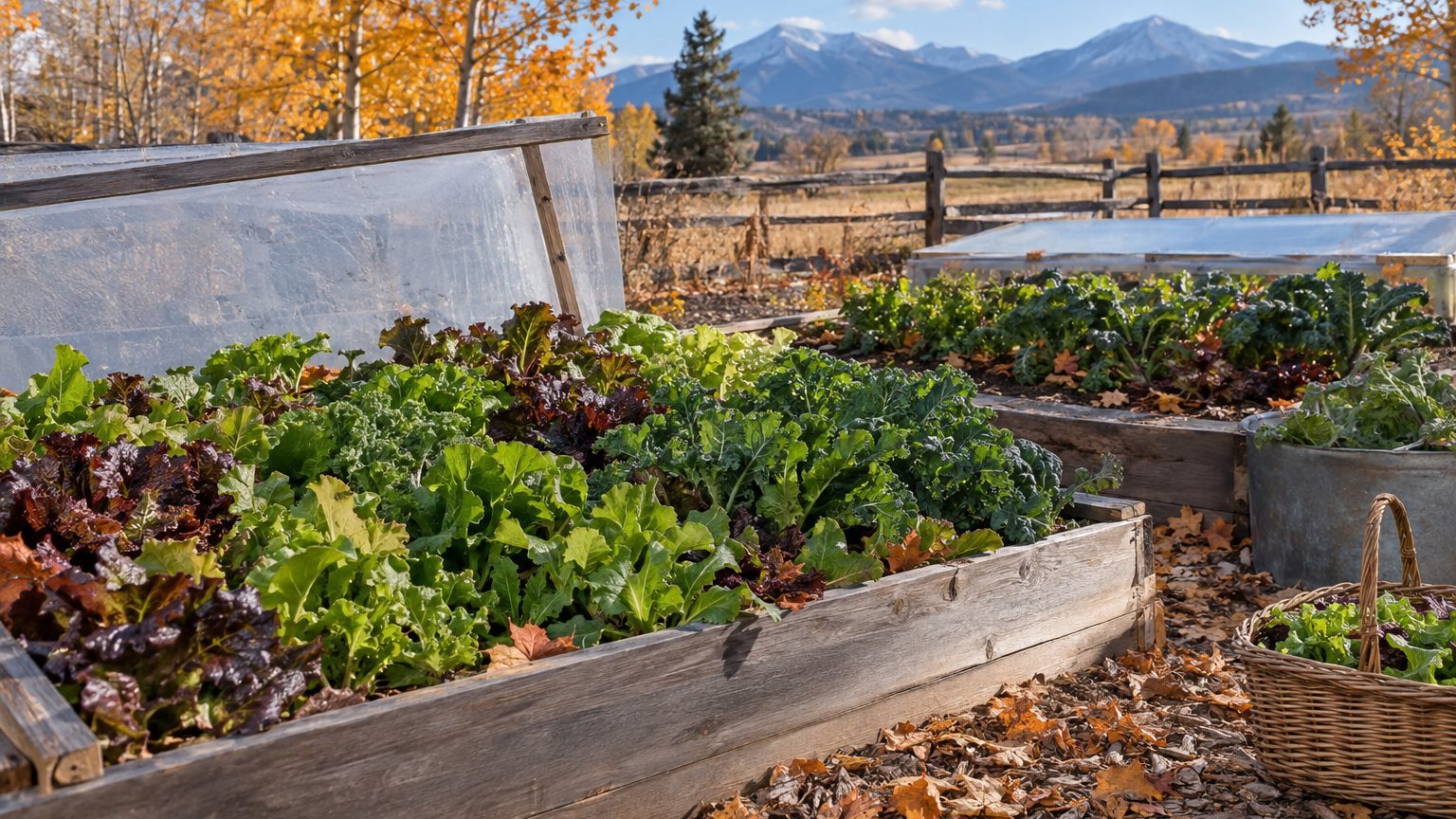

Quebec salads that you cut in winter are grown in autumn. Once the light shortens and the nights freeze, leaves barely grow, so what you harvest in December is whatever reached size before the light failed. Count backward from your first fall frost, using the days to maturity on the seed packet, and sow late enough to avoid summer heat but early enough that plants are nearly full size when the cold arrives.
When the soil is warm enough in Quebec

Environment and Climate Change Canada’s 1981-2010 climate normals put the average last spring frost at May 6 at the Montreal/St-Hubert A station. That is a mean date. In one year out of two the last frost falls later, so it marks the middle of a window and is not a safe date to plant by. The station sits in the Montreal plain. Districts north of it and upland areas run weeks behind, and you should shift your own dates accordingly.
Frost is only a proxy
Winter salads do not wait for frost to end. They wait for soil. Soil warms after the frost risk has passed, because it holds the cold of winter long after the air has turned mild. A garden bed that looks ready on a sunny April afternoon can still be cold and saturated a hand’s depth down, and seed sown into it sits and rots.
The reliable check is a soil thermometer pushed to seed depth in the morning, read against the germination range printed on the packet. Hardy greens such as spinach and mâche (corn salad) tolerate cool soil better than lettuce does, so they are the first to go in once the bed can be worked without turning to paste. Squeeze a handful: if it holds as a wet ball and does not crumble when poked, wait.
Why spring matters less than late summer
For a crop you cut in winter, the spring date matters mainly for preparation. It tells you when to clear and feed the beds, and when a quick early crop can come out to free the ground by midsummer. The sowing that counts happens later, when the problem reverses. Late-summer soil is warm, sometimes too warm for lettuce and spinach seed to germinate well, so shade the seed row, water it lightly and often, and sow in the evening if the ground is hot.
If you have not grown this crop before, the overview in Winter Salads: What Grows When Lettuce Will Not covers the steps this page assumes, such as bed preparation and choosing a spot that catches low winter sun.
How long the season lasts here
Take the same station and the same source. Environment and Climate Change Canada’s 1981-2010 normals for Montreal/St-Hubert A give an average first fall frost of October 5. From the average last spring frost on May 6 to that date is roughly 150 days, a little over five months. Both are means, so in half of all years the last frost comes after May 6 and in half the first frost comes before October 5. A cold spring followed by an early autumn can cut that window by a couple of weeks. Northern gardens lose more.
What roughly 150 days allows
It is enough for a summer crop and a second, later planting, but not for a relaxed second planting. Whatever goes in for winter has to follow something else out of the bed, and the handover is the tight point. Onions, early peas, garlic and spring lettuce all clear ground by midsummer, and the winter salad takes their place.
Work out the sowing date as a calculation, not a recipe. Take the first-frost window, count back the days to maturity on the packet, then add a margin of a week or two, because catalogue figures are counted from transplant in good conditions and autumn growth is slower as days shorten. The result is a range of dates, not a single one. Sow at the late end and you get small plants that hold through winter but give little. Sow too early and lettuce bolts or goes tough before cold arrives.
Sowing versus transplanting
With this window, direct sowing suits the hardy greens. Mâche, spinach and claytonia resent root disturbance and lose a week or more sulking after transplanting, which is a large share of what you can spare. Lettuce and endive types are different. Starting them in cell trays in a shaded spot while the summer crop finishes buys you the head start that a short season demands, and the root check matters less when plants go in still small.
Sowing every ten days or so through the late-summer window, instead of once, spreads the risk of a bad week of weather and gives you different sizes going into winter. Succession sowing is a full subject of its own on this site. For this crop the rule is simply that the last sowing is the one the first frost decides.
Heat and water in Quebec

What can be said honestly is that heat is not what decides winter salad here. The cold is.
Environment and Climate Change Canada’s 1981-2010 normals for Montreal give a mean daily minimum of -14.1 °C in the coldest month (the source stores it as 6.7 °F). That is an average of the nightly lows, not the record low, so individual nights go well below it. Natural Resources Canada’s plant hardiness site places Montreal in Canadian hardiness zone 5b, on its 1991-2020 normals. That is the Canadian system, built on several climate variables, and it does not convert to a US zone.
What the winter low decides
At that mean minimum, and with colder nights on top, nothing tender survives unprotected. The practical sorting looks like this:
- The hardiest types (mâche, claytonia, spinach) may stand outdoors in a mild spell but are far more dependable under a cover.
- Leafy mustards, arugula and Asian greens need a cold frame or low tunnel to stay in edible condition.
- Lettuce and other tender heading types cannot manage a Quebec winter on their own.
A cover raises the temperature at leaf level by a few degrees, which is often the difference between usable leaves and mush. It also keeps snow load and wind off the foliage.
Damp and warm rather than hot and dry
Where summer heat is moderate and humidity is high, the trouble is fungal. Downy mildew and gray mold, along with slow ripening in cool wet spells, are what damage salad plants in the weeks before frost. Water at the base of the plant, in the morning, so leaves dry before evening. Space seedlings for airflow, and thin more than looks necessary.
Under cover in winter, the risk becomes trapped humidity. Vent the frame on any mild day, and water very little. Plants that are nearly dormant use almost nothing, and wet soil around a cold crown does more harm than dry.
The first frost date sets the other limit. A sowing that goes in too late will not reach useful size before the light fails, however well you protect it, and it will stand as a small rosette until spring.
Which winter salads suit Quebec
Choose by type, and let the winter low and the short window make the decision. The main thing to weigh is cold tolerance first, then speed to a harvestable size, then disease resistance, because humid autumns favor mildew.
| Type | Cold tolerance | Best used for |
|---|---|---|
| Mâche (corn salad) | Very high | Small, slow rosettes that hold all winter under cover |
| Claytonia | Very high | Cut-and-come-again leaves in a cold frame |
| Spinach | High | Overwintered plants that resume growth in early spring |
| Mizuna, tatsoi, arugula | Moderate | Fast autumn crops, best under a low tunnel |
| Endive, radicchio, hardy lettuce types | Lower | Early winter cutting, needs a cold frame |
A short season favors the fast types, those that reach cutting size soonest after a late-summer sowing. A humid autumn favors any type sold with mildew resistance, and packets state this. Sow thinly for airflow.
Why no variety names appear here
This page names no cultivars. Ask Quebec’s provincial agriculture ministry, MAPAQ, and your local seed suppliers what has been grown and cut through winter in your region.
For contrast, a milder, wetter winter changes the choice considerably, which the Winter Salads for Oregon Gardens page shows. Where hard winters are the norm, as on the Winter Salads for Iowa Gardens page, the emphasis shifts back toward covers and the hardiest types. All the crops here are grown in beds, frames and containers. Never collect leaves from ditches or streams to eat, since wild plants can be contaminated or mistaken for toxic look-alikes.
Common questions
Can winter lettuce survive outdoors in Quebec without cover?
Not reliably. Tender heading lettuce does not survive a Quebec winter on its own, and even the hardiest greens hold up far better with a cold frame or low tunnel. A mild winter or a deep snow blanket can sometimes carry mâche or spinach through, but you cannot plan on it.
My garden is north of Montreal. Should I move the dates?
Yes. Expect the last spring frost later and the first fall frost earlier, and treat the sowing window as correspondingly shorter. Note your own first frost for a few seasons and use that.
Can I pick leaves that are frozen stiff?
Wait until they thaw. Cutting or handling frozen leaves bruises them and they turn slimy soon after. Open the frame on a mild morning, let the leaves soften and harvest once they are limp and dry.
Do I need a heated greenhouse?
No. An unheated cold frame or low tunnel is enough for the hardy types. The extra protection needed for tender lettuce is usually not worth the fuel, so choose the hardy types instead.