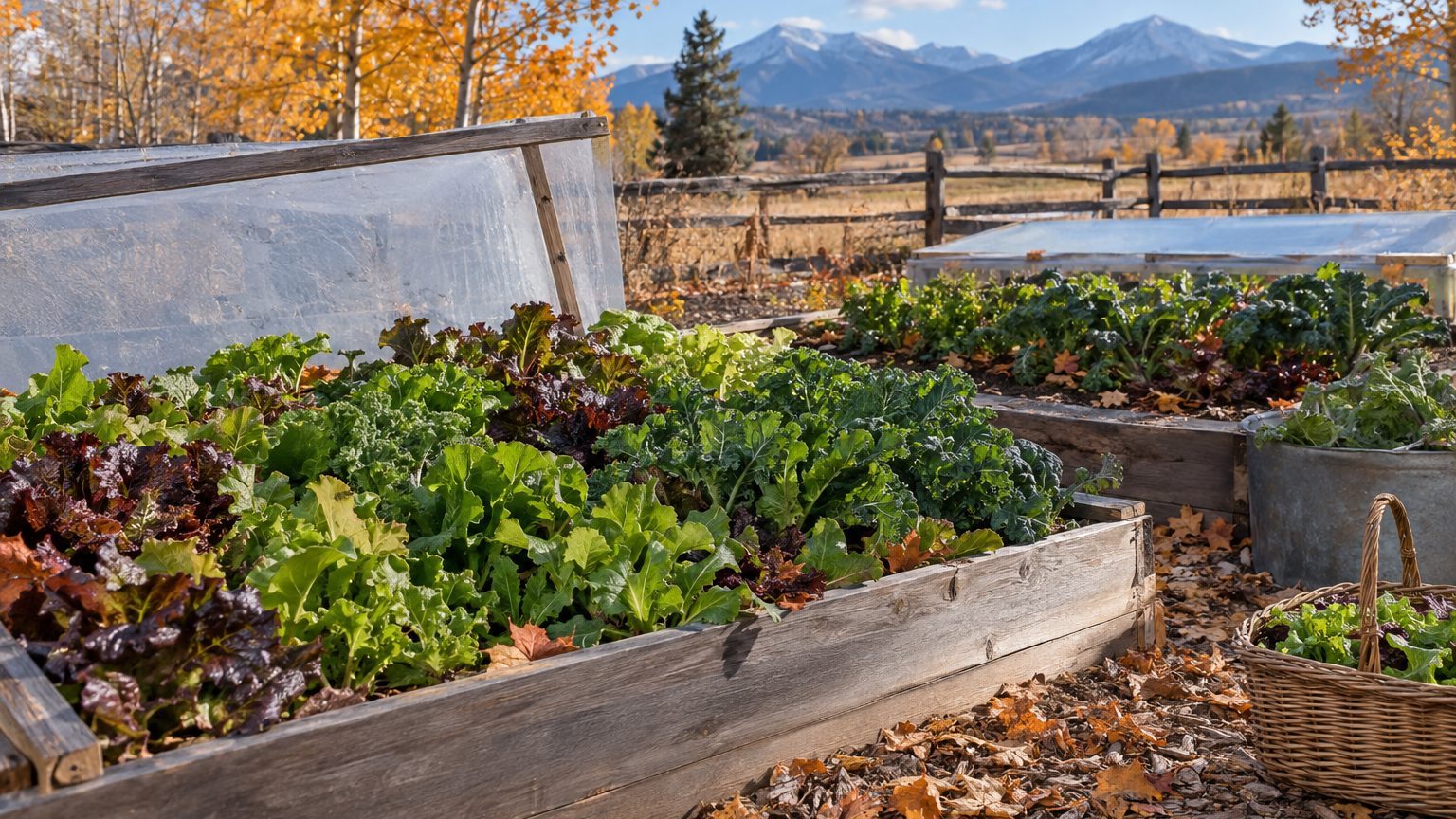

Saskatchewan’s short autumn decides everything about winter salads, because the leaves have to reach useful size while the light is still strong and then simply hold through the cold. You are not growing a crop in midwinter here. You are growing it in late summer and storing it alive in the bed under cover. Count back from your own first fall frost, sow the hardy greens in that window, and have your low tunnel or cold frame built before the first hard night.
When the soil is warm enough in Saskatchewan

The frost date is a starting point
Environment and Climate Change Canada’s 1981-2010 Canadian Climate Normals for the Saskatoon SRC station put the average last spring frost at May 18. That is a mean date. In roughly one year out of two the last frost lands later than May 18, so treat it as the middle of a window and never as a safe date. It also comes from one station. Northern and upland districts of the province run weeks behind Saskatoon, and a garden near Prince Albert or in the Cypress Hills should not borrow it unchanged.
The Canadian normals cover 1981-2010, which is a different period from the 1991-2020 figures. Do not line the two sets up as if they were the same measurement.
Why soil matters more than the frost
Winter salads wait for warm soil, not a calendar date. Soil warms after the frost risk ends, not with it, and it lags the air by days or weeks depending on how wet and how exposed the bed is. A bed that sat under snow melt into May can still be cold and soggy well after a frost-free week.
Winter salad crops are less fussy than tomatoes. Spinach, mâche and the leafy mustards germinate in cool ground, so a spring sowing can go in as soon as the bed is workable and crumbles in your hand rather than smearing. Push a soil thermometer 5 cm (2 inches) down at mid-morning and compare the reading with the germination range printed on the seed packet. If the soil is below that range, the seed sits and rots. If it is well above, as it will be in late July, cool-season seed germinates poorly and you need to cool the bed instead.
That second case matters more, because the crop you actually want for winter goes in when summer soil is at its warmest. Water the bed before sowing to pull heat out of it, sow in the evening, and lay a board or a strip of shade cloth over the row until the seedlings show. Lift it at the first sign of green. Your sowing date for the winter crop comes from the fall frost, and section two shows how to count it. The wider logic of these crops is laid out in Winter Salads: What Grows When Lettuce Will Not.
How long the season lasts here
The same ECCC normals for Saskatoon SRC give an average first fall frost of September 18. Count from May 18 to September 18 and you get about 123 days between the two mean dates. That is the frost-free stretch in an average year, and it is a rough figure. Some years the last spring frost arrives late and the first fall frost early, and the stretch shrinks by weeks. Other years it is generous. Plan on the short version.
What 123 days allows
It allows one full-size crop and not much more. Tomatoes, squash and corn take most of that window, and they are also the crops that demand the warmest ground. A winter salad does not compete with them for time, because the greens are sown after the first vegetables are cleared or in a bed set aside for them. The question is only how much growing time is left after your sowing date and before the first frost, and after that before the light fails.
Plants keep growing after the first frost, but slowly, and the hardy types do not mind a light frost at all. The real limit is daylight. By late autumn the days are short enough that leaves add very little, so whatever size the plants have reached in the weeks after sowing is roughly the size you will be cutting all winter. Sow too late and you get a bed of small seedlings that survive but never give you a real cut.
Transplanting or direct sowing
A short window changes the transplant decision. Every transplant sulks for a few days while its roots recover, and in a long season that costs nothing. Here it costs part of your growing time. Direct sow spinach, mâche and other taprooted greens, since they resent root disturbance most. Leaf lettuce and the mustards tolerate transplanting better, and starting them in cell trays in the shade for a couple of weeks can free a bed that is still occupied by an earlier crop.
There is room for two sowings if the first goes in early. Sow a quick spring crop as soon as the bed is workable, clear it by midsummer, and put the winter sowing in the same ground. Staggering the winter crop itself over two or three weeks in August gives you insurance against one bad stretch of weather.
Work out your own dates like this. Take the first fall frost for your nearest ECCC station, remember it is a mean, and count backward to leave time for the plants to size up. Then add a margin, because a cool August slows everything. Your date will be a window of a week or two, not a single day.
Heat and water in Saskatchewan

The cold is what decides
ECCC’s 1981-2010 normals for Saskatoon give a mean daily minimum of -20.7 °C in the coldest month. Natural Resources Canada’s plant hardiness site, using 1991-2020 normals, places Saskatoon in Canadian hardiness zone 3a. That is the Canadian system, which is built from several climate variables and does not convert to a USDA zone, so do not read seed catalogue zones against it.
Against that cold, the crops sort into three groups:
- Stand with little or no cover: none of them reliably stay in edible condition uncovered, though the hardiest types can survive as dormant plants under snow.
- Need a cover to stay edible: spinach, mâche, claytonia and hardy kale, under a low tunnel or cold frame.
- Cannot manage: tender lettuces and most mustards, which do not survive hard freezes.
Even the covered group only holds. An unheated frame keeps the wind and the deepest cold off the plants, but it does not make them grow when the outside minimum sits near -20.7 °C. Snow is the best insulation you have, so do not clear it from the top of a low tunnel. Vent the cover on sunny days, because a closed frame heated by winter sun can thaw and refreeze the leaves in one afternoon.
Summer heat and rainfall
Check ECCC’s climate normals for your nearest station before you plan irrigation. What you can plan for is the pattern. Prairie summers bring warm days and cool nights, and the trouble spots are the hot spells when you want cool-season seed to germinate in late July or August.
In a hot spell, lettuce and spinach seed may refuse to germinate in warm ground, and young plants bolt or turn bitter. Shade, evening sowing and steady watering deal with most of it. In a cool damp summer the risk turns to downy mildew on spinach, slow ripening, and slugs in crowded beds. Give plants airflow, water at the base in the morning, and thin early. Flea beetles pit the leaves of arugula and the mustards, and a floating row cover laid over the seedlings on day one keeps them out.
Water matters for the last stretch before freeze-up too. Plants going into winter with dry roots suffer more from cold than well-watered ones, so give the bed a good soak before the ground freezes.
Which winter salads suit Saskatchewan
The short season favours the hardiest and earliest types, and the deep cold rules out the tender ones. Choose by type first, then by how much cover you are willing to build.
| Type | Role in a Saskatchewan winter | What it needs |
|---|---|---|
| Mâche (corn salad) | Among the hardiest, small rosettes | Late-summer sowing, light cover |
| Spinach | Holds well, resumes early in spring | Direct sowing, snow or tunnel |
| Claytonia (grown from seed) | Tolerates cold and low light | Cover, moist soil |
| Hardy kale | Tall, stands longer than the small greens | Wind protection |
| Mizuna and tatsoi | Fast, but tenderer | Early sowing, firm cover |
| Leaf lettuce | Fall harvest only in most years | Cold frame, harvested before hard freeze |
Why this page names no varieties
Cultivars differ in cold tolerance, in how fast they size up, and in whether they resist mildew, and the only useful ranking is one from trials run in Saskatchewan soil. Ask the Government of Saskatchewan’s agriculture resources what has been tested near you, and check with prairie seed suppliers whose catalogues state days to maturity and cold tolerance on the packet. Those catalogue days count from transplant and shift by a week or two with the season.
Gardeners next door can compare notes from their own conditions in Winter Salads for Alberta Gardens. Where winters are mild enough to leave much of the crop outdoors, the picture changes, as Winter Salads for Kentucky Gardens shows. Grow all of these in beds, cold frames or containers from seed you bought, and leave foraging out of it.
Common questions
Can I Sow Winter Salads in November?
Not for a winter harvest, since seed sown that late will not size up before the light fails. Some gardeners scatter hardy seed after the ground freezes so it germinates at the first spring thaw. That is a spring crop, and results vary from year to year.
Will spinach survive a Saskatchewan winter under snow?
Sometimes. Small plants of hardy types can overwinter under a deep snow blanket and restart in early spring, but a thin snow year or a January thaw can kill them. A low tunnel over the row improves the odds considerably.
Do I need a heated greenhouse?
No, and heating it changes the job. An unheated cold frame or tunnel keeps plants alive and edible, but it holds them rather than growing them. Heating for true midwinter growth is a different, costlier project.
Is the Saskatoon frost date good for my garden?
Only if you live near Saskatoon. The May 18 and September 18 means come from the SRC station in ECCC’s 1981-2010 normals, and northern and upland gardens run weeks behind. Look up the nearest ECCC station to you, then keep a written record of your own first frost each year.