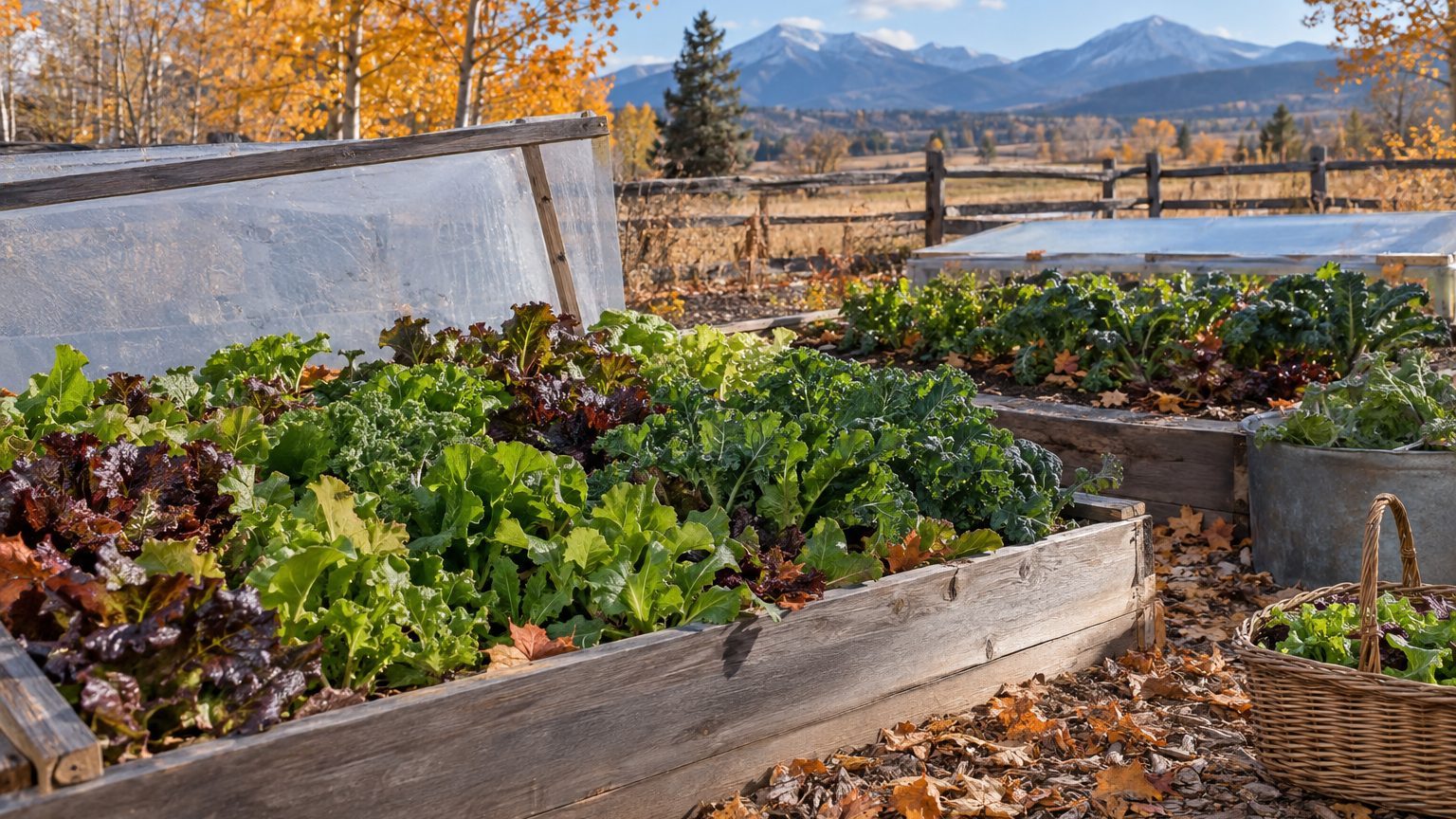

Growing winter salads in Tennessee mostly means reading two things: the calendar and the soil. For Nashville, the last spring freeze falls between March 31 and April 12, and the first fall freeze between October 28 and November 8. Between those dates, the average January night sits just under freezing, so hardy greens often stand outdoors while tender ones want a cover. The soil, not the frost date, tells you when to sow.
When the soil is warm enough in Tennessee
The frost date, and why it is only a proxy
Most Tennessee gardeners start with one question: when is the last spring frost? For the Nashville reference station (USW00013897), NOAA’s 1991-2020 Climate Normals put it between March 31 and April 12. That range is the 30 to 70 percent band of 32F freeze probabilities. It is a probability, not a promise, and some springs land on either side of it.
Frost is also a stand-in for what a seed actually responds to. Seeds answer to soil temperature, and soil warms after the frost risk ends, not with it. Air temperature swings within hours. A bed of wet Tennessee clay, still holding the chill of winter, takes weeks to follow. A garden can be past the last freeze and still have soil that leaves seed sitting, slow to germinate, and open to rot.
Reading the bed instead of the calendar
A cheap soil thermometer settles the argument. Push it to seed depth in the morning, when the bed is at its coldest, and check it over several mornings rather than one. Then compare the reading with the germination range printed on the seed packet. Different salad types have different floors, so one date cannot serve them all.
Texture tells you something too. Grab a handful from a few inches down and squeeze it. If it crumbles when you poke it, it is workable. If it holds a slick, glossy ball, wait. Working saturated clay in early spring leaves clods that dry into bricks, and no seedling enjoys that. Raised beds and containers drain and warm sooner, which is why they often give the earliest sowings.
Shift everything later if you garden in East Tennessee or on the Cumberland Plateau. Both run cooler and later in spring than Nashville, so the March 31 to April 12 range is a starting point there, not a rule. For varieties trialled in your own county, ask University of Tennessee Extension. This page talks in types because the types are what it can stand behind.
How long the season lasts here
Doing the subtraction
Both ends of the Nashville window come from the same NOAA normals: a last spring freeze of March 31 to April 12 and a first fall freeze of October 28 to November 8. Pair the early dates and March 31 to October 28 is 211 days. Pair the late dates and April 12 to November 8 is 210. Set the earliest spring against the latest fall and you get 222 days, and the reverse gives 199. So the frost-free window runs between 199 and 222 days, roughly 28 to 32 weeks.
That is a frost-free span, and it is not the same as the growing season for salad. Hardy greens keep growing, slowly, well past the first fall freeze. But it is the span in which you can plan sowings without gambling on a freeze cutting them down.
What a window that size allows
A window of nearly seven months allows a second sowing, and probably a third. The first can go in as the soil warms. A later one goes in after the summer heat breaks, timed to reach useful size before the days shorten. Tennessee does not force you into a single, all-or-nothing sowing.
It also changes the transplanting question. Transplants disturb roots, and a root check can stall a seedling for a week or more. In a short season you may accept that to buy time. Here, with weeks to spare, direct sowing is usually the better bargain, and transplants are for the gardener who wants a head start in one particular bed rather than for the calendar’s sake.
Compare that with a place where the arithmetic is tight. The same subtraction gives gardeners in Winter Salads for Manitoba Gardens a very different problem, and Winter Salads for Nevada Gardens shows another answer again. Tennessee sits comfortably on the generous side. The practical method for using that room is a staggered sowing: a short row every couple of weeks instead of one long row, so the harvest does not arrive all at once and then vanish. The succession sowing guide on this site walks through the spacing. For the broader picture across climates, start with Winter Salads: What Grows When Lettuce Will Not.
Heat and water in Tennessee
What this page can and cannot say about summer
The verified figures behind this page do not include a count of days above 90 F or a summer rainfall total, so it quotes neither. What can be said without a number is the usual reputation: Tennessee summers are warm and humid, and humid weather is when fungal disease settles into dense leafy beds. Mildew and leaf spots are the practical risk. Crowded rows with no airflow invite them, and so does watering late in the day so that leaves stay wet overnight.
Heat matters mostly at the front end of the fall crop. Lettuce seed sown into hot soil can sit dormant or germinate poorly, so late-summer sowings do better with shade cloth over the bed and a light layer of mulch. Water the soil, not the foliage. After that, the summer is behind you and the cold takes over.
Why the cold makes the decisions
Everything that follows is decided by winter. The mean daily minimum of the coldest month at Nashville is 30.1 F (NOAA NCEI Climate Normals 1991-2020). That is an average low, not a record low, and it means the typical coldest-month night sits about two degrees under freezing. Individual nights can fall well below, and others stay above. It is a mild winter by northern standards and a real one by salad standards.
The USDA Plant Hardiness Zone Map (2023) puts Tennessee across zones 5b to 8a. That is a territory-wide range, built on the average annual extreme minimum, and your county may sit well away from Nashville’s figure. Treat 30.1 F as the reference and adjust for your own ground.
Read against that low, the salad types sort into three groups:
- Stand uncovered in an ordinary winter: the hardy leafy types, such as spinach, mâche, claytonia and kale.
- Need a cover to stay in edible condition: tender loose-leaf lettuce, and often arugula and the milder mustards, once a hard freeze arrives. A row cover or low tunnel is the practice to reach for.
- Cannot manage at all: warm-season salad crops, which have no place in a winter bed.
The first fall freeze, October 28 to November 8, sets the other limit: how late a sowing can still reach useful size. Growth slows hard as the light fails, so count backward from those dates and give yourself more margin than a summer sowing would need. A seedling that is still tiny at the first freeze will mostly sit there until spring.
Which winter salads suit Tennessee
Choosing by type
This territory’s facts point in three directions at once. A window of 199 to 222 days frost-free means you are not forced into the very earliest types. A humid summer means disease resistance leads the list of criteria. And a coldest-month low of 30.1 F means hardiness decides what stays uncovered.
| Tennessee condition | What it favors |
|---|---|
| Frost-free window of 199 to 222 days | Succession sowing of ordinary types rather than only the fastest ones |
| Warm, humid summers | Disease-resistant types, wide spacing for airflow, shade and mulch at the root |
| Coldest-month mean minimum of 30.1 F | Hardy leafy greens uncovered, tender lettuces under row cover |
In practice, that means building a bed around hardy greens and treating lettuce as the crop that needs the extra layer. Give every type room. Dense planting is how a humid spell turns into a bed of mildew, and a gap of a few inches between plants is cheaper than any fix afterward.
Why no variety names appear here
This page names no cultivars, and that is deliberate. A variety that thrives in one county can fail in another. Elevation, soil, and where you sit between the Mississippi River and the Smokies all change the answer. The recommendations that mean anything are the ones trialled locally, and this page does not have them. University of Tennessee Extension and your county office are the right source, and the staff there can tell you what has done well in your part of the state.
One last boundary. Everything here assumes salad grown in beds and containers. Greens gathered from the wild are another matter. Wild watercress growing in water that livestock graze can carry liver fluke, and several plants that resemble young salad leaves are seriously toxic. If you did not sow it, do not eat it.
Common questions
Can I grow winter salads in Tennessee without a greenhouse?
Yes, in most of the state. With Nashville’s coldest-month mean minimum at 30.1 F, hardy greens often stand outdoors, and a row cover or low tunnel handles the tender types on the worst nights. A greenhouse widens the choice but is not required.
Is the last frost date the day to sow?
Not by itself. For the Nashville station it falls between March 31 and April 12, but frost is only a proxy. Soil warms after the frost risk ends, so check the bed with a thermometer and compare the reading with the seed packet.
Do these dates apply across the whole state?
No. They come from the Nashville reference station. East Tennessee and the Cumberland Plateau run cooler and later in spring, and hardiness zones across the state range from 5b to 8a.
Which varieties should I plant?
Ask University of Tennessee Extension for the varieties trialled in your area. This page deals in types because local trials are the only recommendation worth trusting, and a county office will often know which ones have handled recent humid summers best.