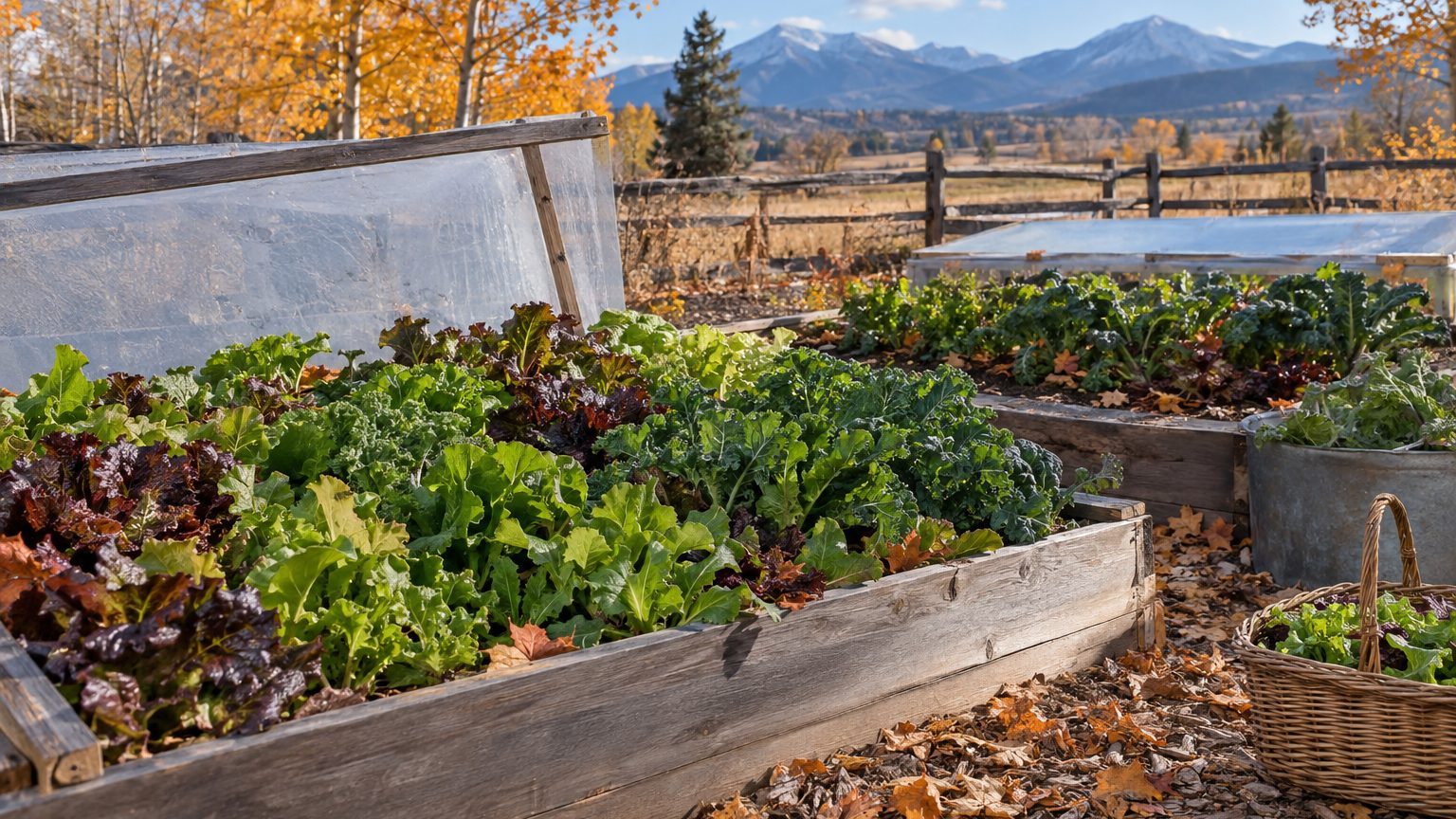

Vermont’s winter low decides what you can eat from the garden in January, and the summer has little say in it. Even in the mildest part of the state, the coldest nights sit well below freezing, so only the hardiest leaves stand in the open. Everything else lives under cover or not at all. Look for the most sheltered spot in your garden before you order seed, and plan a low tunnel or cold frame over the beds that matter.
When the soil is warm enough in Vermont

NOAA’s 1991-2020 climate normals for Burlington (station USW00014742) put the last spring freeze at April 30 to May 10. That is the band where a 32°F freeze is between 30 and 70 percent likely, so it is a probability and a freeze after May 10 is still possible. Burlington sits on Lake Champlain, the mildest corner of the state. The Green Mountains and the Northeast Kingdom run substantially shorter, and a garden in a hill town can be weeks behind the lakeshore.
Frost is a proxy, soil is the real gate
Winter salads do not wait for the frost date. They wait for soil that has dried out and warmed, and that happens after the freeze risk ends, not at the same moment. Vermont clay and loam stay cold and wet well into spring, and seed sown into cold, sodden ground sits and rots or comes up in a ragged, patchy row. Push your hand into the bed. If it feels cold and clammy a few inches down, wait. If a handful crumbles rather than smears, you can sow.
The spring window matters less for winter salads than you might expect. The hardy greens you want in December and January are sown in late summer and early fall, not in April. The spring sowing gives you an early crop of arugula, mizuna, spinach and leaf lettuce, and it teaches you how your particular bed behaves. Treat it as a rehearsal.
The problem flips in late summer
By August the question is no longer whether the soil is warm enough. It is whether it has become too warm. Lettuce seed in particular can refuse to germinate in hot ground, and seedlings that do come up in a sunny bed struggle. Sow in the shade of taller crops, water the row before and after sowing, and lay a board or sheet of burlap over the seed until it sprouts. Take the cover off at the first sign of green.
Gardeners sometimes skip the basics of the crop as a whole, and the general guide, Winter Salads: What Grows When Lettuce Will Not, covers those steps in more depth. For the specific types that have been tried in Vermont beds and tunnels, ask University of Vermont Extension. Talk in types until you have that answer: hardy leaf greens for the open bed, tender greens for the tunnel.
How long the season lasts here
NOAA’s 1991-2020 normals for Burlington give a first fall freeze of October 3 to October 13. Set that against the spring band of April 30 to May 10 and you can do the subtraction yourself. Counting from May 10 to October 3 gives 146 days. Counting from April 30 to October 13 gives 166. Matching the two ends, April 30 to October 3 and May 10 to October 13, gives about 156 days each. Call it roughly five months, between 146 and 166 days, at Burlington. Hill towns and the Northeast Kingdom get less, and the amount varies from valley to valley.
What five months allows
A window of that length allows a spring crop and a second, late-summer sowing, and not much beyond that. It does not allow you to start Winter Salads in July and finish with a flourish in October. The plants have to reach a useful size before the first freeze, because once the days shorten and the cold sets in, growth slows to a crawl. A seedling that is still tiny in early October will mostly sit there until spring.
Work backward from the freeze. Take the days to maturity printed on the seed packet, remember that those figures are usually counted from transplant and shift by a week or two with the season, and then add a generous margin for the slowing growth of autumn. The result is the last sensible sowing date for that crop, and it is a range, not a single day. In a warm autumn you gain a little. In a cool one you lose it.
Direct sowing or transplanting
The shorter your window, the more the first sowing is the only one that counts. Transplants started in a cool spot and set out into the bed buy you a couple of weeks, but every transplant takes a root check, and a hardy green that stalls for a week after moving can lose the margin it was meant to gain. Direct sowing avoids the check. Transplanting suits the slower types and the hill-town garden where the window is short. For sequencing multiple sowings across the months, the same succession approach used for summer lettuce applies, with the last sowing timed to the fall freeze rather than to the calendar.
- Find your own first fall freeze, not the Burlington one, by noting the date each year.
- Count back from it using the packet’s days to maturity plus a margin.
- Sow the slowest crop first and the fastest last.
Heat and water in Vermont

Cool, damp summers
For your nearest station, look up the NOAA NCEI climate normals. What can be said without them is that a northern state like Vermont is not a hot-climate garden. Heat spells do arrive and can make lettuce bitter and send arugula to seed in a few days. The bigger trouble in a cool, damp summer is different: downy mildew, gray mold, slow ripening and slugs. Leaf crops grown tight together in a wet August stay damp for hours, and that is when disease gets in.
Give the seedlings room and airflow. Water at the base in the morning so the foliage dries by evening. Clear the debris from last season’s crop out of the bed before you sow, because it harbors both slugs and the spores of the diseases that follow.
What the winter low decides
NOAA’s 1991-2020 normals for Burlington put the mean daily minimum of the coldest month at 12.9°F. That is an average of the nightly lows, not the record low, so individual nights go colder. The USDA Plant Hardiness Zone Map 2023 places Vermont in zones 3b to 5b, a range that runs from the coldest hill country to the lakeshore, and it is built on the average annual extreme minimum, a different measure from the monthly figure.
Put together, those numbers sort the crops into three groups.
- Stand uncovered: the hardiest greens, such as mâche, claytonia, spinach and kale, especially with snow lying over them.
- Need a cover to stay edible: arugula, mizuna, tatsoi and most leaf lettuce. They survive cold, but the leaves freeze, bleach and turn to mush without shelter.
- Cannot manage: full-size head lettuce and tender greens in an unheated bed through the deepest months.
The first fall freeze, October 3 to October 13 at Burlington, sets how late a sowing can still reach a harvestable size before the light fails. After that, the plants are mostly holding, not growing. You cut what grew in the fall and let a cover keep it in good shape.
Which winter salads suit Vermont
Choose by type, because the short season and the cold rule out most of what a seed catalog offers. The table sorts the main types by how they behave in a Vermont winter.
| Type | Open bed | Under a tunnel or frame | Best use here |
|---|---|---|---|
| Mâche (corn salad) | Holds well, best under snow | Stays clean and tender | Slow starter, sow early |
| Claytonia | Holds well | Reliable through the coldest months | Steady winter cutting |
| Spinach | Holds, leaves may damage | Good, resumes growth early | Late-summer sowing for winter and spring |
| Kale | Holds | Not required | Sturdy backbone of the bed |
| Arugula, mizuna, tatsoi | Marginal | Good | Fast, suits a late sowing |
| Leaf lettuce | Fails in hard cold | Fair until deep winter | Fall harvest, early spring |
A short season favors the fastest types for the late sowing, meaning arugula, mizuna and tatsoi, with spinach and mâche going in first because they are slow to size. A humid, damp summer and fall make disease resistance the first thing to look for, especially mildew resistance in spinach and lettuce, ahead of flavor or leaf shape. Airflow and spacing help every type, and a tunnel that can be opened on mild days helps more.
Why no varieties
The varieties that do well in Vermont beds are the ones trialed in Vermont. A name pulled from a national catalog might suit Burlington’s lakeshore and fail on a hillside 40 miles away. Ask University of Vermont Extension for the varieties recommended for your county, and check the seed packet for disease-resistance codes and days to maturity.
If you want to see how the same crops sort under a different winter, look at Winter Salads for Minnesota Gardens or Winter Salads for Michigan Gardens. Remember that all of these salads are grown in beds, frames and containers, never gathered from the wild.
Common questions
Can I grow Winter Salads in Vermont without a greenhouse?
Yes, a low tunnel or cold frame is enough, and you do not need a heated greenhouse. Hardy greens such as mâche, claytonia, spinach and kale can also stand in the open, particularly under a blanket of snow. Snow insulates better than most covers, but it is unreliable, so a cover is the safer choice.
Should I water winter beds?
Very little, and only when the soil is not frozen. A covered bed dries out more than you expect because rain and snow do not reach it. Water in the morning on a mild day so the leaves are dry by night, and skip watering when the ground is frozen.
Why did my greens stop growing in December even under cover?
Daylight is the limit, not the cold. In midwinter the days are too short for much growth even in a sheltered tunnel, so the plants hold what they already grew. Cut leaves sparingly, and expect growth to resume as the light returns in late winter.
Is the Burlington frost date right for my town?
Only if you garden near the lake. Burlington is the mildest part of the state, and hill towns and the Northeast Kingdom get their last spring freeze later and their first fall freeze sooner. Keep your own notes for a couple of seasons, and ask UVM Extension what growers near you have seen.