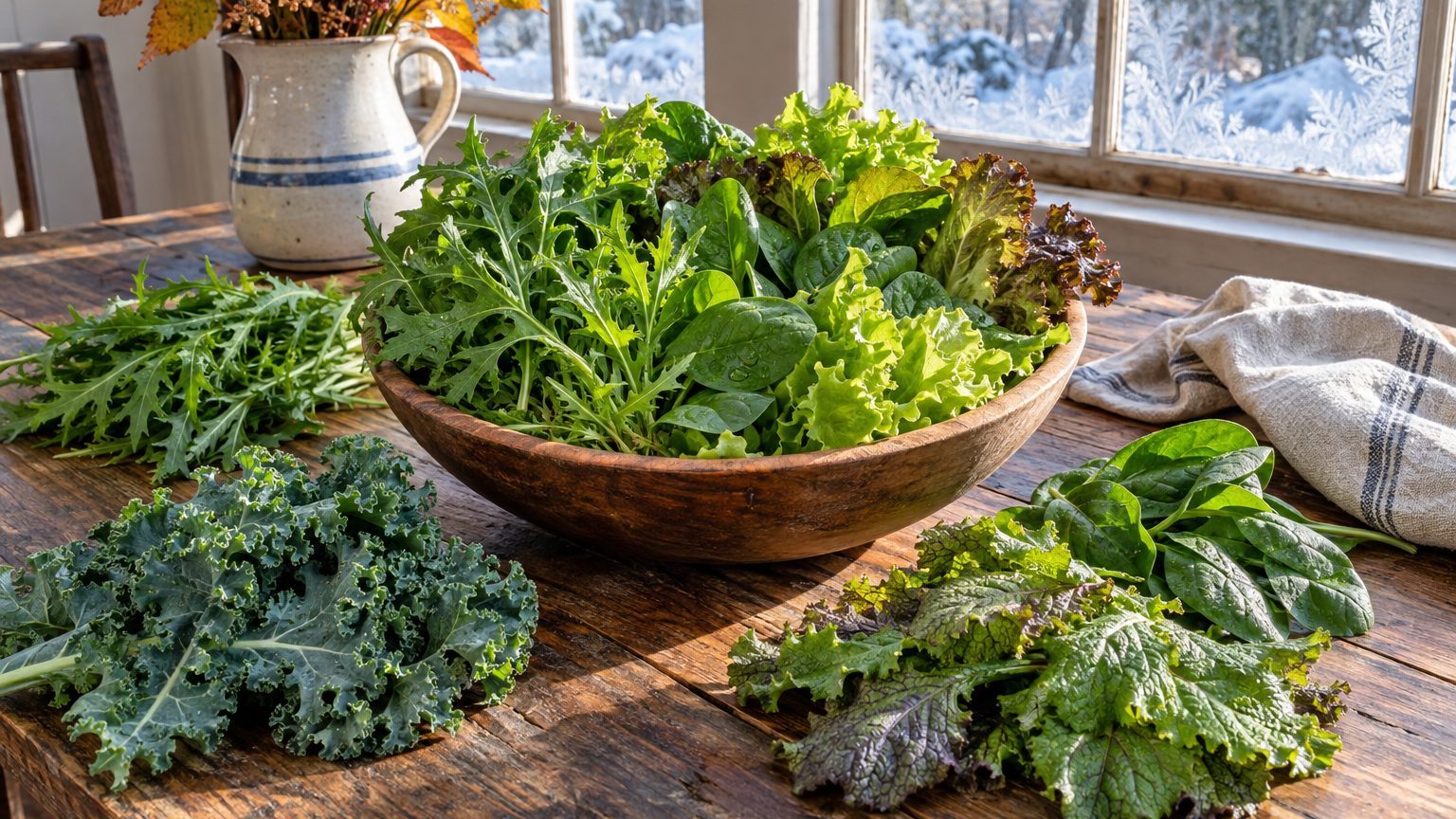

The best winter salads for Idaho are the cold-hardy leafy greens: spinach, mâche, claytonia, kale, and loose-leaf lettuces bred for cold, with arugula and mizuna as quick fall fillers. Heading radicchio and tender butterhead lettuces are the gamble. That ranking holds from the Treasure Valley to the high country. How much protection each type needs changes with elevation, and Boise is the reference point here.
The short answer for Idaho
Start with the numbers this page can stand behind. At the Boise station in NOAA’s 1991-2020 Climate Normals, the last spring freeze (32°F) falls between April 23 and May 7, and the first fall freeze between October 7 and October 21. Those dates are a probability, not a calendar. They mark the band where the odds of a 32°F freeze run from 30 to 70 percent. Boise is also a low valley, and most of Idaho is higher and colder, with far shorter seasons.
The mean daily minimum of the coldest month in Boise is 25.4°F. That number decides what survives winter. A typical coldest-month night sits only a few degrees below freezing, which hardy greens shrug off, especially under a cover. Single nights run colder than the average, so the tender types are the ones at risk.
Types that earn a bed
Spinach, mâche (corn salad), and claytonia (miner’s lettuce) are the backbone. They take hard frost, keep their flavor in the cold, and can sit as small plants through the darkest weeks, then grow again when light returns. Kale belongs in the same group, and its leaves often taste sweeter after a freeze. Loose-leaf lettuces sold as cold-tolerant or winter types come next. They work better in the milder valleys, or anywhere with a cover.
Types that need help or a better plan
Arugula and mizuna grow fast, which makes them useful in fall when the freeze dates are still ahead. They are for harvesting before deep winter, not for carrying through it. Heading radicchio, large endive heads, and butterhead lettuces take the longest to finish, and they are the first to lose when the season runs short.
| Type | Role in an Idaho garden | Cold handling |
|---|---|---|
| Spinach, mâche, claytonia | Overwintering backbone | Tolerate hard frost; a cover adds margin at altitude |
| Kale | Cut-and-come-again, sweeter after freezes | Very hardy; slow regrowth in deep winter |
| Cold-tolerant loose-leaf lettuce | Valley beds and covered rows | Fair; needs protection in colder areas |
| Arugula, mizuna | Fast fall harvest | Handle light frost; best eaten before midwinter |
| Heading radicchio, endive, butterhead | Risky, covered beds only | Too slow to finish in short seasons |
Sowing dates follow from all this, and When to Sow Winter Salads in Idaho works through them. The choice of type comes first, though. A badly chosen type fails no matter how well the sowing is timed.
What will not work here
Heading crops sown late are the most common failure. This page’s frost data puts the first fall freeze at October 7 to October 21 in Boise, and that is the best case in the state. A radicchio or a big endive sown in late summer needs weeks of mild growth to form a head. In colder parts of Idaho that mild weather ends sooner, so the plant reaches the first hard freeze as an awkward adolescent, too big to be tender and too small to eat. Tender butterhead lettuces fail the same way, with the added problem that a night well below 25.4°F can finish them in the open.
Waiting for October is the second failure. Sowing in the first week of October, as the Boise freeze window opens, gives you seedlings rather than plants. Hardy spinach and mâche may still sit through winter as small plants and take off in spring, but the harvest you hoped for in November will not happen. Short days cut growth sharply in deep winter, and a plant that has not built leaves by then has little to work with. Fast crops like arugula sown that late will give you a few baby leaves at best.
Summer heat can ruin the other end of the calendar. The southern valleys are hot and dry in summer, and cool-season greens sown in hot soil often germinate poorly or sulk. Anyone who sows salad seed in July and waters weekly will find the bed dries out between visits. Seedlings need steady moisture, and a weekly soak does not provide it. This page does not carry rainfall figures, so it cannot say how much water your summer needs. Still, a seedbed in the hot, dry valleys that is watered only once a week is a poor bet.
Spring sowing brings its own limit. With the last freeze falling between April 23 and May 7 in Boise, a spring salad has a short window before warm weather turns it bitter and sends it to seed. That is why fall sowing, not spring, is the real winter-salad strategy here.
The last failure is borrowing the wrong place’s dates. Everything above uses Boise’s figures. Take Boise’s October 7 to October 21 freeze window to a high mountain valley and you will sow weeks too late. Heavy, wet snow can also flatten low hoops, and a cover left sealed on a sunny winter day can cook the greens inside. Open the ends when the sun is out.
What changes across Idaho
Idaho has no single answer. The USDA Plant Hardiness Zone Map (2023, built on 1991-2020 normals) puts the state anywhere from 3b to 7b. That is a very wide spread for one state. The northern panhandle, the southern valleys, the eastern plateau, and the mountain basins each live in a different winter.
The zone system measures one thing: the average annual extreme minimum temperature. It says whether a perennial survives the cold at all. It does not give frost dates, summer heat, or how long a sunny day stays warm, which matter just as much for a salad bed. So a reader should use it for hardiness and use frost data for timing. A Boise-style recommendation, such as the dates on this page, belongs to the valley floor. Another part of the state may differ by weeks.
If you garden in the north or at altitude, shift three things. Sow earlier, because the freeze arrives sooner. Lean on the hardiest types (spinach, mâche, claytonia, kale) and drop the heading crops. Plan on a cover, such as a cold frame, low tunnel, or row cloth, as a standard part of the bed rather than an emergency measure. The same advice sits in Winter Salads for Idaho Gardens, which treats the state as a whole.
This page will not tell you which zone you are in. Look up your location on the USDA Plant Hardiness Zone Map, which lets you search by ZIP code. Then read the result as a hardiness guide, not a sowing date. Gardeners near a zone boundary should treat it as a rough line, since a south-facing wall or a cold hollow can move a bed half a zone either way.
Where to check this for your own county
Your state extension service is the best next stop. University of Idaho Extension runs county offices across the state, and county staff know the local frost patterns, soils, and pests far better than a state-level page can.
Look for two things. The first is a local planting calendar for your county or nearest town, which will give sowing windows tuned to your elevation. The second is the list of varieties trialled in your county or a similar climate, because a variety that performs well in one valley can fail in another. This page does not have either one. It does not carry a county calendar, and it does not list trialled varieties, so it makes no claim about which named variety does best in your area.
Be ready to ask a few practical questions when you contact an office. When do local gardeners usually see the first hard freeze? Do winter salads overwinter outdoors in your area, or only under cover? Are there known problems with deer, voles, or slugs in cold frames? Extension staff and local gardening programs often answer these quickly.
A county recommendation beats a state one. This page is the state one, built on Boise normals and a statewide zone range. Treat it as a starting frame, then let your county office correct it where the local record says otherwise.
Checking this against your own garden
Your own observation outranks every date here. A frost table is an average over decades, and your bed is one particular spot. Three things are worth watching, and none needs an instrument.
- Soil warmth by feel. Push your hand into the bed in mid-afternoon and again at dawn. If the soil stays cool to the touch well into the day, seeds will germinate slowly. If it feels warm in a late-summer afternoon, you may be too early for cool-season sowing. A bed that holds warmth longer in fall is a good place for your tenderest crops.
- The first flush of male flowers on spinach. Spinach plants are either male or female, and the males flower first. When they do, the plant is heading to seed. If that happens early, your bed runs warm or long-day, and you should sow the next round sooner or in a shadier spot.
- The first true leaves. The first pair of leaves comes from the seed. The next pair, the true leaves, shows the seedling is feeding itself. If seedlings reach that stage before the first hard freeze, they stand a fair chance of overwintering. If they are still bare when the cold arrives, your timing is late for your microclimate.
Keep a few notes from one season, even scribbles on a calendar. They will tell you more about your own plot than any regional chart can.
Common questions
Can winter salads stay outdoors all winter in Idaho?
In milder valleys, hardy types such as spinach, mâche, claytonia, and kale can often overwinter outdoors, especially under a light cover. Boise’s coldest-month mean minimum is 25.4°F, which these greens tolerate. At higher elevations the cold is harsher, and a cold frame or low tunnel moves from optional to expected.
Which single green is the safest bet?
Spinach is the most dependable starting point, with mâche close behind for cold tolerance. Both handle hard frost and hold their flavor. For a first winter, grow those two before trying anything fussier.
Is it too late to sow now?
Today is October 5, and in Boise the first fall freeze window opens on October 7 and runs to October 21. A sowing made now outdoors in the open will mostly give small plants rather than a winter harvest. A protected bed gives better odds, and colder parts of Idaho are already past the useful window for most types.
Does my USDA zone tell me when to sow?
No. The USDA system rests on one variable, the average annual extreme minimum temperature. It tells you what survives the cold, not when frost arrives or how long the season runs. For timing, use local frost dates from your county extension office.