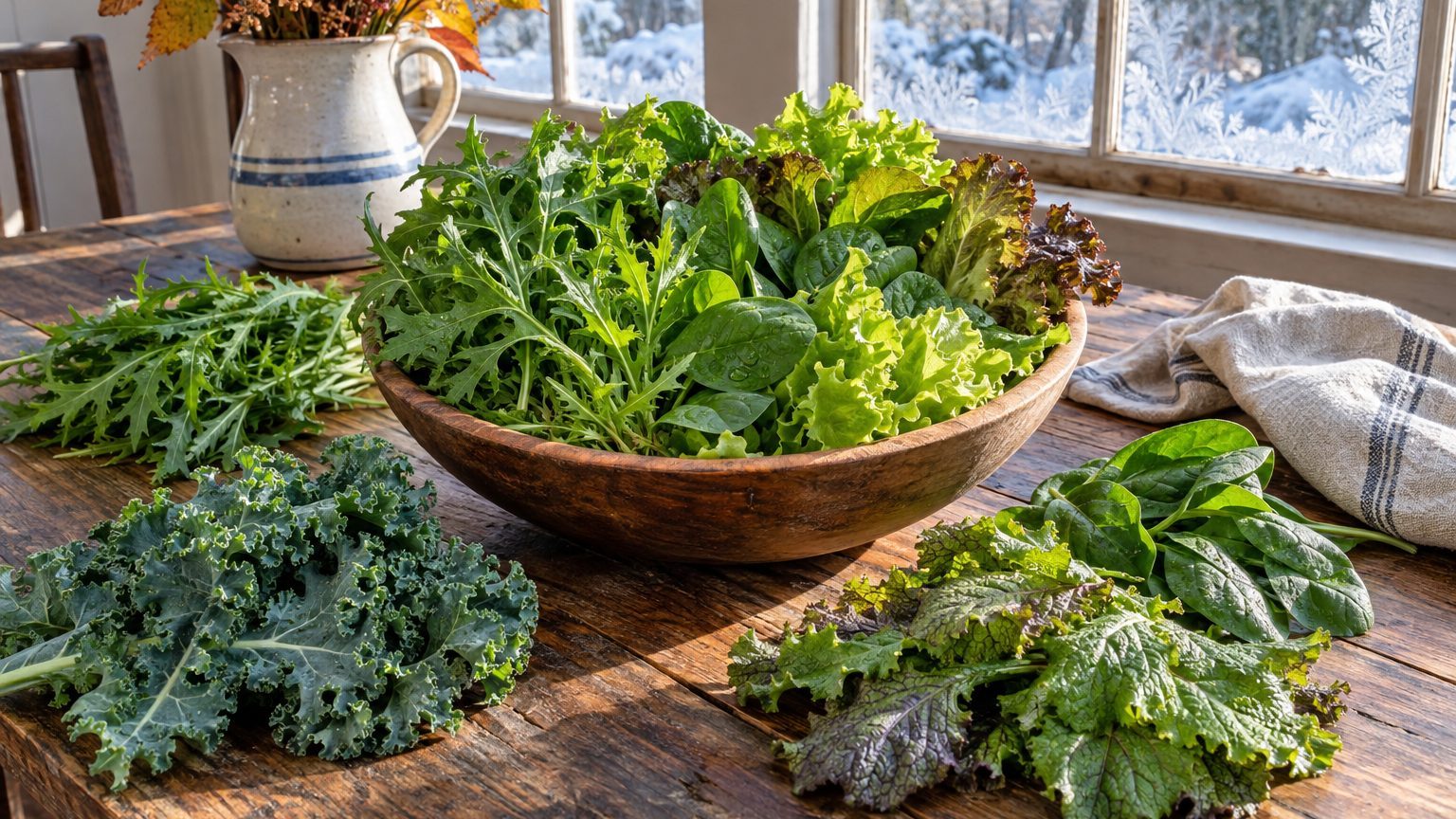

The best winter salads for Illinois are the cold-tolerant leaf crops: spinach, mâche, claytonia and hardy kale, with winter-bred lettuces and Asian greens as a second tier. Illinois winters kill tender greens in open ground, but they rarely lock everything solid for months. A low cover makes up the difference. The state spans USDA zones 5a to 7b, so the right mix in Rockford is not the right mix in Cairo.
The short answer for Illinois
Choose by type, not by cultivar name. The numbers behind that advice come from the Chicago reference station (NOAA’s 1991-2020 Climate Normals, from an airport weather station). The last spring frost there falls between April 11 and April 22, and the first fall frost between October 24 and November 3. Both ranges are the 30 to 70 percent probability band of a 32°F freeze, so they mark the dates when a freeze goes from unlikely to likely. They are not guarantees. The coldest month averages a daily minimum of 18.8°F. That is cold enough to finish tender lettuce in an open bed, yet mild enough for the hardiest greens to hang on under a light cover.
The window between those frost dates is the fall growing season, and winter salads live on what they put on before the days get short. Here is how the types sort out for this climate:
| Type | Examples | Role in an Illinois winter | Cover needed? |
|---|---|---|---|
| Hardiest leaves | Spinach, mâche (corn salad), claytonia | Backbone of the winter bed; hold through repeated hard freezes | Light cover helps in the coldest weeks |
| Hardy brassicas | Salad-sized kale, tatsoi, mizuna | Sturdy leaves that sweeten after frost | Cover in the deepest cold |
| Cold-hardy lettuces | Varieties sold for winter or overwintering | Best in a cold frame or tunnel, not in open ground | Yes |
| Fast, mild-weather greens | Arugula, baby leaf mixes | Quick fall harvests before the deepest cold | Yes for anything past December |
A seed packet that says “winter” or “overwintering” is a better signal than a pretty photo. For the wider picture, see Winter Salads for Illinois Gardens. Sowing dates are covered in When to Sow Winter Salads in Illinois.
What will not work here
Late sowing is the biggest failure, and it is relevant right now. Today is October 5, and the reference-city freeze window opens October 24. Suburban and rural gardens often see the first fall frost one to two weeks earlier than an airport station, and farther from the city than that, earlier still. A seed sown in open ground this week may germinate, but it will not size up. As days shorten, growth slows sharply, and a seedling that is small at the first freeze mostly sits through winter. You get tiny plants and a harvest that begins in March, not December.
Head-forming crops are the second casualty. Full heads of lettuce and Chinese cabbage need weeks of steady growth that Illinois fall light and temperatures cannot supply once November arrives. Leaf types, cut and regrown, fit the season far better.
Then there is the cold itself. With the coldest month’s mean daily minimum at 18.8°F, and that figure being an average, plenty of nights run colder. Unprotected butterhead or romaine in an open bed will not make it. Spinach and mâche usually will. The honest rule: anything bred for summer eating needs a roof, even a flimsy one.
Illinois soil adds trouble of its own. Heavy clay soils common across much of the state stay wet in winter, and repeated freezing and thawing can heave shallow-rooted seedlings out of the ground. Raised beds with a little added compost drain better and avoid the worst of it. Closely spaced plants under a tight cover bring a different problem. Illinois air is humid even in cool months, and condensation under plastic invites gray mold and mildew. Crowding seedlings to squeeze out more salad usually backfires. Vent covers on mild afternoons and give plants room to dry out.
One more trap runs the other direction. Spinach sown in late winter bolts as soon as spring heat and long days arrive, and Illinois springs can swing from freezing to warm within a week. Spring sowings of winter crops need to go in early, or they will flower before they feed anyone.
What changes across Illinois
Illinois is not one garden. The USDA Plant Hardiness Zone Map (2023, built on 1991-2020 normals) places the state in zones 5a to 7b. That is a spread of several zones, and the system measures only one thing: the average annual extreme minimum temperature. So there is no single answer for the state. The page can only give you the spread and tell you which direction to shift.
The frost dates above belong to the Chicago reference station, so they lean toward the north. This page does not have frost figures for southern Illinois, and borrowing a neighboring state’s numbers would be a guess. What can be said is directional. In the colder zones to the north, the fall window closes sooner and the winter bites harder, so lean on spinach, mâche and claytonia and protect everything else with a cold frame or low tunnel. Gardeners in the milder south get more weeks to build size before winter and may carry hardy leaf crops through with lighter protection, though the cold-hardy lettuces still want a roof.
Exposure matters too. A garden on open prairie with nothing to break the wind will run colder than the zone suggests. A bed against a south-facing wall may run milder. Cities hold heat, and a lakeside or river-valley site can differ from ground a few miles inland.
Which zone is yours? Look it up on the USDA map by ZIP code rather than guessing from a neighbor’s advice. The zone describes survival, and your own frost dates describe timing, so check both.
Where to check this for your own county
Start with University of Illinois Extension, the state’s land-grant extension service. Every county has an office, and the staff and Master Gardener volunteers there know the local soil, the usual frost pockets and what has actually grown in nearby gardens.
Look for two things. The first is a local planting calendar with sowing and harvest windows for cool-season vegetables in your area, with dates tied to your county instead of a single airport. The second is any list of varieties trialled locally. A cultivar that thrived in a university trial garden a few counties over is better evidence than any catalog description.
A county recommendation beats a state one, and this page is the state one. It covers the pattern across Illinois and the reference-city numbers, with the caveat that suburban and rural frost dates drift later in spring and earlier in fall, often by one to two weeks and more at elevation. Where this page and your county office disagree, trust the county office. The sowing calendar page is a good starting frame, but your extension office can sharpen it for your zip code.
It also helps to ask specific questions: what the average first hard freeze looks like near you, whether cold frames are recommended for your area, and which winter greens have done well in local trials. Staff answer those questions every fall, and the answer is usually free.
Checking this against your own garden
Your own observations outrank every date on this page. Three are worth watching, and none needs a gadget.
Soil warmth by feel. Push your hand into the bed in the morning. Soil that feels cool but not cold, and drains without clumping, still supports germination and root growth. Soil that feels cold and sticky is telling you the season for open-ground sowing has passed in your spot. Beds in sun and sheltered corners will hold warmth longer than shaded ground.
The first true leaves. Seedlings put out a pair of seed leaves first, then the leaves that look like the adult plant. If your fall sowings have true leaves before the first hard freeze, they are likely to overwinter and resume growth in early spring. If they are still bare seed leaves, treat them as a cover-only crop or accept a late harvest.
Where frost lingers. On a cold clear morning, walk the yard. White grass shows the frost pockets, and bare patches show where cold air drains away. Those differences, sometimes within a few feet, tell you where the hardy crops belong and where the borderline ones can sit.
Common questions
Can I grow salad outdoors all winter in Illinois without any cover?
The hardiest types, spinach, mâche and claytonia, often survive with no cover in milder spots. Because the coldest month averages a daily minimum of 18.8°F at the reference station, covered beds are far more reliable, especially in the north.
What is the easiest winter salad for a first-timer?
Spinach is a forgiving place to start. It tolerates frost, and cutting outer leaves keeps it producing. Mâche is a close second where soil drains well.
Is October too late to sow?
For open-ground sowing aimed at a winter harvest, it is late. The reference-city freeze window starts October 24, and rural gardens may see frost sooner. Under a cold frame, fast greens can still work, and the planting calendar page has the sowing detail.
Are the frost dates on this page my frost dates?
No. They are a probability band for a 32°F freeze at the Chicago reference station, and gardens outside the city typically freeze sooner in fall and later in spring. Your county extension office can give you local figures.