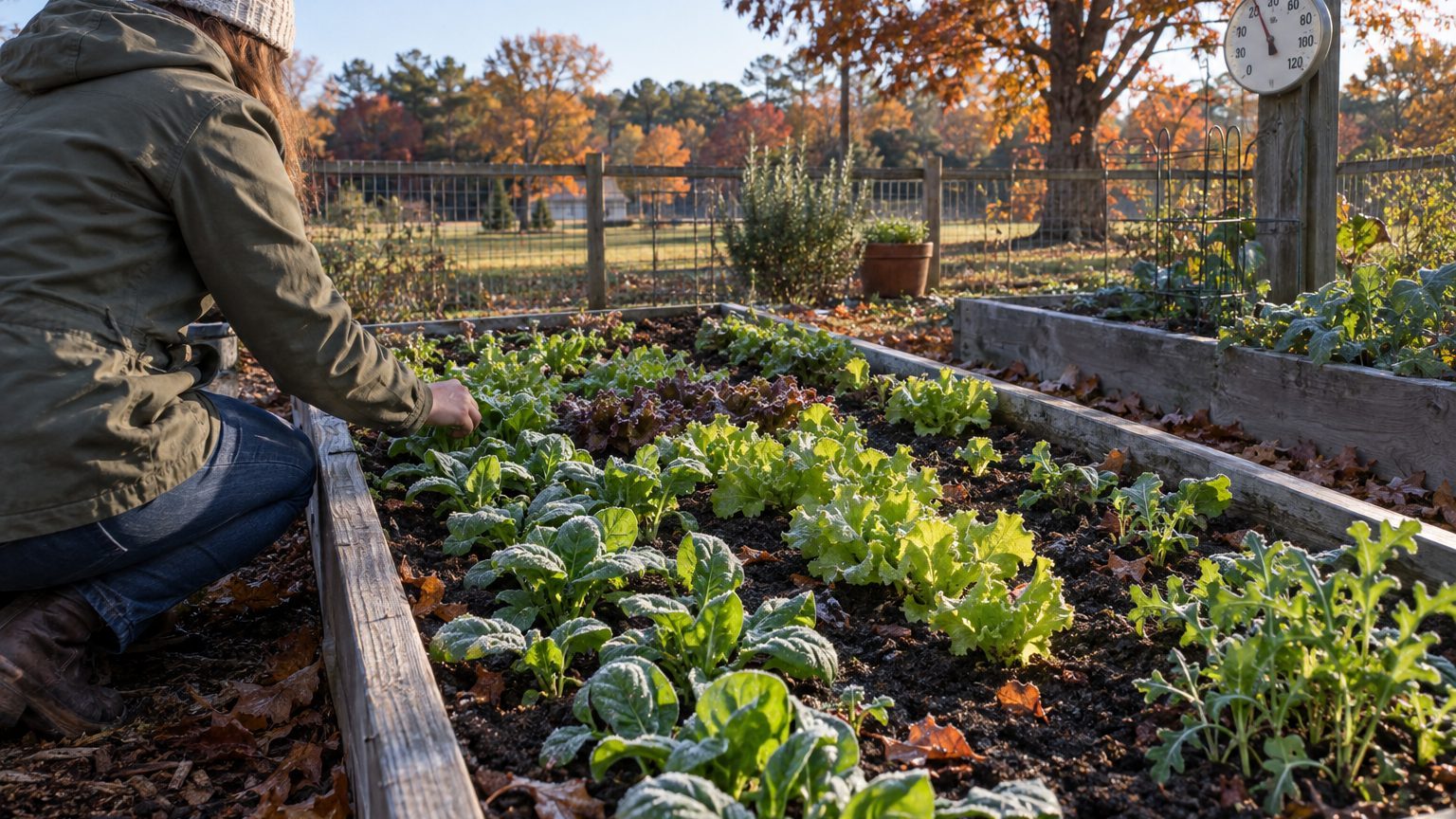

Sow winter salads in Illinois from late summer into early fall, timed so plants are close to harvest size when the first hard freeze arrives. At Chicago’s airport weather station, that freeze lands between October 24 and November 3. This page builds the sowing calendar around those frost dates, explains what tends to fail in this state, and sends you to your own county for the final call.
The short answer for Illinois
Sow winter salad crops in late summer to early fall, counting back from a first fall frost that the Chicago airport station puts between October 24 and November 3. A second, smaller window opens in early spring, ahead of a last spring frost that the same station puts between April 11 and April 22.
Those dates are not deadlines on a calendar. They come from the NOAA 1991-2020 Climate Normals, and what they measure is probability: the band where the odds of a 32°F freeze run between 30 and 70 percent. On October 24, a freeze is still more of a coin flip than a certainty. By November 3, it is more likely than not. The NOAA station data is public if you want to check the source.
| Event | Chicago airport station window | What the dates represent |
|---|---|---|
| Last spring frost | April 11 to April 22 | 30-70% odds band for a 32°F freeze |
| First fall frost | October 24 to November 3 | 30-70% odds band for a 32°F freeze |
One caution matters more than the dates themselves. These are airport figures for a reference city, not a statewide guarantee. Suburban and rural gardens typically see the last spring frost later and the first fall frost earlier than an airport does, often by one to two weeks. If your garden is outside the city, shift both windows accordingly.
To turn the fall window into a sowing date, start with the days to maturity printed on your seed packet. Count backward from October 24, then add a cushion, because growth slows to a crawl as autumn days shorten. A packet that promises harvest in a set number of days is describing midsummer growth, not October growth. The quickest crops go in last, and the slower ones go in earlier.
For the crop-by-crop picture, the parent guide, Winter Salads for Illinois Gardens, covers how the whole season fits together.
What will not work here
Sowing in November and hoping. By the time the freeze odds pass 70 percent on November 3 (in a suburban yard, probably sooner), seedlings have little light and warmth left to put on size. Seed may germinate, but it won’t grow into a harvestable plant before winter. Slow, head-forming types that need many weeks suffer most, because their clock runs out before the frost window even opens.
Leaving tender lettuce uncovered. The mean daily minimum of the coldest month at the Chicago reference station is 18.8°F. That is an average of the lows, so plenty of nights run colder. Tender lettuces generally do not tolerate nights in the teens without cover. Hardier leafy crops get through with protection such as a low tunnel or cold frame, but bare ground with soft lettuce is a gamble that Illinois reliably wins.
Planting by the airport’s dates in a country garden. A gardener 40 miles from the station who plants on the airport’s schedule may be a week or two behind where the frost actually falls. In fall, that is the difference between a bed that is half-grown and one that is nearly done.
Using the hardiness zone as a sowing guide. The USDA zone system is built on one variable, the average annual extreme minimum temperature. It tells you which perennials survive a rare brutal night. It says nothing about when to sow a salad bed, and it is a different measure from the 18.8°F typical-coldest-month figure above. Treat the two as separate questions.
Sowing into hot ground and walking away. The sowing window sits at the tail of summer, when soil can still be warm and dry. Lettuce seed is known to sulk in hot soil, and a bed watered once a week will often fail to sprout evenly. Gardeners who get good stands in this window usually sow in the cooler part of the day, shade the bed, and keep the surface damp until seedlings appear.
What changes across Illinois
The state spans USDA hardiness zones 5a to 7b, according to the 2023 USDA Plant Hardiness Zone Map (built on 1991-2020 normals). That is three full zones, 5, 6 and 7, inside one set of borders. There is no single answer for Illinois, and any page that gives one date for the whole state is smoothing over a real gradient.
The reference city sits in the northern part of the state. If you garden in the north, the Chicago figures are your closest starting point, and you should lean toward the early end of the fall sowing window and plan on cover for winter. Farther south, the first fall frost generally arrives later, which stretches the outdoor growing time. The same gardener, though, faces warmer soil during the late-summer sowing, so the heat problem described above gets worse as you go south.
Elevation matters less in Illinois than in a mountain state, since most of the terrain is low and flat. Latitude and the setting of your own yard do more work. A garden near the lake or in a dense city can run milder than open farmland a few miles away, which is why the airport-versus-suburb gap of one to two weeks is worth taking seriously.
Nobody can tell you which zone your yard falls in from this page. Look up your location on the USDA Plant Hardiness Zone Map, then use the result as one clue among several. For help matching crops to your conditions, The Best Winter Salads for Illinois sorts options by how they handle cold and short days.
Where to check this for your own county
Your state extension service is the next stop. University of Illinois Extension is the land-grant university’s public outreach arm, and it has local offices serving residents county by county. That local layer is where state-level advice gets converted into something you can plant by.
Two things are worth looking for there. The first is a local planting calendar for fall and spring vegetables, ideally one that names dates for your area rather than the whole state. The second is the list of varieties trialled in your county, because a lettuce that performs in one soil and climate can sulk in another. Trials done close to home carry more weight than any general recommendation.
A county recommendation beats a state one, plainly. This page is the state one. It rests on figures from a single airport station, and it does not have county-level frost dates or variety trial results. Where the extension guidance and this page disagree, trust the extension.
If you can’t find a calendar for a specific crop, ask the local office directly. Staff and trained volunteers field questions like this all season, and they know which neighborhoods run cold.
Checking this against your own garden
Your own observations outrank every date above. Three things are worth watching, and none needs equipment.
- Soil warmth by feel. In late summer, press a bare hand into the bed in the morning. If the soil still feels warm rather than cool, lettuce seed may germinate poorly, so shade the bed or wait a few days. A bed that cools early is a sign of a shaded or low spot where your fall window may be shorter.
- The first male flowers on squash. In spring, squash and zucchini open male blossoms before female ones. Seeing them in your garden or a neighbor’s tells you warm weather is settling in, and that the spring salad window is closing.
- The first true leaves. Seedlings first show a pair of seed leaves, then true leaves. If your fall sowings are still on seed leaves when nights turn cold, growth is stalling, and that bed needs cover or an earlier start next year.
Write down the date you saw each sign. After a year or two, your notes will beat the airport table, because they describe your actual yard.
Common questions
Can I still sow winter salads after the first frost in Illinois?
Seeds sown after the frost window will rarely reach harvest size before winter. Some gardeners sow late under cover anyway, aiming for very early spring growth, but treat that as an experiment rather than a plan.
When is the spring window for salads?
The Chicago airport station puts the last spring frost between April 11 and April 22, based on the 30-70% odds band for a 32°F freeze. Suburban and rural gardens often run one to two weeks later.
Does my hardiness zone change when I should sow?
The zone mostly tells you about winter survival of perennials, not sowing dates. Illinois spans zones 5a to 7b, so a northern and a southern garden will still differ, but frost dates and your own yard are better guides.
Are these dates a guarantee?
No. They are probability bands from 1991-2020 normals at one reference station. A freeze can come before or after the window in any given year, which is why cover and a buffer in your sowing date help.