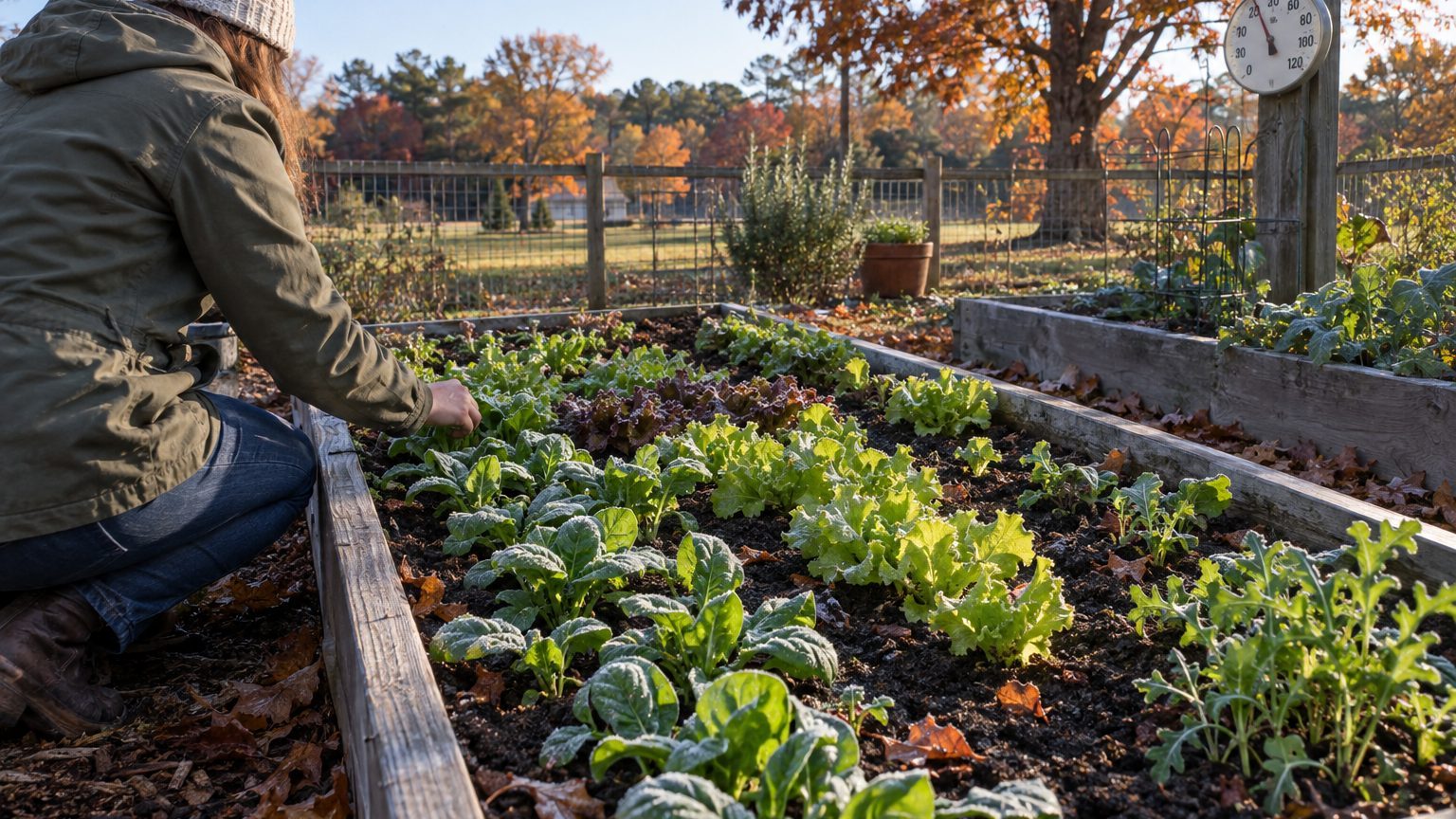

Sow winter salads in Indiana in late summer and early fall, timed backward from the first fall frost. At the Indianapolis reference station that frost arrives between October 21 and October 30, so the sowing window closes well before then. The rest of this page covers how to count back from that date and where the dates shift across the state.
The short answer for Indiana
The dates behind this page come from NOAA’s 1991-2020 Climate Normals for the Indianapolis station, and they are probabilities, not promises. Each one marks the band where the chance of a 32°F freeze runs between 30% and 70%. In spring, that band falls from April 9 to April 21. In fall, it runs from October 21 to October 30. A frost can land outside either window, and in a cold year it will.
For winter salads, the fall date is the anchor. These crops need to be close to harvest size before the cold slows them, because growth nearly stops once days get short and nights fall into the 20s. A plant that reaches picking size in October keeps feeding you through the dark months. A plant that is still a seedling in November mostly sits and waits.
So you count backward. Take the days to maturity printed on the seed packet and add a cushion of about two weeks, since fall growth is slower than summer growth. Here is a worked example, not a rule for any particular variety: a green listed at 40 days, plus 14 days of cushion, needs 54 days before October 21. That puts the sowing date around the end of August. A faster crop can go in later, and a slower one needs to go in earlier.
What the dates leave out
Indianapolis is the reference point, and the state is long. Southern Indiana runs earlier in spring and later in autumn than the north by a fortnight or more, so the dates above are a middle estimate. This page also has no sowing date for individual varieties. For those, the seed packet and a county extension office will serve you better than a state average. If you are still choosing what to grow, The Best Winter Salads for Indiana sorts the options by type, and Winter Salads for Indiana Gardens covers the wider picture.
What will not work here
Sowing in the last week of October fails more often than any other mistake. By then the first freeze is a coin flip at Indianapolis, and a seed that germinates in cooling soil produces a few small leaves at best. Those seedlings often survive and wake up in March, which makes them a late-winter crop. They will not give you salad in December.
Leaving tender lettuce uncovered fails for a different reason. The mean daily minimum of the coldest month at Indianapolis is 20.9°F. That is an average of the night lows, so a good share of January nights drop below it. Loose-leaf lettuces that are happy in October frost turn translucent and collapse after a few nights in the low 20s or below. Spinach and other cold-tolerant greens handle it far better, but even they stall.
Row cover alone will not carry delicate crops through January either. A single layer of fabric buys a few degrees, not a different climate. At a 20.9°F average minimum, a few degrees helps, but it does not make a lettuce bed safe. A low tunnel or a hoop house with a cover over the cover does the real work, and it needs venting on sunny days so the plants do not cook or rot.
The trouble also starts earlier than winter. The weeks when you need to sow, late August and early September, are often hot, and the soil can be warm enough that lettuce seed refuses to sprout. Anyone who waters once a week will see patchy rows. Seed in the ground needs a damp surface until it emerges, which means a light watering daily, or a board or shade cloth over the row for the first few days.
Humid Indiana falls punish crowding. Dense stands stay wet after rain and dew, and leaf diseases move fast through them. Space plants for the size they will reach, not the size they are on sowing day, and thin early.
Last, a single statewide date fails the gardener at either end. Following a date calibrated to Indianapolis in the far north means sowing too late. Following it in the far south means you may sow into heat the plants do not need to endure.
What changes across Indiana
Indiana does not have one winter. On the USDA Plant Hardiness Zone Map (2023 edition, built on 1991-2020 normals), the state spans zones 5b to 7a. That is four half-zone steps, from the colder north to the milder southern edge along the Ohio River. There is no single answer for “the” Indiana zone, and you should not guess yours. Look it up by ZIP code on the USDA map.
One caution about reading that map. The zone is built on a single variable, the average annual extreme minimum temperature. It tells you what survives the coldest night of a typical year. It does not tell you when the first frost arrives, and the first frost is what sets your sowing date. Two gardens in the same zone can differ by weeks on frost timing.
| Area | Frost timing compared with the Indianapolis dates | What to shift |
|---|---|---|
| Northern Indiana | Fall frost comes earlier, by a fortnight or more toward the far north | Sow earlier, and plan for covers sooner |
| Indianapolis (reference) | October 21 to October 30 for fall; April 9 to April 21 for spring | Use the worked example as written |
| Southern Indiana | Fall frost comes later, by a fortnight or more | Sow later, and expect a longer harvest in the open |
A reader in the north should move sowing earlier and lean on protection from the start. A reader in the south gets more room, but should not read that as freedom from cold, because a 5b-to-7a state still has hard nights everywhere. Lake effects, hills and town heat also move things around inside each region, which is why the next section sends you to something more local than this page.
Where to check this for your own county
Your state extension service is the next stop. In Indiana that is Purdue Extension, part of the land-grant university system. Its county offices exist so that a gardener in Allen County and one in Posey County do not have to rely on the same average.
Two things are worth looking for. The first is a local planting calendar, ideally one that lists vegetable and salad crops by month for your part of the state. The second is the list of varieties trialled in your county or the nearest one. A trial result tells you which kinds actually performed under local frost, rain and heat, which no state average can.
If your county office does not publish a leafy-greens calendar, call or email and ask. Local staff and Master Gardener volunteers often know the practical date for your area, and they know which fall problems are running that year.
A county recommendation beats a state one, and this page is the state one. Treat the Indianapolis dates as a starting estimate, then replace them with the county calendar if you find one. When the two disagree, go with the county.
Checking this against your own garden
Your own observations outrank every date on this page. Three are worth watching, and none needs equipment.
Soil warmth by feel. In late August, push your hand a couple of inches into the seedbed in the morning. If it feels warm like a heated room, lettuce germination may be unreliable and you should shade the row. If it feels cool, you can sow. A bed in afternoon sun will run warmer than one against a north fence, and that difference is yours alone.
The first male flowers. Squash and cucumber vines open male flowers before the females. Note the date they appear in your garden. If they arrive early in a given year, your spot has run warm, and if they come late, your season is behind. Comparing from year to year shows whether your garden runs ahead of or behind the state’s averages.
The first true leaves. The first pair of leaves after the seed leaves looks different from them. Write down how many days a sowing takes to reach that stage. Slow progress in a shaded or cold bed tells you to sow earlier next year, while fast progress shows you can wait.
Common questions
Can I sow winter salads in spring instead?
You can sow hardy greens in spring, in the April 9 to April 21 band at Indianapolis, but they grow into spring salads. Winter harvests come from late-summer and early-fall sowings that reach size before the cold.
What if I miss the sowing window?
Sow anyway, under cover if you can. Late seedlings that survive often sit through winter and resume growth in late winter, so you get an early spring harvest rather than a winter one.
Does a 20.9°F average minimum mean everything dies?
No. It is the mean daily minimum of the coldest month at Indianapolis, so many nights are colder and many are milder. Cold-tolerant greens can ride through with protection, while tender lettuces are the ones that fail.
Are the spring frost dates safe to plant by?
Not entirely. Purdue notes roughly a 10% chance of a 32°F event after the published spring date, so tender plants set out at the early edge of April 9 to April 21 need covers ready.