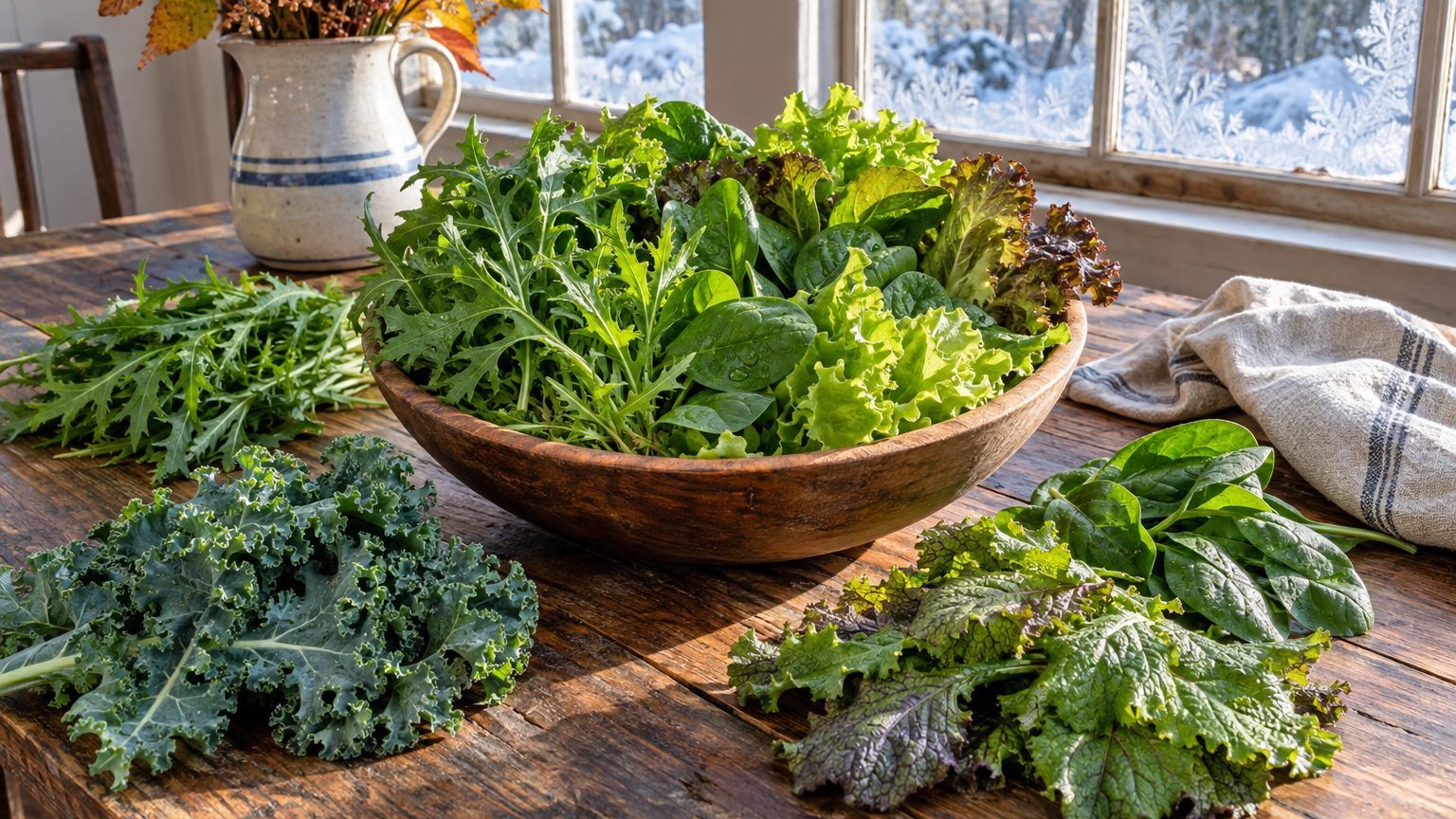

Kansas rewards the tough greens. Spinach, kale, mâche, claytonia and the quick mustard-family salads carry a bed through the cold months here, while soft butterhead lettuce needs a roof over it. The reasoning rests on one number from Wichita: an average coldest-month night of 22.5°F. What follows turns that number into choices, names the failures to avoid, and shows how to check it in your own yard.
The short answer for Kansas
Choose by type, not by variety name. In Kansas the hardy leafy greens (spinach, kale, mâche, claytonia) are the dependable winter salads. Fast mustard-family greens such as arugula, mizuna and tatsoi fill the fall and the early spring, and tender lettuce belongs under a cover.
The reason is cold, not calendar. The mean daily minimum of the coldest month at Wichita, from NOAA’s 1991-2020 Climate Normals, is 22.5°F. That is an average of nightly lows, so some nights run colder and some milder. It sits ten degrees under freezing, which is enough to collapse a tender lettuce leaf in an open bed and not enough to bother spinach. Hardy greens also turn sweeter in the cold, which is half the point of a winter salad.
The frost dates frame the season. At the Wichita airport station, the last spring frost falls between April 4 and April 18, and the first fall frost between October 23 and November 2. Both ranges are probabilities of a 32°F freeze, the band where the odds run between 30 and 70 percent. That is coin-flip territory, not a promise that frost stops on a given day.
| Type | Examples | Cold tolerance | Role in a Kansas bed |
|---|---|---|---|
| Hardy leafy greens | Spinach, mâche, claytonia, kale | Very hardy | Backbone of the winter harvest, often uncovered or under light cover |
| Quick mustard-family greens | Arugula, mizuna, tatsoi | Moderate to hardy | Fast fall cuttings, early spring regrowth |
| Tender lettuces | Butterhead, romaine, looseleaf | Tender to moderate | Only under a cover; looseleaf types outlast head types |
These are the Wichita reference-city figures. Gardens in the suburbs and the country usually see the last spring frost later and the first fall frost earlier than the airport, often by one to two weeks, and more at elevation. For the crop-by-crop picture, see Winter Salads for Kansas Gardens.
What will not work here
Late sowing is the first casualty. Winter salads are grown to near-full size before the days shorten, then held in the garden like a pantry. A kale or head lettuce sown after the fall frost range of October 23 to November 2 will sit as a seedling all winter. A rural garden whose first frost arrives one to two weeks ahead of the airport has even less runway. The slowest crops need the earliest start, and the When to Sow Winter Salads in Kansas page covers the sowing window.
Sowing in the heat is the opposite mistake. Fall sowing happens when summer has not let go. Lettuce and spinach seed often refuses to sprout in hot soil, and a bed watered once a week dries out between waterings long before a seed has rooted. Shallow seed needs a surface that stays damp. Gardeners who water on a weekly schedule get patchy rows, then blame the seed. Shade cloth and a light daily sprinkle until emergence work better than a deep soak every seventh day.
Unprotected tender lettuce fails on the winter numbers. With a coldest-month average low of 22.5°F, the colder nights fall well below that average. Butterhead and romaine left in an open bed in January usually come out mushy and brown. Looseleaf types hold on longer, but they still do not match spinach.
Covers bring a different failure. A closed low tunnel on a sunny winter afternoon can overheat, and the trapped moisture, combined with tight spacing, invites rot and gray mold on leaves that never dry out. Kansas wind adds a third problem: loose row cover whips around and tears, or blows off at night. Weight the edges, vent on mild days, and give each plant room for air to pass.
One failure runs the other way. Early spring sowings of tender greens in the April 4 to April 18 window can still catch a hard freeze, since that is where the odds sit near a coin flip. Hardy types shrug it off. Tender ones need that row cover kept handy.
What changes across Kansas
Kansas is not one garden. Under the USDA Plant Hardiness Zone Map (2023, built on 1991-2020 normals), the state runs from zone 5b to 7a. That spread covers three half-zone steps, roughly 15°F in the average annual extreme minimum temperature. There is no single answer for the state, and anyone who gives you one is rounding.
The map measures one thing: the coldest extreme of the year. It tells you whether a perennial survives. Winter salads are mostly annuals, so frost timing and day-to-day cold matter more than the zone number. Even so, the zone spread points the same direction as the frost dates. Colder parts of the state, generally the north and the west, should expect earlier fall frost, later spring frost and a shorter growing window at both ends. The warmer south and southeast gives hardy greens more weeks of real growth and may keep cuttings going through much of winter.
What to shift is straightforward. In the colder areas, sow earlier in late summer than the Wichita-based dates suggest, put covers on sooner, and lean on the hardiest types: spinach, mâche, claytonia and kale. Gardens at higher elevation should treat the one-to-two-week offset on the frost dates as a minimum. In milder areas you have more room to try tender lettuce under a cover and to sow the quick mustard-family greens a little later.
Do not guess your own zone from a neighbor or from a nursery tag. Look up your location on the USDA Plant Hardiness Zone Map and read your result there. Even then, your yard may run a step warmer or colder than the map.
Where to check this for your own county
This page is the state view, and it uses a single reference station. A county recommendation beats a state one every time, because county agents see the frost pockets, soil types and wind exposure that no statewide page can. Treat everything above as a starting frame, not a final schedule.
Your best source is K-State Research and Extension, the land-grant extension service for Kansas. This page does not have a county-level planting calendar in its data, and it will not guess at one. Check the extension site for these items:
- The local planting calendar for fall and winter vegetables, including leafy greens, for your area.
- Variety trial results, meaning which spinach, lettuce, kale and other greens were actually grown and compared in Kansas conditions.
- Your county or district extension office, where a horticulture agent can answer frost-date and cover questions.
Trial results matter more than seed-catalog promises. A variety that does well in a cooler state may bolt or sulk in Kansas, and a plain, older variety may win the local trial. If the extension calendar and this page disagree, follow the extension.
Checking this against your own garden
Your own observations outrank every date on this page. Three are worth making, and none needs equipment beyond your hands and eyes.
Soil warmth by feel. In late summer, press your hand flat on the bed in the morning and again in the afternoon. Soil that still feels hot to the touch is too warm for lettuce and spinach seed to sprout well. When it turns pleasantly cool, sowing time has arrived. A bed against a south-facing wall will stay warm longer than an open one, which tells you where your microclimate runs hot.
First true leaves. Seedlings first show a pair of seed leaves, then the true leaves that look like the mature plant. How fast the true leaves appear tells you if the sowing date is working. If they arrive a few weeks before your first frost, the plants have time to size up. If they are still tiny when frost shows up, sow earlier next year, or plan on covers.
Where frost lands first. On the first frosty morning, walk the yard at sunrise and note which spots are white and which are green. Low corners where cold air pools frost early. Beds near walls, fences or paving stay clear longer. That map is your own frost calendar, and it may differ from the airport’s by those one to two weeks.
Keep notes for a year, since a written date beats memory.
Common questions
Can I grow winter lettuce in Kansas without a cover?
Looseleaf types survive mild stretches, but with an average coldest-month low of 22.5°F at Wichita, tender lettuce is a gamble in an open bed. Spinach, mâche, claytonia and kale are the better uncovered choices.
Which is the most reliable winter salad green here?
Spinach, with mâche and claytonia close behind. All three tolerate freezing, and cold weather makes the leaves taste sweeter. Check your county’s variety trials for named varieties.
When should I sow for fall and winter harvest?
Early enough that plants are nearly full size before the fall frost range of October 23 to November 2, and earlier still for rural or higher-elevation gardens. The sowing window is covered in When to Sow Winter Salads in Kansas.
Are the frost dates on this page right for my garden?
They are the Wichita airport figures, shown as a 30 to 70 percent probability band of a 32°F freeze. Your garden may see later spring frost and earlier fall frost by one to two weeks, so confirm with your county extension office.