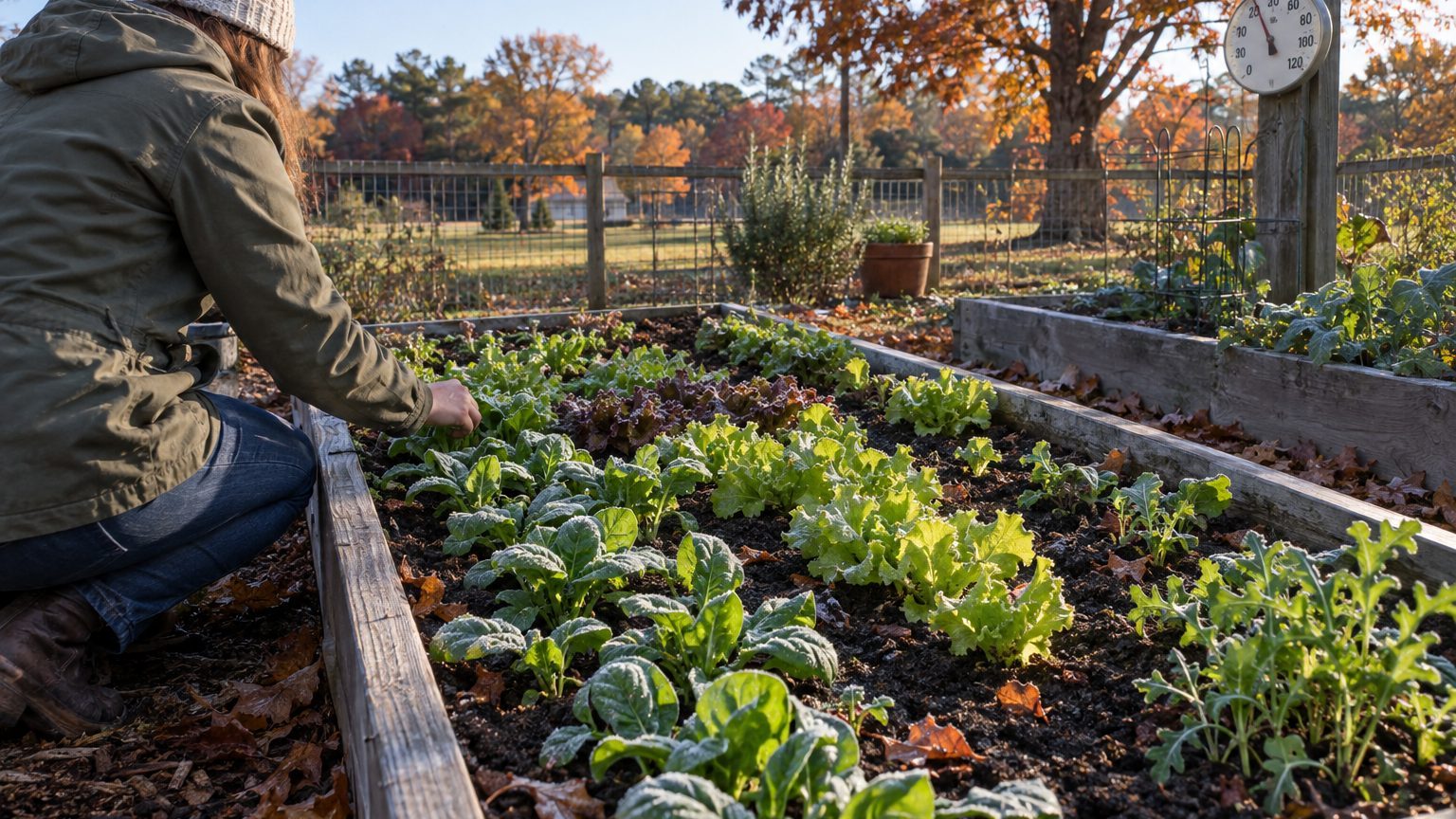

Sow winter salads in Kansas from the last days of August through about the third week of September for open beds. Covered sowings in a cold frame or low tunnel can stretch into October. Spring sowings of the same hardy greens start around the April 4 to April 18 last-frost band, or earlier under cover. Those dates come from one airport station, so expect your own garden to run a week or two off.
The short answer for Kansas
The calendar starts with two sets of numbers from NOAA’s 1991-2020 Climate Normals. The last spring frost falls between April 4 and April 18. The first fall frost falls between October 23 and November 2. Both are the 30-70% band of 32°F freeze probabilities. They are not dates when frost “ends” or “begins.” They mark the stretch where a freeze is neither unlikely nor certain, somewhere between 30% and 70% likely.
Count backward from the fall band and the sowing window appears. Winter salads such as spinach, mâche, arugula, mustard greens and hardy lettuces need roughly six to eight weeks to reach harvestable size before growth slows in short days. That is my arithmetic from the frost band, not a sourced figure. Eight weeks before October 23 is about August 28, and six weeks before November 2 is about September 21. Bed sowings belong inside that span.
Today is October 5, which means the open-bed window has mostly closed. The fast, cold-tolerant greens can still go in under a cold frame, a row cover or a low tunnel. A covered bed buys a few weeks of growth that bare soil won’t give you, and it is the realistic route for anyone starting late this year.
Spring runs the other way. Hardy greens tolerate light freezes, so they can be sown a few weeks ahead of the April 4 to April 18 band, as soon as the soil is workable. Tender lettuces and anything you are hoping to rush should wait until you are inside or past that band.
Choosing what to sow is a separate question, which The Best Winter Salads for Kansas covers. For the wider picture of how these crops fit a Kansas garden year, start at Winter Salads for Kansas Gardens.
One caution applies to every date above. They describe the reference station, which sits at an airport. Suburban and rural gardens typically see the last spring frost later and the first fall frost earlier, often by one to two weeks, and more at elevation. Treat the figures as the reference-city numbers, not a statewide guarantee.
What will not work here
The most common failure is sowing too late. If your garden gets its first fall frost one to two weeks ahead of the October 23 to November 2 band, a September 25 sowing that looked safe on paper is suddenly three weeks short. The seedlings sit at two true leaves through December, too small to eat and too young to harden off. They don’t die, but they don’t produce either.
Late-summer sowing fails the other way. Seed put into a bed in late August is going into soil that has been baking all summer. Lettuce is the usual victim, because hot soil can leave seed sulking or germinating in patches. Watering once a week won’t rescue that. A seedbed needs to stay evenly damp until the seedlings are up, which in a Kansas August means light watering every day or two and some afternoon shade from a board or a shade cloth. Gardeners who run a weekly deep soak, which suits established tomatoes, lose these beds regularly.
Cold is a second problem, and the number to respect is 22.5°F. That is the mean daily minimum of the coldest month at the Wichita reference station. It’s an average of nightly lows, so plenty of nights fall below it. Spinach, mâche and kale shrug that off. Tender butterhead or loose-leaf lettuces left uncovered in the open do not, and they turn to translucent mush after a few hard nights. Cover them or leave them out of the winter plan.
A cold frame, the standard fix, has its own Kansas trap. Winter sun can warm a closed frame well above outdoor temperatures even on a cold day, and the seedlings cook or turn leggy. Prop the lid on any sunny afternoon, then close it again before dusk. Anyone who can’t be home to do that is better off with vented row cover laid over hoops.
Finally, the spring gamble. Because the April 4 to April 18 band is a 30-70% probability, sowing tender transplants at its early edge means accepting a real chance of a freeze. Hardy greens forgive that. Tomatoes and peppers don’t, and they have no place in a winter-salad calendar anyway.
What changes across Kansas
Kansas is not one garden. The USDA Plant Hardiness Zone Map (2023 edition, built on 1991-2020 normals) puts the state across zones 5b to 7a. That spread is wide enough that there is no single answer to “when do I sow.” The zone system rests on one variable, the average annual extreme minimum temperature, so it tells you how cold the worst nights get, not when frost arrives.
In practice, a gardener toward the cold end of that range can expect the fall band to arrive sooner than October 23 to November 2 and the spring band to run later than April 4 to April 18. The practical move is to shift the fall sowing earlier, by a week or two, and to lean harder on cover. Higher ground behaves the same way, since the reference figures are for an airport, not for a hillside or a plateau.
Toward the warmer end, you gain a little time in both directions. Even so, the heat problem in late August gets worse, not better, so the extra weeks of cool-season growth come at the front end of the window only if you can keep seedbeds moist and shaded.
Which zone applies to you is a question for the USDA map, not for this page. Look up your own location on the map, then ask whether you sit toward the colder or warmer side of the state. That tells you which direction to shift the dates above. Then check the calendar for your own county, which is where the next section points.
Where to check this for your own county
Your state extension service is the best next stop. In Kansas that is K-State Research and Extension, the land-grant extension system, with local offices serving counties and districts across the state. What you are looking for there is specific. First, a local planting calendar or vegetable planting guide that gives sowing dates for fall and spring crops for your area. Second, a list of varieties trialled near you, ideally by gardeners or research plots in your county rather than in a distant state.
A county recommendation beats a state one, and this page is the state one. A date that works in a river-valley garden in the south may be two weeks wrong on a windswept northern ridge. The extension agent can tell you how your county’s frost dates compare with the airport numbers, which crops local gardeners actually get through winter, and which pests or diseases show up in fall beds.
When you contact a local office, bring three facts: your town or ZIP code, whether your garden is sheltered or exposed, and whether you plan to use any cover. Those details make the answer much more useful than a general question about winter lettuce.
Checking this against your own garden
Every date on this page is a starting point. Your garden’s own signals outrank it, and you can read three of them without buying anything.
- Soil warmth by feel. In late summer, push your hand into the top inch of the seedbed in the morning. If it still feels warm, not merely cool and damp, cool-season seed will struggle, and you should wait or shade the bed. A bed that cools sooner than your neighbor’s tells you about shade, soil type or exposure.
- The first true leaves. Seedlings first show seed leaves, then the true leaves that look like the mature plant. If your fall sowings have not reached true leaves by the time nights turn properly cold, they are behind schedule for that spot, and you should sow earlier next year.
- The first flush of male flowers. When squash and cucumber vines start producing their early male blossoms, you are watching the warm season turn. Note when the vines finally quit in autumn. A garden where they die back before the airport’s frost band is telling you your frost comes early.
Write those three dates down this year, even roughly. Next season, they will correct the state calendar better than any chart.
Common questions
Is it too late to sow winter salads in Kansas in early October?
For open beds, mostly yes, because the window described here runs from late August to about the third week of September. Under a cold frame, tunnel or row cover, fast hardy greens can still be started, though harvests will be small and slow.
Why do the frost dates say “30-70%”?
Because frost is a probability, not a date. NOAA’s figures give the band in which the chance of a 32°F freeze runs between 30% and 70%. Your garden might freeze before or after any date inside that band.
Do I need a cold frame to grow winter salads?
Not for the hardiest greens, such as spinach and mâche, which can survive Kansas nights in the open. The coldest month’s mean daily minimum is 22.5°F at the Wichita reference station, so tender lettuces and late sowings are the ones that need cover.
Which Kansas hardiness zone am I in?
This page cannot say. Kansas spans zones 5b to 7a on the USDA Plant Hardiness Zone Map, so look up your own location on that map and confirm local conditions with your county extension office.