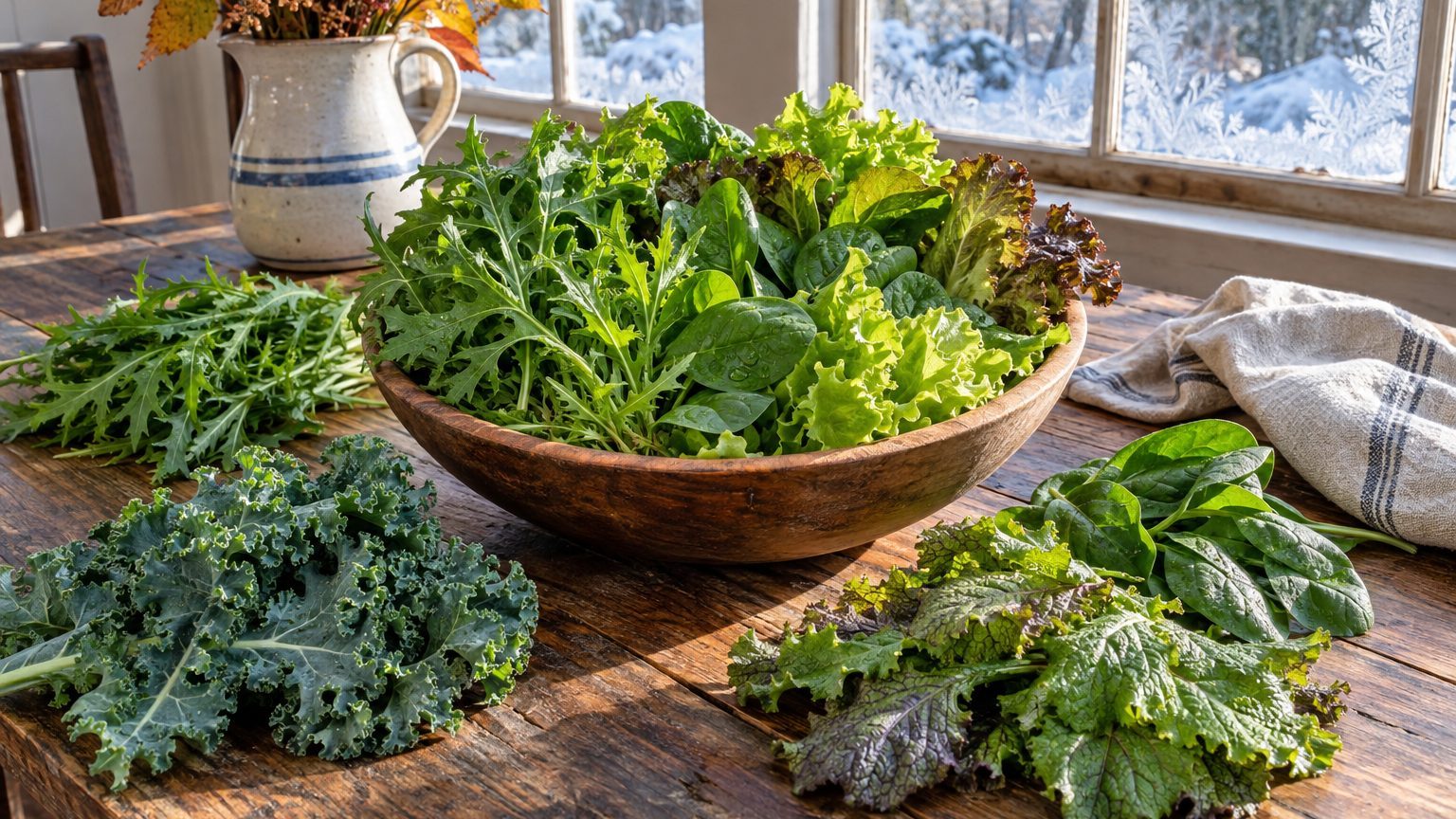

Spinach, mâche, claytonia and kale make the best winter salad bed in Kentucky. Hardy mustards, arugula and cold-tolerant lettuces come second. The reason is a winter that bites without staying brutal: the coldest month’s average nighttime low at the Louisville reference station is 27.8°F. Hardy leaves shrug that off. Tender heads of lettuce often don’t.
The short answer for Kentucky
Build the bed around cold-hardy leaf crops (spinach, mâche, claytonia, kale, mustard greens) and treat lettuce and arugula as bonus crops that want a little cover. That ranking comes from one number: a mean daily minimum of 27.8°F in the coldest month, per NOAA’s 1991-2020 Climate Normals for Louisville. It is the figure that decides whether a plant survives the cold here at all.
Why the hardy leaves lead
That 27.8°F is an average of nights, so plenty of nights run colder and plenty run milder. A plant that tolerates repeated freezes carries on through both. Spinach, mâche and kale not only tolerate it but often taste sweeter after a freeze, because the leaves build up sugars as protection. A tender lettuce leaf, by contrast, can turn glassy and collapse after one hard night.
The frost dates frame the growing window. At the Louisville station, March 24 to April 4 is the last spring frost range, and November 2 to November 12 is the first fall frost range. Both are the band where the chance of a 32°F freeze sits between 30 and 70 percent, taken from the NOAA NCEI 1991-2020 normals. They describe odds, not a calendar promise. Rural gardens should expect a tighter window than that urban station shows.
The decision by type
| Type | Role in a Kentucky winter bed | Cover needed? |
|---|---|---|
| Spinach | Backbone crop; sweetens in the cold | Rarely; useful in the harshest stretches |
| Mâche (corn salad) | Very hardy, small rosettes, slow but steady | Rarely |
| Claytonia | Thrives in cool conditions, tolerates some shade | Rarely |
| Kale | Baby leaves for salad, then cut-and-come-again | Rarely |
| Mustards and arugula | Fast, peppery, hardiness varies by variety | Sometimes |
| Cold-hardy lettuce | Pick varieties sold for winter or cold-season use | Yes, row cover or a low tunnel |
What will not work here
The common failure in Kentucky is timing, not cold. A first fall frost that arrives between November 2 and November 12 at Louisville, and earlier in many rural spots, leaves a short stretch of real growth. After that, short days slow everything to a crawl.
Slow crops and late sowing
Anything sown after the fall growing window has largely closed will sit as tiny seedlings all winter. That defeats the slowest salad crops first: full-size heading lettuces, heading radicchio and anything that needs to reach a mature head before the light fades. They survive the cold but never size up. Small, fast, cut-as-you-go leaves fit the season far better than heads.
The other end of the calendar matters too. With the last spring frost falling between March 24 and April 4 (again a 30-70% probability band, not a date), overwintered spinach and mâche start bolting as days lengthen and warmth returns. Plan on harvesting hard through late winter instead of expecting a bed to carry into May.
Heat, humidity and wet soil
Early fall in Kentucky can still be warm, and warm soil is where cool-season seed struggles. Spinach and lettuce seed are known to germinate poorly when the soil is hot, so sowing too early wastes seed. Shading the bed and watering the soil surface before the cool-down helps.
Humidity punishes close spacing. Crowded rows hold moisture on the leaves, and in a state with damp falls and mild spells, that invites fungal leaf spots and slugs. Space plants for airflow. Heavy clay, common in many Kentucky yards, adds a third problem: soggy soil rots roots and heaves seedlings in repeated freeze-thaw cycles. Raised beds or amended rows drain better.
Finally, do not borrow a Gulf Coast schedule. Advice written for places where lettuce grows happily in December assumes milder nights than a 27.8°F coldest-month average allows, so unprotected tender varieties will not carry through here.
What changes across Kentucky
Kentucky is not one garden. The USDA Plant Hardiness Zone Map (2023 edition, built on 1991-2020 normals) places the state in zones 6a to 7a, so there is no single answer. That spread covers three half-zone steps (6a, 6b and 7a). The zone rests on one variable only, the average annual extreme minimum temperature, so it says nothing directly about frost dates, summer heat or humidity.
A cold-station caveat
Every date on this page comes from the Louisville reference station. NWS Louisville warns that this urban station runs later in spring and earlier in fall than rural Jefferson County. In practice that means a rural garden should expect an earlier first fall frost and a later last spring frost than the ranges shown above. Use the Louisville dates as a starting point, not a verdict. This page does not have separate frost dates for other parts of the state.
What to shift in the north or at altitude
If you garden in a colder part of the state, on higher ground, or in a low spot where cold air pools, move the schedule earlier in fall and lean harder on the hardiest crops: spinach, mâche, claytonia and kale. Add cover sooner, and treat lettuce as a protected crop only. In the milder parts of the state, cold-hardy lettuce and arugula have more room to work, and the harvest window may stretch longer in both directions.
To find your own zone, look up your location on the USDA map instead of guessing from a neighbor. For timing against the frost bands above, see When to Sow Winter Salads in Kentucky.
Where to check this for your own county
This page is the state-level view, and a county recommendation beats it. Your local office of University of Kentucky Cooperative Extension knows the soils, the frost pockets and the pest pressure where you actually garden. Our sources for this page do not include a Kentucky extension winter salad calendar, so any such guidance has to come from your county office.
When you get there, look for two things. The first is a local planting calendar for fall and winter vegetables, ideally with sowing windows tied to your county’s frost dates and not Louisville’s. The second is a list of varieties trialed in your county or a neighboring one. Trial results tell you which spinach or lettuce held up through a wet, muddy winter in conditions like yours, which a seed catalog cannot.
It also helps to ask staff directly about local slug and disease pressure, and about whether cover is routinely needed in your area. For the wider picture of how winter salads fit a Kentucky garden, Winter Salads for Kentucky Gardens covers the territory as a whole.
Checking this against your own garden
Your own observations outrank every date here. Three are worth tracking, and none need equipment.
- Soil warmth by feel. Press a bare hand into the bed in early fall. If the soil still feels warm, wait on spinach and lettuce seed. Compare a sunny bed with a shaded one, and you learn how much your yard differs from the station numbers.
- First true leaves. Note when seedlings put out their first true leaves, the ones after the seed leaves. If that happens well before your first hard frost, the bed is on schedule. If it happens late, expect slow growth and plan for more cover.
- Where frost shows first. Watch which corner of the yard, roof or lawn whitens first, and which stays clear. The spot that frosts earliest is your cold pocket, a place for the hardiest crops. A spot that stays clear longest suits the tender ones.
Write the dates in a notebook for a season or two. They will tell you more about your microclimate than a state page can.
Common questions
Can I grow lettuce all winter in Kentucky?
Not reliably without protection. With a coldest-month mean low of 27.8°F, many lettuces need row cover or a low tunnel, and only varieties sold as cold-hardy stand a chance outdoors.
What is the easiest winter salad crop for a first try?
Spinach is the usual starting point. It tolerates repeated freezes and tastes sweeter after them. Mâche and claytonia are close behind if you want something that holds through the cold.
Are the frost dates on this page exact?
No. They are probability bands from the Louisville station, covering a 30 to 70 percent chance of a 32°F freeze. Rural gardens usually see a tighter window.
Which hardiness zone is my garden in?
Kentucky spans USDA zones 6a to 7a, so check the USDA Plant Hardiness Zone Map for your location rather than assuming. Your county extension office can also confirm it.