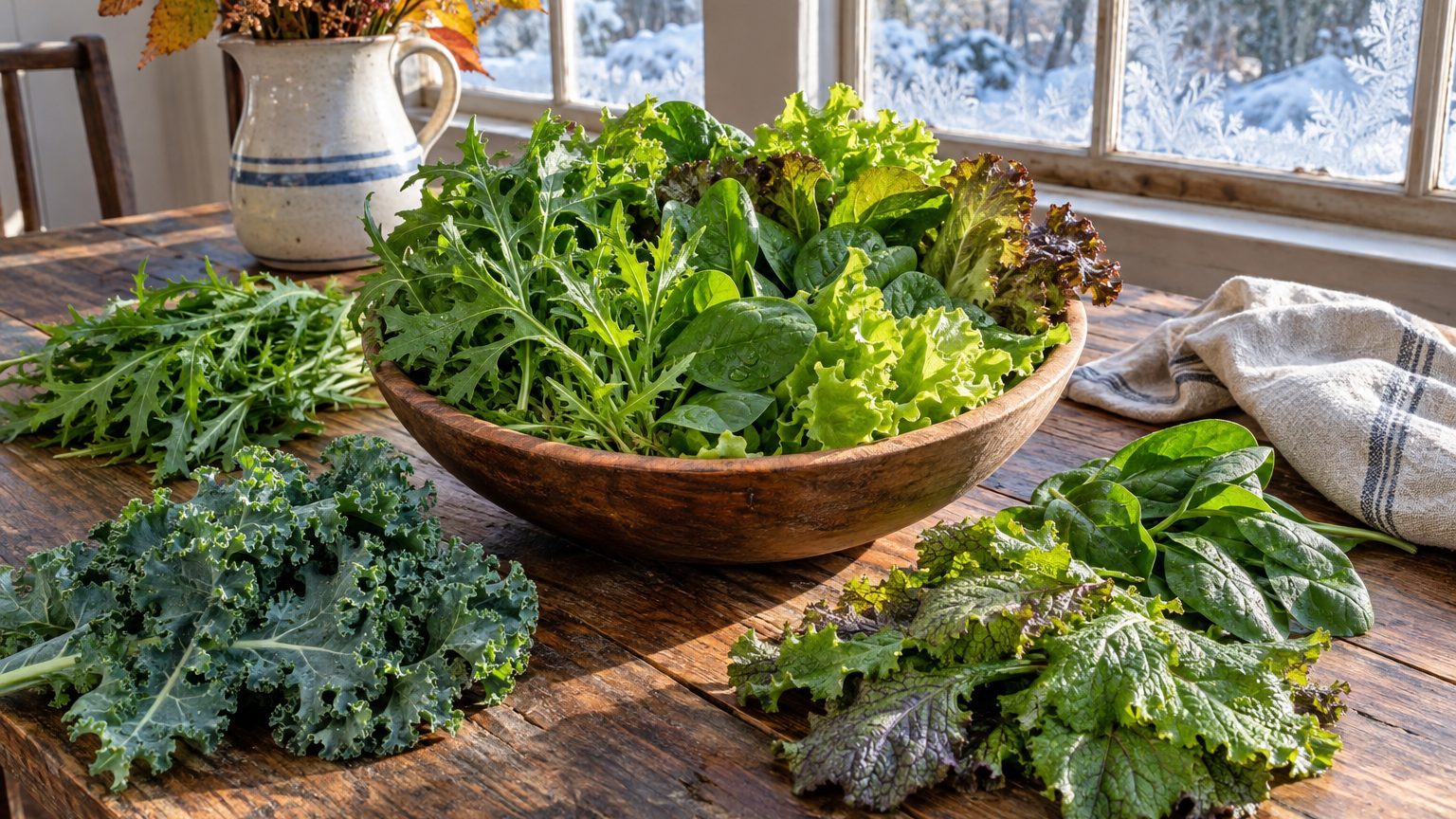

For a Louisiana winter salad bed, plant quick, cold-tolerant greens: loose-leaf lettuce, arugula, mizuna, mustard, spinach and kale. Skip the slow heading types. Winter here is mild (the coldest month averages a nighttime low of 46.1°F in New Orleans), so cold seldom kills a crop. Heat does, at both ends of the season, and that shapes every choice below.
The short answer for Louisiana
Choose by speed and heat tolerance, not by frost hardiness. Loose-leaf lettuces, the fast Asian greens, arugula, kale and collards suit the state. Head lettuce, butterhead and romaine are the gamble, because they need a long, steady cool stretch that Louisiana delivers only some years.
The frost numbers explain why. At the south Louisiana reference station, the last spring frost falls between January 18 and February 8, and the first fall frost between December 17 and January 8. Those are not guaranteed dates. They mark the band where the odds of a 32°F freeze run between 30 and 70 percent, according to the NOAA 1991-2020 Climate Normals. A 32°F freeze occurs in only 86.8 percent of years there, so roughly one winter in seven has no freeze at all. And notice the fall window straddles New Year’s Day: the “end of the season” and the “start of the next one” are barely a month apart.
Match the type to the season
With frost nearly a non-factor for much of winter, the real clock is how fast a crop reaches harvest before warm weather returns. Quick crops win that race.
| Type | Verdict | Why |
|---|---|---|
| Loose-leaf lettuce | Best bet | Cut outer leaves young, long before the plant thinks about bolting |
| Arugula, mizuna, mustard, tatsoi | Best bet | Fast to harvest and happy with mild nights |
| Kale and collards | Very reliable | Shrug off cold snaps and keep producing through a long winter |
| Spinach | Good in the cool core | Likes cool weather but sulks and bolts in warm spells |
| Endive and escarole | Solid | Tolerate more warmth than most lettuce |
| Butterhead, romaine, tight-heading types | Hit or miss | Need weeks of steady cool weather to finish |
Think of it as a relay. You want salad on the plate while the weather is mild, not a crop still sizing up when the first warm week hits. For the sowing dates that go with this list, see When to Sow Winter Salads in Louisiana. For the broader picture, Winter Salads for Louisiana Gardens covers the topic as a whole.
What will not work here
Northern advice fails first. Guidance written for places with a hard freeze tells you to protect plants from frost and to wait for cold to sweeten the leaves. In Louisiana, the coldest month’s average low is 46.1°F. Most winter nights are far too mild to do either, and in about one year in seven the freeze never comes.
Sowing lettuce too early in fall is the classic failure. If seed goes in while summer heat lingers, germination turns patchy, seedlings stretch, and what survives tastes bitter. The limiting factor in south Louisiana is heat, not frost. A gardener who waits for the first frost date before starting is waiting for something that may land on Christmas week, or not at all.
The slow heading types fail at the other end. The last spring frost window runs January 18 to February 8, which means the warm-up starts early. A romaine that needs a long run of cool weather can run out of winter before it forms a good head. Then it bolts, and bolted lettuce is a bitter, tall stalk. Spring sowings of cool-season salads face the same trap: they have only a few weeks before warmth arrives.
Close spacing also fails here, and the cause is humidity rather than temperature. Louisiana winters are damp. Crowd lettuce or spinach shoulder to shoulder and leaves stay wet long after rain, which invites fungal problems such as downy mildew and rot at the base of the plant. Give plants room, water in the morning, and favor raised beds or well-drained rows, because heavy rain on flat clay sits.
Finally, do not assume the mild winter means you never need cover. A freeze does occur in the large majority of years at the southern station, and a cold snap can scorch tender seedlings. Keep a lightweight row cover or old sheet handy for those nights. It costs little, and you will use it only a few times.
What changes across Louisiana
The state is not one garden. The USDA Plant Hardiness Zone Map (2023 edition, built on 1991-2020 normals) places Louisiana in zones 8a to 10a. That is a wide spread, and there is no single answer for the whole state. The zone number rests on one variable, the average annual extreme minimum temperature, so it tells you about survival in the worst cold, not about how many weeks of comfortable salad weather you get.
The frost dates and the 46.1°F figure on this page come from the south Louisiana reference point, New Orleans. Other parts of the state differ, and this page does not have frost dates for them. What it does say is that north Louisiana freezes far more reliably than the coast. A reader in the north should expect more nights where tender lettuce needs cover, more value from the hardy end of the list (kale, collards, mustard, spinach), and less certainty about tender salad mixes in the coldest weeks.
A reader along the coast should lean the other way. Warm spells arrive sooner and linger, so fast crops, early harvests and tolerant types like escarole earn their place. Elevation barely matters in a state this flat, so the gradient runs mostly with latitude and distance from the Gulf rather than with altitude.
To find your own zone, do not guess from a neighbor’s advice. Enter your ZIP code on the official USDA Plant Hardiness Zone Map and read it from there. Treat the result as one input, then adjust for the low spot, the south-facing wall or the windbreak in your own yard.
Where to check this for your own county
This page is the state-level view. A recommendation from your local extension office beats it, because that office knows your soils, your rainfall and the varieties that have actually been grown nearby. Start with the LSU AgCenter, Louisiana’s land-grant extension service. One note: Louisiana organizes local offices by parish rather than county, so look for your parish office.
Once you are there, look for two things. The first is the local vegetable planting calendar or planting guide, which gives sowing windows tuned to your part of the state rather than the southern reference dates used here. The second is any variety trial results for leafy greens. Trials compare cultivars side by side in local conditions, noting which bolt early, which resist disease and which hold flavor. That information turns a general category such as “loose-leaf lettuce” into a short list of proven choices.
If you cannot find a published guide for your parish, call or email the office. Extension agents field these questions all the time, and many offer soil testing, which helps with the drainage and fertility questions that matter for a wet-winter bed. Ask what has done well in local gardens in recent winters, and what failed.
Checking this against your own garden
Dates are averages. Your garden is a specific place, and what you observe there outranks every window on this page. Three things are worth watching, and none needs equipment.
- Soil warmth by feel. Push your fingers a few inches into the bed in the morning. If the soil feels warm like a sun-heated driveway, wait to sow lettuce and spinach. If it feels cool and slightly damp, the bed is ready. A bed that stays warm longer than your neighbor’s tells you it holds heat, perhaps from a wall or paving.
- The first true leaves. Seedlings first show rounded seed leaves, then the first true leaves with the real shape of the plant. If they come quickly and stay stocky, conditions suit the crop. If seedlings stretch, yellow or stall, the spot is too warm, too wet or too shaded.
- First signs of cold damage. Note which plants get nipped on the first chilly night and which stay green. Damage in one corner but not another reveals your cold pockets and your sheltered ones, and tells you where to put tender crops next year.
Write what you see in a notebook or on your phone. After two winters, your own records will be a better planting calendar than any published one.
Common questions
What is the easiest winter salad crop to grow in Louisiana?
Kale and collards are the most forgiving, and loose-leaf lettuce and arugula are the easiest true salad crops. All of them tolerate mild cold and can be harvested young, so they finish before warm weather arrives.
Can I grow head lettuce in Louisiana?
Sometimes. Butterhead and romaine need a long, steady cool stretch, and Louisiana does not always provide one. Loose-leaf types give far more reliable results because you can pick leaves early.
Do I need to worry about frost?
Less than northern gardeners do. At the south Louisiana reference station a 32°F freeze occurs in 86.8 percent of years, so about one year in seven has none. Still, keep a row cover handy for the occasional cold snap, and expect more freezes in north Louisiana.
What hardiness zone is Louisiana?
The USDA Plant Hardiness Zone Map (2023) places the state in zones 8a to 10a, so it varies by location. Check the official map for your ZIP code instead of relying on a state-wide number.