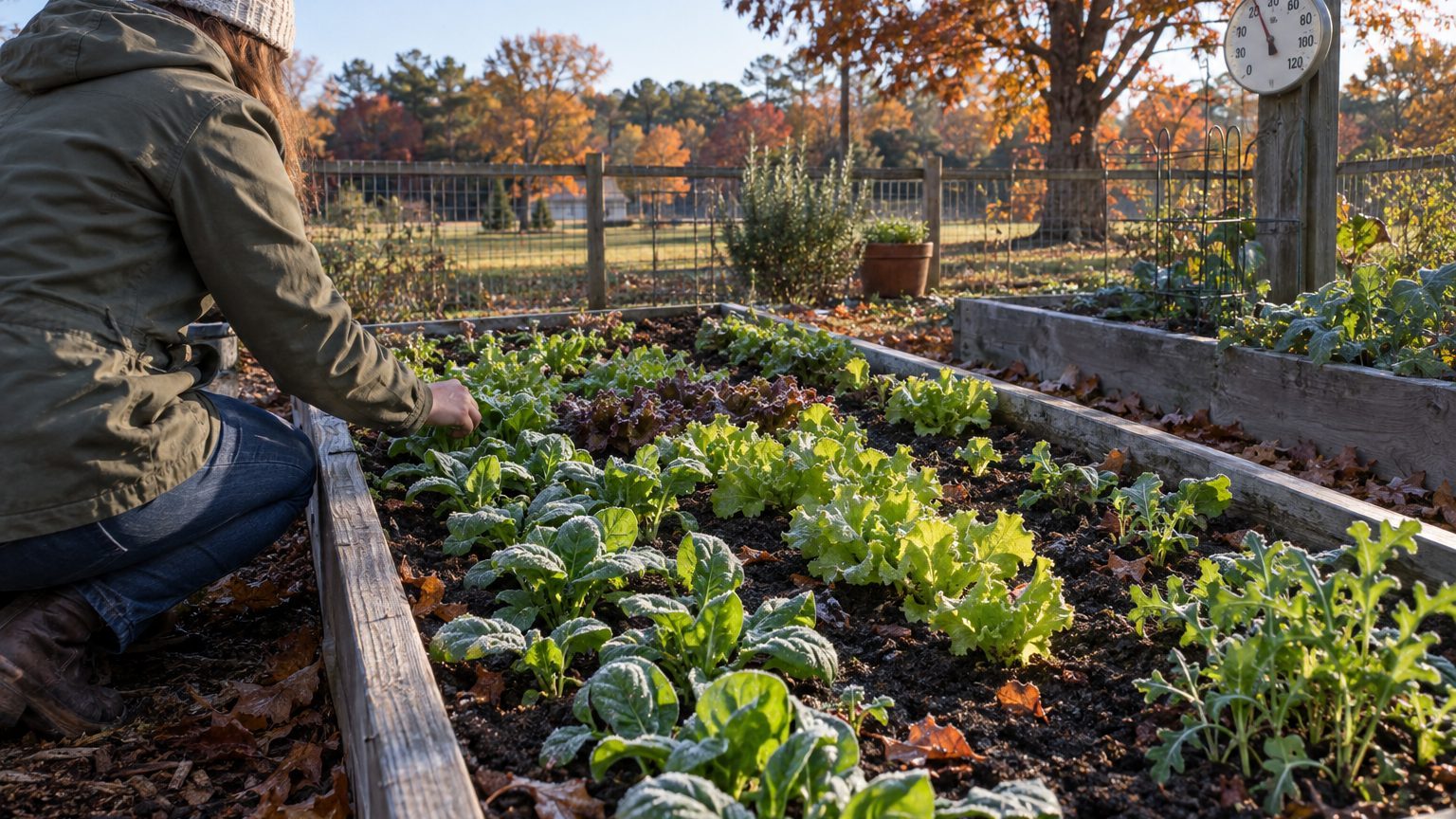

Sow winter salads in Maine in late summer, early enough that the plants are nearly full size before the first fall freeze. At the Portland reference station that freeze arrives between October 9 and October 21. After it, cold and short days slow growth to a crawl, and you are harvesting what you already grew. Inland and northern gardens need to start earlier.
The short answer for Maine
For Portland, NOAA’s 1991-2020 Climate Normals put the last spring freeze between April 22 and May 1, and the first fall freeze between October 9 and October 21. Both are probability bands, not promises. Each is the span in which the chance of a 32°F freeze sits between 30% and 70%. So October 9 is not the day frost hits. It is roughly when the odds start to look like a coin flip.
| Marker | Portland date band | What it is a probability of |
|---|---|---|
| Last spring freeze | April 22 to May 1 | A 32°F reading, 30-70% chance |
| First fall freeze | October 9 to October 21 | A 32°F reading, 30-70% chance |
Winter salads work backward from the fall band. A winter harvest depends on plants that reach near-harvest size while days are still long enough to grow them. Once light drops off and nights stay cold, a plant puts on little new growth. Whatever size it had in October is mostly the size it will be in January.
The practical method is simple. Take the days-to-maturity printed on the seed packet and count back from October 9, not from the end of the band. Then add a generous cushion, because autumn growth is slower than the packet’s spring-and-summer assumptions. This page does not have a verified day count for that cushion, so treat the packet number as a minimum and let the cushion be large.
The spring band matters for a second, smaller window. Hardy salad crops sown under cover in late winter or early spring ride the same logic in reverse. They need to be up and growing before the unprotected bed is truly safe, which is around April 22 to May 1 at Portland.
The cold number explains why cover matters. The mean daily minimum of Maine’s coldest month at Portland is 15.6°F (NOAA Climate Normals 1991-2020). That is an average of the lows, so some nights go well below it. Most salad crops left in an open bed will not keep their quality through that, which is why a winter salad here usually means a cold frame, a low tunnel, or an unheated greenhouse. For a full run of what to grow inside them, see Winter Salads for Maine Gardens.
What will not work here
Sowing at the first frost will not work. A gardener who waits for the October 9 to October 21 band to “start the winter garden” has started it about two months too late. Seeds sown then may sprout under cover, but the seedlings will sit at nearly the same size all winter instead of filling out.
The frost-to-frost stretch is shorter than it looks. At the Portland station it runs from the end of the spring band to the start of the fall band, roughly five to six months depending on which ends of the bands you use. Anything slow, such as large-headed lettuces that need most of that time, leaves almost nothing for a second planting. The slowest types lose first. Quick baby-leaf cuts and cold-hardy greens fit the window. Long-maturing heads usually do not.
Uncovered beds are the next casualty. With a coldest-month average low of 15.6°F, tender lettuce left in the open has little chance of surviving the winter. Hardy greens fare better, but even they stall without a layer of protection. If you are choosing what to plant, The Best Winter Salads for Maine sorts the hardier types from the ones that sulk.
Warm late-summer soil causes trouble that gets less attention. The best sowing time for fall salads falls in the warmest weeks of the season, and lettuce seed is known to germinate poorly in hot soil. Sowing in the evening, watering the row before and after, and giving the bed afternoon shade handle most of the problem. A sowing that is too dry will often fail outright, and the failure arrives just when the calendar has no room for a second try.
Maine’s damp autumns defeat tight spacing. Coastal fog, long dewy mornings and closed covers hold humidity around leaves. Crowded rows invite gray mold and rot, and a cold frame shut tight on a mild gray day can do more harm than a frost. Thin seedlings to a proper spacing early, and vent the covers whenever the air is above freezing.
Finally, borrowing a calendar from outside the state will not work. A schedule written for the mid-Atlantic or the South puts October sowings on a clock that Maine’s season simply does not support. Even inside Maine, Portland’s dates are the mild end of the range, so they are not a safe template for a garden 100 miles inland.
What changes across Maine
Maine has no single sowing date. The USDA Plant Hardiness Zone Map 2023, built on 1991-2020 normals, places the state between zones 3b and 6a. That is six half-zones (3b, 4a, 4b, 5a, 5b and 6a), and the spread is wide enough that advice for one end can be wrong at the other.
The USDA system rests on one variable: the average annual extreme minimum temperature. That tells you how cold the worst nights get. It says little about how many weeks you have before fall freezes. Two gardens in the same zone can have quite different first-frost dates, so treat the zone as a guide to winter survival, not as a sowing calendar.
The Portland dates in this article sit at the mild end of Maine. Inland and northern Maine run substantially later in spring and earlier in fall. A gardener in the north or at altitude should shift in these directions:
- Sow earlier in late summer, since the fall freeze arrives ahead of Portland’s October 9 to October 21 band.
- Rely on a double layer, such as a tunnel inside a frame, rather than a single cover.
- Choose the fastest and hardiest crops, and drop anything that needs a long finish.
- Expect the spring start to come later than April 22 to May 1.
How much earlier is a number this page cannot give you. The brief behind it has no verified figure for northern or high-elevation Maine, so it will not guess one. Look up your own zone on the USDA map by ZIP code, then use your local frost dates, not the Portland ones, as your anchor.
Where to check this for your own county
The best next stop is University of Maine Extension. Extension offices work at the county level, which is exactly the resolution this page lacks. A county recommendation beats a state one, and this page is the state one: it uses one coastal reference station and one set of normals.
When you get there, look for two things. First, the local planting calendar, ideally one that lists sowing windows for cool-season greens and gives frost dates for your county or nearest town. Second, any variety trials run in your county or a climate close to it. Trials matter because a variety that survives a Portland winter under a cold frame may not do the same where nights run colder.
If the website does not list what you need, call or email your county office. Staff and Master Gardener volunteers hear the same question every September, and they often know which local microclimates run warmer or colder than the official numbers suggest. Ask them how much earlier to sow than the coastal dates, whether your area favors tunnels or frames, and which varieties have actually come through winter near you.
Be careful about borrowed calendars. Some extension services publish calendars by crop or species rather than by state, so make sure any calendar you use matches both your plant and your region. A schedule for a different crop, or a lawn guide from another state, will mislead you. Keep the Maine sources for Maine decisions.
Checking this against your own garden
Your own observations outrank every date on this page. Dates describe a long-run average at one station. Your bed describes this year, in your yard. Three things are worth watching.
Soil warmth by feel
In late summer, push a bare hand a few inches into the bed in the morning. Soil that still feels warm means lettuce seed may struggle, so shade and water first. In early spring, soil that feels cold and heavy tells you the bed is behind the coast. A south-facing wall or a sheltered corner will feel warmer longer than an open field.
The first male flowers
Squash and cucumber plants produce male flowers first, a few days before female ones. Note the date they appear and compare it from one year to the next. A season that runs early or late there will probably run the same way at the fall end, which tells you whether to shift your sowing up or back.
The first true leaves
A seedling’s first pair of leaves is the seed leaves. The true leaves come next. Sow a small test row in late summer and note how many days it takes to get true leaves. If the row is slow, your bed is cooler or shadier than average, and you should sow earlier. If it is fast, you have room to spare.
Write all three dates in a notebook. After two seasons, you will have a calendar that is more accurate than any state page, this one included.
Common questions
Is it too late to sow winter salads in October in Maine?
For harvest-size plants, yes, at least on the coast. The first fall freeze at Portland falls between October 9 and October 21, and inland it comes sooner. Some hardy crops are sown late to overwinter as small plants for early spring, but that is a different goal from a winter harvest.
Do the spring frost dates matter for winter salads?
Less than the fall ones. The April 22 to May 1 band at Portland marks when the chance of a 32°F freeze drops below 30%. It matters for an early spring sowing under cover, but the winter crop depends on the fall dates.
Can I use the Portland dates in northern Maine?
No. Portland is the mild end of the state, and inland and northern Maine run later in spring and earlier in fall. This page does not have verified dates for those areas, so use your county’s figures from extension.
Do I need a greenhouse?
Not necessarily, but you do need cover. The coldest-month average low at Portland is 15.6°F, which is too cold for most salad crops in an open bed. A cold frame or low tunnel is the usual starting point, and a second layer helps in colder parts of the state.