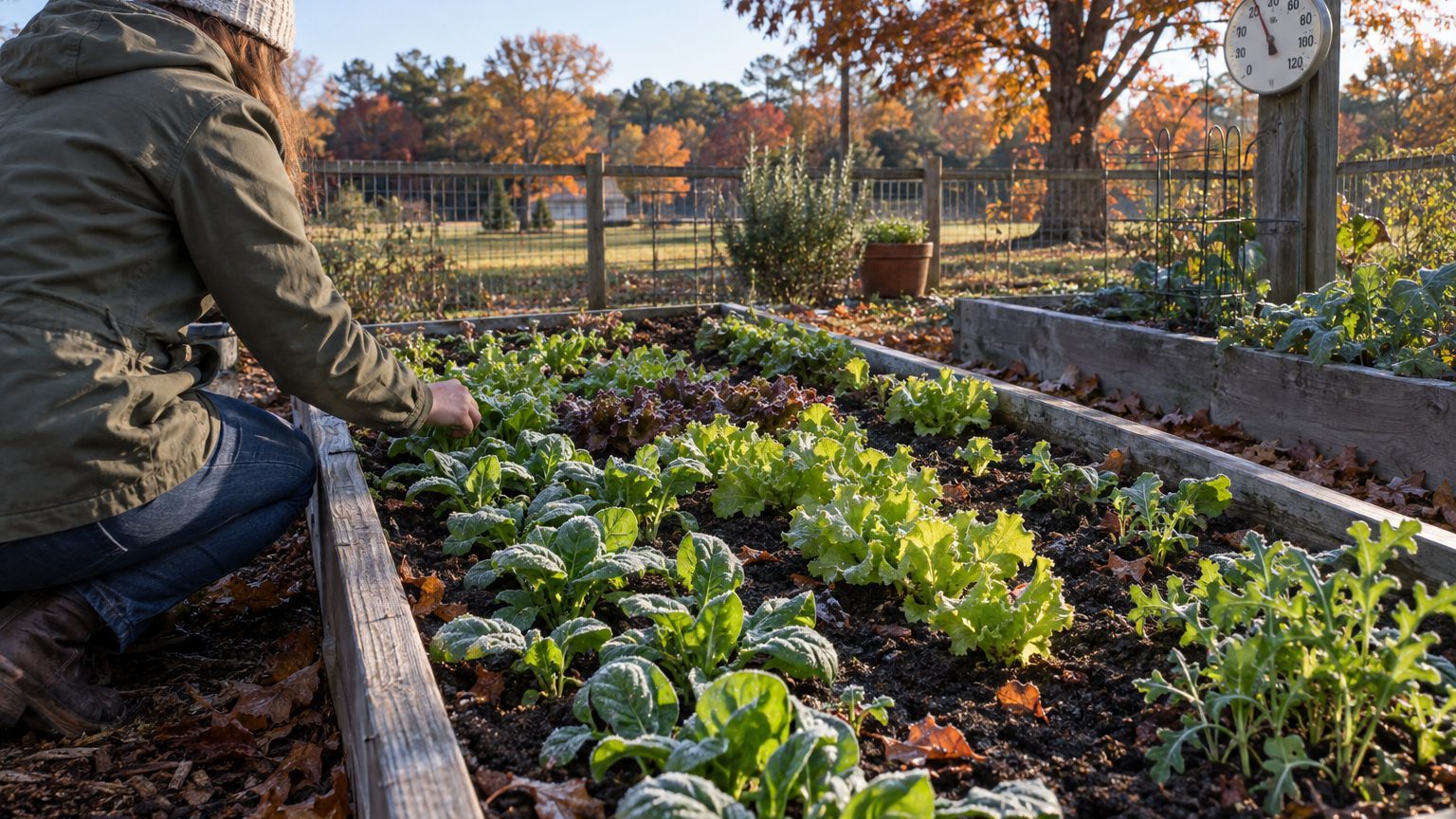

Sow Maryland winter salads in late summer and early fall, working backward from a first fall frost that NOAA places between October 26 and November 5. Start too close to that band and plants never reach harvest size. Start too early and August heat wrecks the seedlings. Below: the window itself, what fails inside it, and how to shift it for your part of the state. For variety picks, see The Best Winter Salads for Maryland.
The short answer for Maryland
Finish outdoor sowing of winter salads several weeks before the October 26 to November 5 band, and use the early end of that band as your anchor. Seeds that go in after it mostly sit as tiny seedlings and wait for spring, which is not a winter harvest.
Those two dates deserve a closer look, because they are a probability and not a deadline. They come from NOAA’s 1991-2020 Climate Normals and mark the 30 to 70 percent band for a 32°F freeze. Inside that band, a freeze in any given year is somewhere between a long shot and a likely bet. Some years it comes in mid-October, and some years you are picking arugula in a T-shirt in the second week of November.
Counting backward from the fall band
Start with the days to maturity printed on your seed packet. Then add a cushion, because growth slows as fall days shorten, and a plant that needs 45 days in warm weather needs noticeably longer once nights cool. Subtract the total from October 26. Baby-leaf mixes and quick greens can go in later than full heads of lettuce, kale or other slower crops, which belong at the early end of your window.
Row cover or a cold frame moves the practical cutoff later, since it buys some frost protection and a few degrees of warmth. It does not rescue a seeding made after growth has already stalled.
The spring side of the calendar
The last spring frost band runs April 3 to April 16, measured the same way: a 30 to 70 percent chance of a 32°F freeze. That band tells you when overwintered beds start to bolt and when cool-weather spring sowings can begin under protection. It does not tell you the freeze is over. A cold night after April 16 is entirely possible.
What will not work here
The classic Maryland mistake is sowing too early. Late-summer soil in the Mid-Atlantic stays warm, the air is humid, and lettuce seed that goes into hot ground germinates unevenly or not at all. Gardeners who sow in the first flush of fall enthusiasm, while the tomatoes are still cranking, often end up with patchy rows and a lot of replanting.
Heat, humidity and weekly watering
Anyone who waters once a week will lose a late-summer sowing. Seeds and seedlings need steady surface moisture, and a Maryland dry spell in September can bake a seedbed in a few days. Shade the bed in the afternoon, water lightly and often until the seedlings are up, and expect to do it daily at the start.
Humidity punishes close spacing. Crowded seedlings in still, damp air invite fungal trouble such as downy mildew, and wet fall weather brings slugs. Thin to the spacing on the packet even though the bed looks sparse in October. It fills in, and air movement through the rows is cheap disease control.
Sowing too late and trusting tender greens
The cold side has its own failures. At the Baltimore reference station, the mean daily minimum of the coldest month is 25.4°F. That is an average, so the typical coldest-month night is already below freezing, and plenty of nights run colder. Hardy greens such as spinach, kale and mâche are built for that. Tender lettuce left uncovered is not, and a sowing made at the end of the window leaves plants too small to take the hit.
The mountains break the pattern entirely. Garrett and Allegany counties run weeks off these frost dates, so a gardener there who copies a Baltimore calendar will get caught by cold before the plants are ready. The page does not have separate frost figures for those counties, and the honest advice is to lean early and plan on cover from day one.
What changes across Maryland
Maryland does not have one winter-salad climate. On the USDA Plant Hardiness Zone Map 2023, which is built on a single variable (the average annual extreme minimum temperature), the state spans 5b to 8a. That is a spread of several zones inside one state, from mountain ridges to tidewater, so there is no single answer to “what should I sow and when.”
| Part of the state | What the facts say | What to shift |
|---|---|---|
| Western Maryland (Garrett, Allegany) | Mountainous; frost dates run weeks later than the state bands | Sow on the early side, use row cover or a cold frame from the start, and expect hardy greens only |
| Central Maryland (Baltimore reference) | The frost bands and the 25.4°F coldest-month minimum on this page fit best here | Use the dates as written, then adjust for your own site |
| Eastern Shore | Milder than the state bands | Hardy greens carry further into winter; this page has no separate Eastern Shore dates |
Hardiness zones also measure only cold survival. They say nothing about summer heat or late-summer moisture, which decide how well fall seedlings establish. A reader in the mountains and a reader on the Eastern Shore may both face problems, but different ones.
To find your own zone, use the USDA Plant Hardiness Zone Map and enter your ZIP code. Do not rely on a neighbor’s guess or a nursery tag. Treat the result as one input next to the frost dates and your own site.
Where to check this for your own county
Your state extension service is the best next stop. In Maryland that is University of Maryland Extension, the land-grant university’s outreach arm, with local educators and Master Gardener volunteers across the state.
Look for two things. The first is a local planting calendar for vegetables, ideally with fall sowing dates for your county, since a calendar written for the central part of the state will not fit a ridge-top garden. The second is any variety trial or recommended-variety list from your area. Trials matter because they show which lettuces, spinach and kale were actually grown and judged in Maryland conditions, with its humid late summers, rather than in a seed-company test garden somewhere else.
A county recommendation beats a state one, and this page is the state one. It is built from statewide frost probabilities and a Baltimore reference station for winter cold, which is good for orientation and weak for precision. If the extension office gives you a date that contradicts this page, go with the extension office.
For the wider picture on what to grow and how, see Winter Salads for Maryland Gardens.
Checking this against your own garden
Your own observations outrank every date here. Three are worth watching, and none needs equipment.
- Soil warmth by feel. Push your hand a couple of inches into the bed in late summer. If it feels warm even in the morning, wait or shade it before sowing lettuce. A bed against a south-facing wall will stay warm longer than one in open ground, and that difference is your microclimate.
- The first true leaves. The first pair that emerges are seed leaves. The true leaves come next and look different. How many days that takes tells you how fast your bed is growing in fall light. Slow arrivals close to the frost band mean you need cover.
- Where frost lands first. After the first light frost, walk the garden early and note which spots are white and which are clear. Low corners and open lawn edges frost first, and beds near the house or fence often stay clear. That tells you where tender greens will survive.
Write down the dates for two or three seasons. A notebook of your own frost and germination dates will tell you more than any state average.
Common questions
Can I sow winter salads after the first frost in Maryland?
Under cover, sometimes, but outdoors it rarely works. Past the October 26 to November 5 band, growth slows so much that seedlings tend to sit small until spring. A cold frame improves the odds for hardy greens, but it will not give you a full winter harvest from a late sowing.
Do I need a cold frame or row cover in Maryland?
It depends on the crop and the region. With the coldest-month mean minimum at 25.4°F at the Baltimore reference station, hardy greens can often get by with little protection in central Maryland. Tender lettuce benefits from cover, and Western Maryland gardeners should plan on it.
What do the April 3 to April 16 dates mean?
They are the last spring frost band from NOAA’s 1991-2020 Climate Normals, covering the 30 to 70 percent probability band for a 32°F freeze. They do not guarantee that frost is over after April 16. Treat them as the point where the odds begin to favor warmer weather.
Does this calendar apply to Western Maryland and the Eastern Shore?
Only loosely. The mountains of Garrett and Allegany counties run weeks later than these dates, and the Eastern Shore runs milder. This page does not have separate frost figures for either, so use your county extension office for local dates.