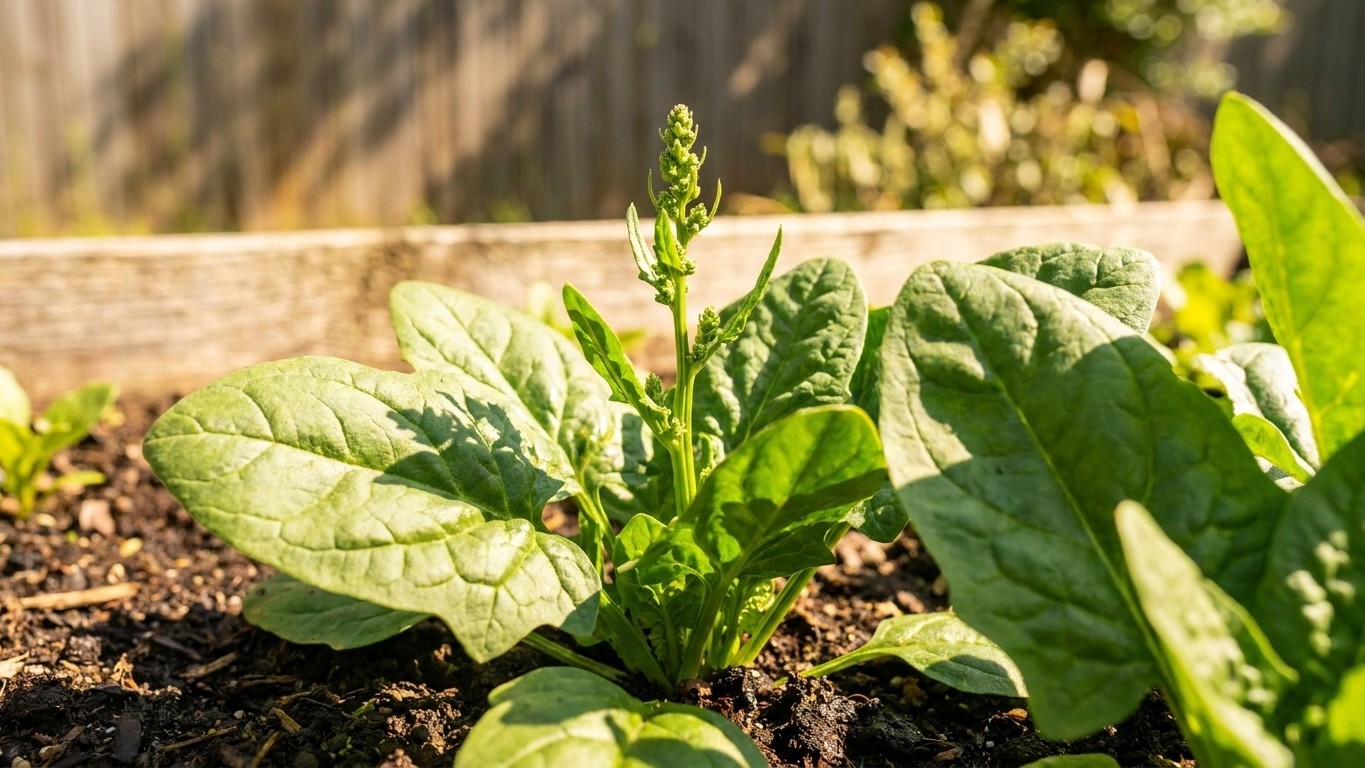

In Tennessee, cut spinach in two windows. The spring window runs from a mid-March sowing until daytime highs start passing 75 F. The fall window runs from a late-summer sowing to a harvest before the first freeze. Once cut, the leaves are a short-lived crop. Even in ideal cold storage they hold good quality for no more than two weeks, and in the door of an ordinary refrigerator they start yellowing within days. For the full growing picture, see Growing Spinach in Tennessee.
The short answer
Nashville’s longest day delivers 14 h 28 of daylight, and for spinach that number matters more than any thermometer reading. Long days alone push spinach to flower, no heat wave required. Warmth adds to the push, and the two together end the harvest. The figure is calculated from the latitude of the reference city using the standard sunset formula, and it leaves out roughly seven minutes of extra daylight from atmospheric refraction.
That is why a cool summer does not buy extra weeks here. A gardener on the Cumberland Plateau or in East Tennessee, where spring runs cooler and later than in Nashville, gets a later start, but the length of the day does not shrink with elevation. By late spring the days are stretching toward that 14 h 28 peak, and the plant reads the calendar of light whatever the air is doing. If you want the longer treatment of early flowering, Will Spinach Bolt Early in Tennessee? covers it.
Day length and heat both set the limit
In Tennessee the limit is both. Day length sets a ceiling that no shade cloth or good soil can raise. Heat sets a second one. Utah State University Extension puts the best growing conditions at temperatures that do not exceed 75 F, and that same number is where the leaves start turning bitter. One figure, two consequences: growth slows and flavor sours at the same point.
Nashville averages 40 days a year at 90 F or higher. That is the measure of summer heat load, and it explains why spinach fails here as a summer crop even when the foliage looks healthy in June. The 75 F ceiling is a temperature, never a calendar date. It shows up earlier in a warm spring and later in a cool one, and no table can promise the day.
How long cut leaves keep
The UC Davis Postharvest Technology Center states that the best storage temperature is 32 F with 95 to 98 percent relative humidity. Its spinach fact sheet adds that spinach is highly perishable and will not maintain good quality for more than 2 weeks. Wilting, yellowing and decay increase after 10 to 14 days. At 41 to 50 F, the range common in distribution and in a home fridge door, the decline comes faster.
Treat two weeks as a ceiling, not a plan. In a home refrigerator the coldest, most stable spot is the back of the bottom shelf, not the door, which swings through every temperature the kitchen has. Put the leaves there, in a container that holds humidity without sealing in water, and use them well inside the limit.
How long the spring window really is
Spring spinach is a counting exercise, and the count here is short. Four steps get you from frost dates to a realistic cutting period.
- Start with the last freeze. NOAA NCEI’s 1991-2020 normals for the Nashville station put the last spring freeze between March 31 and April 12, using the 30 to 70 percent probability band. That is a range of likelihood, not a guarantee.
- Back up two to three weeks to sow. Three weeks before March 31 is March 10. Two weeks before April 12 is March 29. So the sowing window runs from about March 10 to March 29, and it is itself only about three weeks wide. East Tennessee and the Cumberland Plateau run later in spring than Nashville, so shift your own dates forward there.
- Let the thermometer close the window. Growth stops being good above 75 F. Utah State University Extension gives no date for that, and neither do the climate normals used here, so no date appears in this article. Watch your own forecast for the first run of highs above that mark.
- Watch the light as well. Days keep lengthening through April and May toward 14 h 28. Even if a cool snap holds the highs down, the day length keeps pushing the plant toward a seed stalk.
So how many usable weeks does that leave? The honest count is the gap between a mid-March sowing and the first stretch of highs above 75 F, and that gap is measured in weeks, not months. The source publishes no days-to-maturity for spinach, so I will not put a number on the growing time in between. What the frost dates and the heat load do show is that the front end of the window is the only part you control. Sow at the earliest date the soil can be worked and the plants get every cool week available.
Which variety to sow
Utah State University Extension names four varieties: Bloomsdale, Melody, Teton and Olympia. It publishes no data about any of them, nothing on bolting resistance, maturity or leaf type, and I will not guess. If a seed packet claims a bolting advantage, read it as the packet’s claim, not a published comparison. Pests also compete for that short spring crop, and What Eats Spinach in Tennessee, and When lays out the timing.
The autumn crop, and when the soil lets you sow
The fall crop is the more forgiving one, since days shorten and air cools after the solstice. Two obstacles stand in the way, and neither of them is cold.
The soil is still too warm to germinate
Seed germination is reduced when the soil is above 80 F. In Tennessee, where Nashville sees 40 days a year at 90 F or higher, the ground holds its summer heat long after the calendar suggests autumn. A seed sown into hot soil may sit, sprout poorly or not sprout at all. It is the soil, not the air, that blocks an early sowing.
In a hot region the window opens when the soil falls below 80 F, not when a date on the calendar says so. A soil thermometer settles it better than guessing. Shading the bed and keeping it moist helps cool the surface before sowing, though neither will rescue a bed that is far above the threshold. The only authority for the 80 F figure used here is Utah State University Extension, and it gives no regional dates.
The frost that ends the season
The other obstacle sits at the far end. NOAA NCEI’s 1991-2020 normals for the Nashville station put the first fall freeze between October 28 and November 8, again using the 30 to 70 percent probability band. The source says to plant 50 to 75 days before the date you want to harvest, so count backward from a realistic harvest.
Aim to finish cutting by the early edge, October 28. Fifty days back is September 8, and 75 days back is August 14. Aim for the late edge, November 8, and the same count lands on September 19 and August 25. Taken together, the arithmetic spans August 14 to September 19. The early half of that range falls in the stretch when the soil is most likely still too warm, so the soil decides how much of it you can use. The later half is where most Tennessee gardeners will find the workable dates.
These are Nashville numbers. East Tennessee and the Cumberland Plateau run cooler than the reference station, so treat the count above as a method and rerun it with the frost dates for your own county. The source publishes no days-to-maturity for spinach, so the 50 to 75 days is a planting guideline, not a promise of what a given variety does in your bed.
Common questions
Can I still cut spinach once it starts to bolt?
You can cut what is there, but the plant is finished. Heat above 75 F is also the bitterness threshold, so leaves from a bolting plant in warm weather tend to taste sharp. Cut what you plan to eat soon and pull the rest.
How long does cut spinach last in the refrigerator?
UC Davis says it will not maintain good quality for more than 2 weeks, and only at 32 F. At 41 to 50 F, the range of a typical refrigerator door, it deteriorates faster. Store it at the back of the bottom shelf and eat it early, not at the two-week mark.
Which spinach variety holds out longest in Tennessee heat?
The published source names Bloomsdale, Melody, Teton and Olympia and gives no data about any of them, so that comparison is not available here. Day length also triggers flowering whatever the variety, which makes timing the more reliable lever.
Do the frost dates change in East Tennessee or on the Cumberland Plateau?
The dates above come from the Nashville station. East Tennessee and the Cumberland Plateau run cooler and later in spring, so your sowing window shifts later too. The figure for those areas is not published here, so use your own county’s frost dates and apply the same counting method.