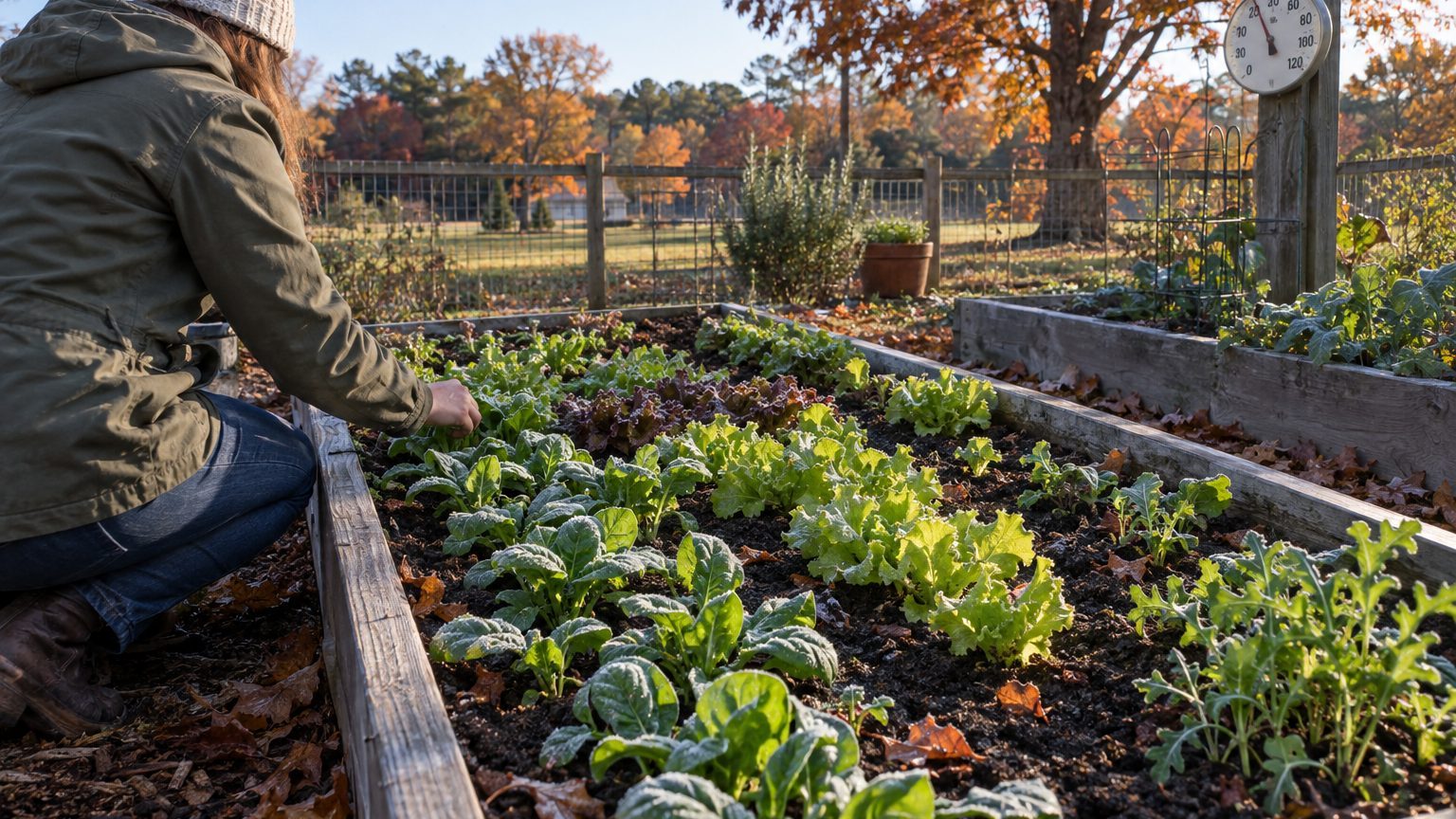

Sow winter salads in Mississippi from late September through mid-October, with a second, shorter window in late winter once the last freeze is near. Both windows hang on two frost ranges from NOAA’s 1991-2020 normals: March 6 to March 22 in spring and November 7 to November 22 in fall. Your own yard almost certainly runs a little different, and the sections below show which way.
The short answer for Mississippi
The fall window runs from late September to mid-October. It is anchored on a first fall frost range of November 7 to November 22. These are not the dates frost always arrives. NOAA’s figures mark the stretch when the chance of a 32°F freeze at the reference station sits between 30 and 70 percent. Before the range starts, a freeze is unlikely. After it ends, a freeze is more likely than not. The spring range, March 6 to March 22, works the same way in reverse, as the odds of a freeze fall away.
| What | Reference-city figure | What it is a probability of |
|---|---|---|
| Last spring frost | March 6 to March 22 | 30 to 70 percent chance of a 32°F freeze |
| First fall frost | November 7 to November 22 | 30 to 70 percent chance of a 32°F freeze |
| Coldest month, average daily low | 36.6°F (Jackson reference station) | An average, not a record or an extreme |
| Hardiness zone | 7b to 9a (USDA system) | Average annual extreme minimum, statewide range |
The fall window
The late September to mid-October dates come from a simple rule of thumb, mine rather than NOAA’s. Count back about six weeks from the frost range. Six weeks before November 7 lands in the last days of September, and six weeks before November 22 lands around October 11. That gives lettuce, spinach, arugula and mustard greens time to reach a harvestable size before short days slow everything down. Today is October 5, so the window is open right now.
The late-winter window
The second window opens around the spring range. Cold-tolerant greens germinate in cool soil, and a seedling just up can take a light freeze that would flatten a tomato transplant. Sowing in the weeks around March 6 to March 22 gives you a short spring cut. It is short because Mississippi warms quickly after that.
Every date here is a reference-city figure, not a statewide guarantee. Suburban and rural gardens usually see the last spring frost later and the first fall frost earlier, often by one to two weeks, and more at elevation. For which salad crops belong in these windows, see The Best Winter Salads for Mississippi. The wider overview lives at Winter Salads for Mississippi Gardens.
What will not work here
The gap between a March last freeze and a November first one is roughly eight months. That long frost-free stretch is the trap. It tempts gardeners to think there is plenty of time, and most failures in this state come from sowing at the wrong end of it.
Sowing too early
Lettuce sown in August or early September goes into soil that is still summer-warm. Germination turns patchy, and the seedlings that do come up are the ones most likely to turn bitter or send up a flower stalk before you get a decent salad. A first frost that may not arrive until the second half of November gives no reason to hurry. Waiting until the soil cools is not a delay. It is the whole point of the calendar.
Sowing too late
The opposite mistake is just as common. Seed scattered after the November 7 to November 22 range germinates slowly, and the seedlings stall through the shortest days of December and January. The coldest month’s average low of 36.6°F is mild enough that a stalled seedling survives, so the bed looks fine. It just produces nothing until the days lengthen. Winter growth here is limited by daylight as much as by cold.
That 36.6°F is an average of daily lows, not the coldest night you will get. Individual nights drop below it, and an unprotected tender lettuce can be damaged on one of them. Hardy greens shrug off the same night. Row cover is cheap insurance for the rest.
Close spacing in a humid climate
Mississippi winters are mild and damp, so leaves stay wet for long stretches. Plants spaced tight for a cut-and-come-again look invite fungal disease, because air cannot move through the canopy. Give heads and leafy rows the spacing on the seed packet, water in the morning if you water at all, and consider raised beds if your soil is heavy clay that sits soggy after winter rain.
One more trap is treating a single date as a statewide deadline. Plenty of gardeners read “November 22” and assume they have until then. At the airport, maybe. In a rural yard a week or two north of the reference city, that date may already be behind you.
What changes across Mississippi
The state sits in USDA hardiness zones 7b to 9a. That is a spread of four half-zone steps inside one set of borders, so there is no single answer for “Mississippi.” The USDA system is built on one variable, the average annual extreme minimum temperature. It says whether a plant survives the coldest night of a typical year. It does not say when to sow.
The practical shifts run like this:
- Northern and higher-elevation gardens sit toward the colder end. Aim for the early part of the sowing window, late September, and expect the spring range to land later than March 6 to March 22.
- Central gardens are closest to the reference-city figures on this page, though suburban and rural plots still run one to two weeks off the airport numbers.
- Gardens toward the Gulf sit at the milder end. Winter growth is steadier, and the later part of the window has more room. The trouble there shifts toward fall and spring warmth, which can push bolting.
These are directions, not prescriptions. Where your garden falls depends on your slope, your soil and your distance from open water or pavement. Look up your own zone on the USDA Plant Hardiness Zone Map using your ZIP code, and do not assume the range given here applies to you. A dated recommendation should rest on one place, which is why this page uses the reference city rather than the full 7b to 9a spread.
Where to check this for your own county
Your state extension service is the next stop. Mississippi State University Extension runs the land-grant network for the state, with county offices staffed by people who know local soil and weather. This page does not cite a Mississippi extension planting calendar for winter salads, so the county source is where to find one.
What to look for
Two things matter most. The first is the local planting calendar for fall and winter vegetables, ideally one that names leafy greens and gives sowing dates for your part of the state. The second is the list of varieties trialed in your county. A lettuce that performs well in a trial plot a few counties away has been tested against the conditions you actually garden in. That counts for more than a catalog description.
If you call or visit the county office, ask three direct questions. What is the typical last freeze date for the county, as opposed to the nearest airport? Which fall greens do best without cover? And which varieties have held up through a wet winter here?
A county recommendation beats a state one, plainly. This page is the state one: it rests on a reference city’s frost probabilities and a rule of thumb for counting back from them. It will get you into the right month. The county office can get you to the right week.
Checking this against your own garden
Your own observations outrank every date above. The soil and the plants will tell you what the airport cannot, and none of it needs equipment.
Soil warmth by feel. In early morning, push your hand into a bed and hold it there. Soil that feels cool and slightly damp, not warm like a summer afternoon, is ready for lettuce seed. If one bed feels warmer than another, you have found a microclimate: usually a south-facing wall, a paved edge or a sheltered corner. Sow the cold-sensitive crops there.
The first true leaves. Seedlings first show two rounded seed leaves, then the first pair that look like the real plant. How long that takes in your bed tells you how fast things grow in your light and soil. If true leaves arrive within a couple of weeks, you sowed on time. If they stall for a month, you sowed late or the spot gets too little sun.
The first blackened tender plant. Watch basil, tomato leaves and squash vines. The first time one turns black overnight, that is your frost date, for your yard. Compare it with the November 7 to November 22 range. If your plants blackened earlier, you are in a cold pocket, probably low ground where cold air settles, and next fall’s sowing should start sooner. Keep a note of the date. After two or three seasons you will have a calendar no statewide table can match.
Common questions
Can I still sow winter salads in early October?
Yes. Early October falls inside the late September to mid-October window that comes from counting back about six weeks from the November 7 to November 22 frost range. Choose cold-tolerant greens and sow soon.
What is the last safe date to sow in fall?
This page does not have a sourced cutoff date. What it does have is the first fall frost range of November 7 to November 22 at the reference city. Seed sown after that range germinates slowly and grows little through the shortest days, so earlier is better.
Will a Mississippi winter kill my salad greens?
The coldest month’s average daily low is 36.6°F at the Jackson reference station, which is mild. Averages hide colder nights, though. Hardy greens usually tolerate a light freeze, and tender lettuce does better under row cover.
Is November 7 to November 22 the frost date for my yard?
Probably not exactly. The range is a reference-city figure based on 32°F freeze probabilities. Suburban and rural gardens typically see the first fall frost one to two weeks earlier, and elevation adds more. Check your county through your extension office.