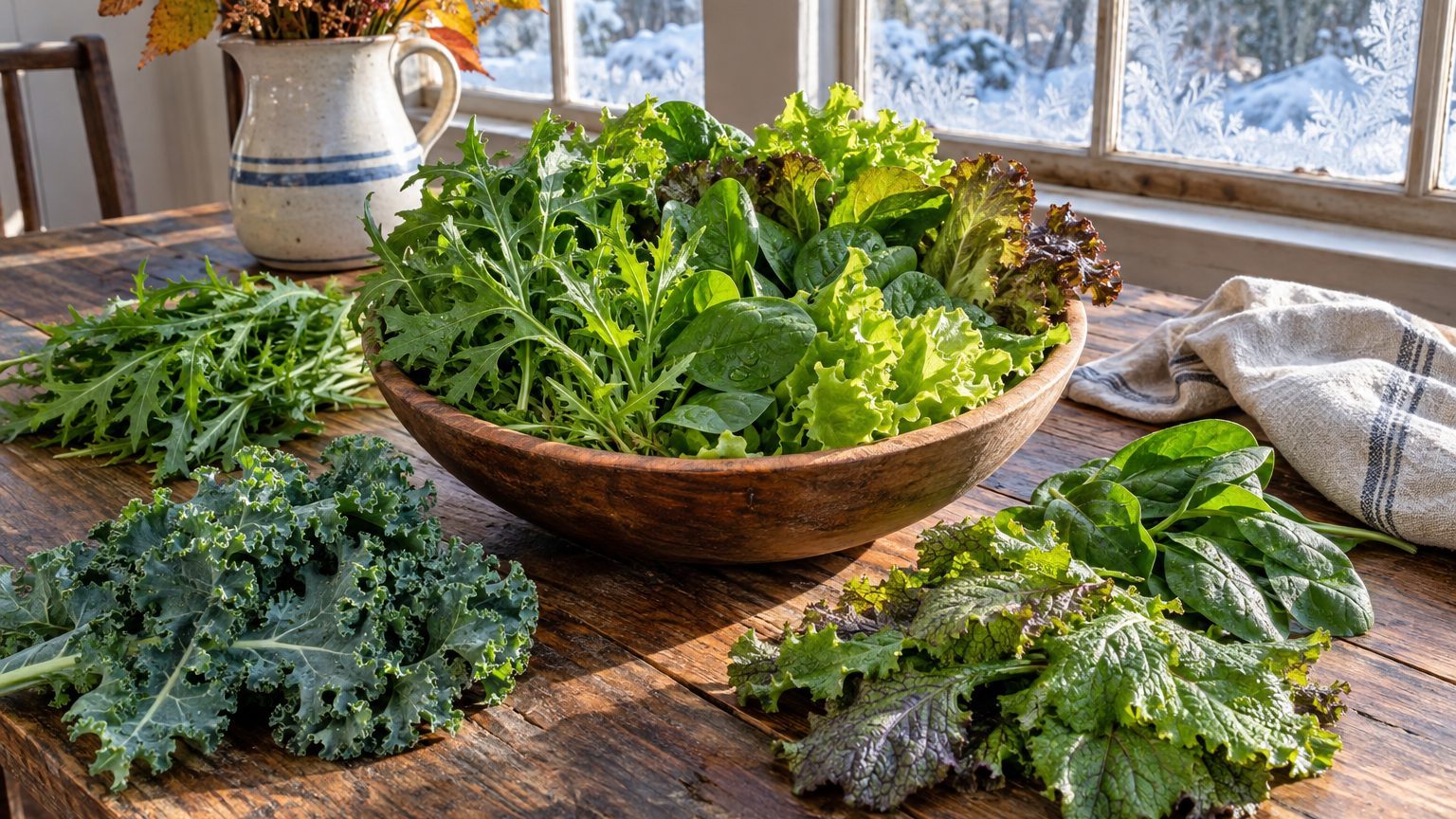

For most Missouri gardens, the best winter salads are the cold-hardy leaves: spinach, mâche, claytonia, tatsoi, mizuna and kale, with arugula and loose-leaf lettuce as quick fillers under cover. Tender head lettuce is a poor bet outdoors. At the Kansas City International station, fall frost arrives between October 18 and October 29, so the real question is which crops reach harvest size before then and which can sit through January.
The short answer for Missouri
Start with what the numbers say. Kansas City’s coldest month has a mean daily minimum of 19.5°F (NOAA 1991-2020 Climate Normals). That is an average night, not a record low, and it sits well below freezing. Any salad crop you leave uncovered has to take a hard freeze as routine, not as a rare event. The frost dates frame the season on both ends. First fall frost falls between October 18 and October 29, and last spring frost between April 6 and April 20. Both are NOAA NCEI figures for the 32°F freeze, taken from the 30-70% probability band. They are not deadlines. They mark the stretch of dates when the odds of a freeze are somewhere between a one-in-three and a two-in-three chance.
This page has no summer heat figure for Missouri, so the advice below rests on frost dates and winter cold, not on how hot August gets. Decide by type:
- Hardiest, fine outdoors with light cover: spinach, mâche (corn salad), claytonia, kale.
- Hardy but happier with cover: tatsoi, mizuna, other Asian mustards, chicories such as radicchio and escarole.
- Cover required for steady harvests: loose-leaf and small winter-type lettuces, arugula.
- Skip for winter: butterhead, large romaine and other summer-type lettuces.
A quick comparison helps when you are choosing seed:
| Type | Cold tolerance | Speed to first pick | Best use in Missouri |
|---|---|---|---|
| Spinach | High | Moderate | Core crop, outdoors or under cover |
| Mâche and claytonia | High | Slow | Reliable January greens, small leaves |
| Kale | High | Moderate | Baby leaves for salad, mature plants for cooking |
| Tatsoi and mizuna | Good | Fast | Quick fall harvest, then protect |
| Chicories | Good | Slow | Bitter, sturdy, good in a cold frame |
| Loose-leaf lettuce, arugula | Moderate | Fast | Cold frame or low tunnel only |
The ratings are comparative, not measured for Missouri. For the sowing side of the story, see When to Sow Winter Salads in Missouri. The broader overview lives at Winter Salads for Missouri Gardens.
What will not work here
Start with the 19.5°F figure. If the average January night is that cold, plenty of nights are colder. Tender lettuces such as butterhead and big romaine, left in an open bed, tend to turn to translucent mush after repeated hard freezes. A bed of them looks great in October and is gone by Christmas. Growers who plant them in late September and expect salad through winter are working against the climate, not against bad luck.
Timing is the second failure. Today is October 5, and the frost window opens in about two weeks. A seed sown now will be a seedling, not a plant, when the first freeze arrives. The slower hardy crops, mâche and claytonia among them, grow tiny leaves for weeks before they size up. In a short window, they need to be well along before the cold slows everything. Sowing them late means waiting until spring for much of a harvest. Faster crops like tatsoi, mizuna and arugula have a better chance of getting a pick in before things stall.
Third, trusting a frost date as a promise. The April 6 to April 20 and October 18 to October 29 windows are probability bands, not guarantees. Even after the later date in the fall window, a freeze is not certain. Before the earlier one, it is still possible. The dates also come from the Kansas City International station, which sits well north of the city. The downtown station runs about five days earlier in spring, and southern Missouri is milder still. A gardener in the Bootheel who copies a Kansas City sowing date is borrowing the wrong calendar.
Fourth, a sealed cold frame. Covering salad greens solves the cold problem and can create a moisture one. A closed frame on a mild, damp day holds humidity, and crowded leaves stay wet. Vent it when daytime temperatures rise, and thin seedlings so air moves between plants. I would rather see a gardener lose a week of growth than a whole tray to rot.
Finally, zone numbers are a poor guide to winter salads. The USDA hardiness zone system is built on one variable, the average annual extreme minimum temperature. A salad green faces something different: weeks of freezing nights, wind, wet and short days. A plant rated for a colder zone is not automatically a better winter salad, and a milder zone does not guarantee success with tender lettuce.
What changes across Missouri
Missouri does not have one winter. The USDA Plant Hardiness Zone Map (2023, built on 1991-2020 normals) places the state in zones 5b through 7b. That spans two full zones, which means roughly 20°F of difference in average annual extreme minimum between the coldest and mildest parts of the state. There is no single answer for the state, and any page claiming one is smoothing over the facts. The Kansas City numbers above are a reference point, not a verdict on everywhere else.
In the north, expect colder winters, an earlier first fall frost and a later last spring frost than the Kansas City figures suggest. Hardy types such as spinach, mâche, claytonia and kale are the sensible core. Lean harder on cover, whether a cold frame, a low tunnel or a layer of row cover over the bed. Plan to sow earlier in fall, because the growing window before the freeze closes sooner. Fast crops like arugula and mizuna still have a place, but treat them as a bonus, not the backbone.
In the south, the same crops get a longer season. This page does not have a southern Missouri frost date, only the caution that it is milder than Kansas City. That mildness lets chicories and some lettuces last longer outdoors, with less need for cover. It also means salad crops may bolt earlier in spring, so succession sowing matters more.
Elevation and terrain matter inside every zone. A garden on a ridge, in a river bottom or beside a south-facing wall can behave like a different zone from a yard a mile away. The USDA map shows your zone at a fine scale, and that is where to confirm it. I will not guess which zone you are in. Look at the map, find your location, and use it to nudge the advice here earlier or later.
Where to check this for your own county
This page gives the state view, built on a Kansas City reference station and a statewide zone range. For your own county, go to University of Missouri Extension. County offices there know the local soils, the local frost pockets and what has actually grown in your area.
Look for two things. The first is a local planting calendar for fall and winter vegetables, which will list sowing windows tied to your region rather than to the Kansas City airport. The second is variety trial results. Extension and university trials show which spinach, lettuce, kale and mustard varieties have been grown side by side in Missouri conditions. A trial result from your part of the state is worth more than any ranking a website can offer.
The county office is also a person to call. Staff and local Master Gardener volunteers can say whether your town sits in a cold hollow or on a warmer rise, and which crops have failed there before. I would take that advice over any state-level page, this one included. A county recommendation beats a state one, because it is based on conditions closer to your garden. This page is the state one.
Checking this against your own garden
Dates on a screen are averages. Your garden is one specific place, and it will tell you more if you watch it. Three observations need no gear at all.
Soil warmth by feel. In early fall, push your hand into the bed in the morning. If the soil still feels warm, lettuce and spinach seed may germinate poorly. Wait for it to feel cool, or shade the bed for a few days. Soil that cools fast is a sign of a cooler microclimate, and it will usually be a good spot for hardy greens.
The first true leaves. Seedlings first show seed leaves, then true leaves. Note how many days that takes after sowing. If your seedlings reach that stage with plenty of time before frost, you have room to expand your sowings. If they are slow, your garden is cooler or shadier than the average, and you should sow earlier next year.
Where frost lands first. On the first frosty morning, walk the yard. Note which beds are white and which stay green. Low spots, open ground and areas away from walls freeze first. A bed beside the house may stay unfrosted for days after the lawn has turned crisp. That bed is where your tenderest salad crops belong.
Keep a few notes from this year. After one winter, your own observations will beat any date printed here.
Common questions
Can I grow winter salads in Missouri without any cover?
Some of them, yes. Spinach, mâche, claytonia and kale are the most likely to come through in an open bed. With a January mean minimum of 19.5°F in Kansas City, though, even hardy crops grow slowly or stop. A light row cover gives you a better chance of picking in midwinter. Tender lettuces need a frame or tunnel.
Is it too late to sow in early October?
For crops that need weeks to size up, it is late, because the first fall frost window of October 18 to October 29 is close. Faster crops such as tatsoi, mizuna and arugula can still make a harvest, especially under cover. Slower types may overwinter as small plants and grow in spring. The sowing calendar has the timing in more detail.
Do the frost dates on this page apply to my town?
Treat them as a starting point only. They come from the Kansas City International station, which sits well north of the city. Downtown runs about five days earlier in spring, and southern Missouri is milder still. Your county extension office can give a closer date.
Does my hardiness zone tell me which salad to plant?
It helps, but not on its own. The USDA zone is based on the average annual extreme minimum temperature, and Missouri spans 5b to 7b. Salad success also depends on frost timing, wind, moisture and the microclimate of your own beds. Use the zone as one input and your own observations as another.