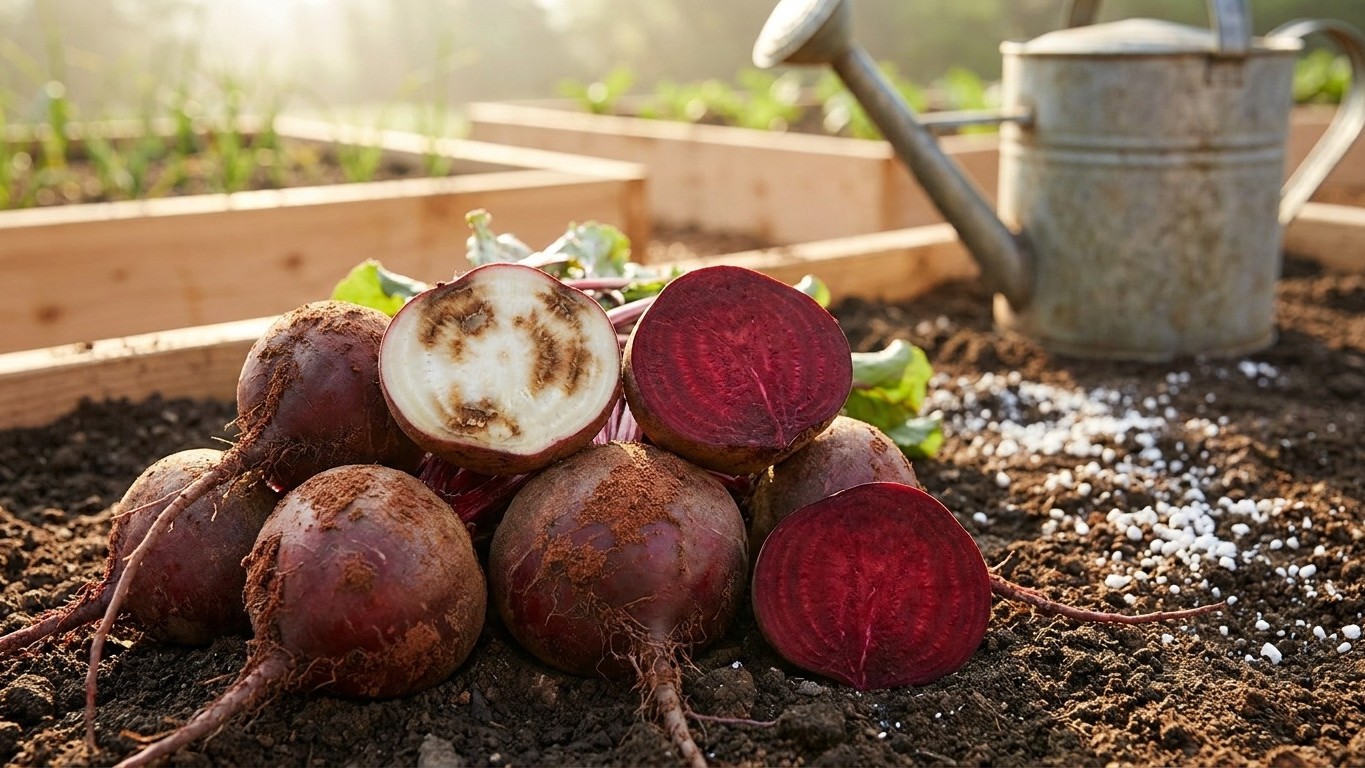

Three things take most of a New Jersey beet crop, and they arrive at different times. Thirst in the first six weeks after seeding pushes plants to flower instead of fattening the root. Heat above 85 F combined with water stress, later on, turns the root woody. After harvest, storage that is too cold invites black spot and rot. All three can be planned around.
The short answer
What the state’s soil does to a beet
USDA lists the Downer series as the representative soil of New Jersey. It is an Ultisol, an old, heavily weathered and leached soil that is naturally acid and low in nutrients. The surface layer averages 79 percent sand, 6 percent clay and 15 percent silt, with about 1.2 percent organic matter and a pH around 6.3, which is slightly acid. It is well drained. Those are representative values for the surface horizon of the major components of the series as mapped (USDA NRCS Soil Data Access), not a measurement of anyone’s garden bed.
That distinction matters. A state spans hundreds of soil series, and river bottoms, hill country and any lot a builder has scraped or filled can look nothing like Downer. Treat it as a starting point for what the region’s ground tends to do. Your own number comes from a soil test, and the 6.3 is not your pH.
Utah State University Extension says beets want deep, sandy, well-drained soil rich in organic matter. Downer meets the first three and misses the last. Sand with only 6 percent clay has little to hold water, so a seedbed that looks fine on Monday can be dry by the weekend. Organic matter near 1.2 percent gives it almost no cushion. The same Extension guidance caps amendment at no more than 1 inch of composted organic matter per 100 sq ft. More is not better. For what the root will actually meet underground, see Beet Soil in New Jersey: What the Root Will Meet.
Heat and the woody root
Woodiness is a different problem from bolting. According to the same Extension source, heat above 85 F together with water stress makes the root woody. I would love to hand you the number of days a year the reference city passes 90 F, but that figure is not published here, and I won’t guess at it. Your nearest station’s climate normals will carry it. What the facts do support is the pairing: heat alone is not the whole story, and a sandy bed that sheds water makes the stress half of the pair the one most likely to catch you out. A beet that sizes up on schedule and gets pulled within its 60 to 80 days from seeding usually misses the worst of it.
The six weeks that decide it here
Where the sowing window lands
Beets are sown in place, so the clock starts at seeding, never at a transplant. The usual advice is to sow 2 to 3 weeks before the last spring frost. At the reference airport station, the last frost falls between March 29 and April 6 (NOAA NCEI U.S. Climate Normals 1991-2020, 32 F freeze probabilities, 30 to 70 percent band). Counting back puts sowing at roughly March 8 to March 23, and the first six weeks of growth at roughly April 19 to May 4.
Those dates come from one airport. Suburban and rural gardens typically see the last frost one to two weeks later, and more at elevation, so check your own county before you trust the calendar. The full sowing logic is in When to Sow Beets in New Jersey.
Where bolting risk sits
Early spring in New Jersey rarely settles into one pattern. A soggy week can give way to a warm, breezy, dry one, and then to another cold snap. Plants sown in the March window spend the whole of that swing in their first six weeks, which is exactly the stretch when water stress causes premature flowering.
On sand, the risk is the dry stretch. A wet March does not protect a bed that is bone dry by late April, because the soil gives up its water so quickly. The gap between rains matters more than the rainfall total. That is why I would check seedbed moisture by hand, a few inches down, rather than by the look of the leaves. By the time leaves wilt, the stress has already happened.
Once a beet bolts, the plant has put its effort into a flower stalk, and there is nothing to rescue. So the first six weeks are the ones to protect with a watering schedule that does not wait for a drought forecast. The wider picture of the crop is in Growing Beets in New Jersey.
What goes wrong here
This page carries no sourced data on insect pests, so it names none. Your county extension office is the place to ask about those. The failures below are the ones this soil and climate cause, split into the garden and the cellar.
In the bed
- Bolting from early thirst. Sandy ground with 6 percent clay dries fast, and water stress in the first 6 weeks causes premature flowering. Remedy: keep the seedbed evenly moist from seeding through those six weeks, and check moisture below the surface after every dry spell.
- Woody roots from later heat. Heat above 85 F with water stress makes the root woody. This is a separate failure from bolting, with a separate window. Remedy: water through warm spells and pull roots within the 60 to 80 days from seeding rather than leaving them to sit.
- Thin, low-nutrient ground. An Ultisol is naturally low in nutrients, and organic matter around 1.2 percent leaves little in reserve. Remedy: test your own soil first, then add composted organic matter at no more than 1 inch per 100 sq ft.
In storage
- Storing too cold. Colder is not better here, which runs against what most root crops want. USDA Handbook 66 says storage at 32 to 34 F produces more black spot and rot than a little warmer. Topped roots belong at 33 to 36 F and 98 percent humidity. In a pit or cellar, stay between 31 F and 41 F.
- Leaving the tops on. Bunched beets with leaves keep about 10 to 14 days at 32 F and above 98 percent humidity, and no longer. Remedy: top them first if you want to keep them past two weeks.
- Storing the small roots. Small roots lose water and shrivel faster than large ones. Remedy: keep the big roots for storage and eat the small ones first.
Common questions
Do New Jersey beets need compost?
Probably, if your ground resembles the state soil. Downer’s surface runs about 1.2 percent organic matter, while beets want soil rich in it. Utah State University Extension caps the amendment at no more than 1 inch of composted organic matter per 100 sq ft. A soil test tells you where your own bed starts.
Is the Downer soil what I have in my garden?
Maybe, maybe not. It is the series USDA lists as representative of the state, and a state spans hundreds of series. The 79 percent sand and pH of about 6.3 describe the mapped surface layer, not your bed. Disturbed or filled ground can differ completely.
How long from seed to harvest?
Plan on 60 to 80 days counted from seeding. Beets are sown in place, so there is no transplant date to count from. A March sowing at the reference city’s dates puts harvest from roughly early May into mid-June.
How cold should I store beets?
Topped roots do best at 33 to 36 F and 98 percent humidity. The handbook warns that 32 to 34 F brings more black spot and rot. Pick the largest roots for storage, since they lose water and shrivel more slowly than small ones, and eat the small ones first.