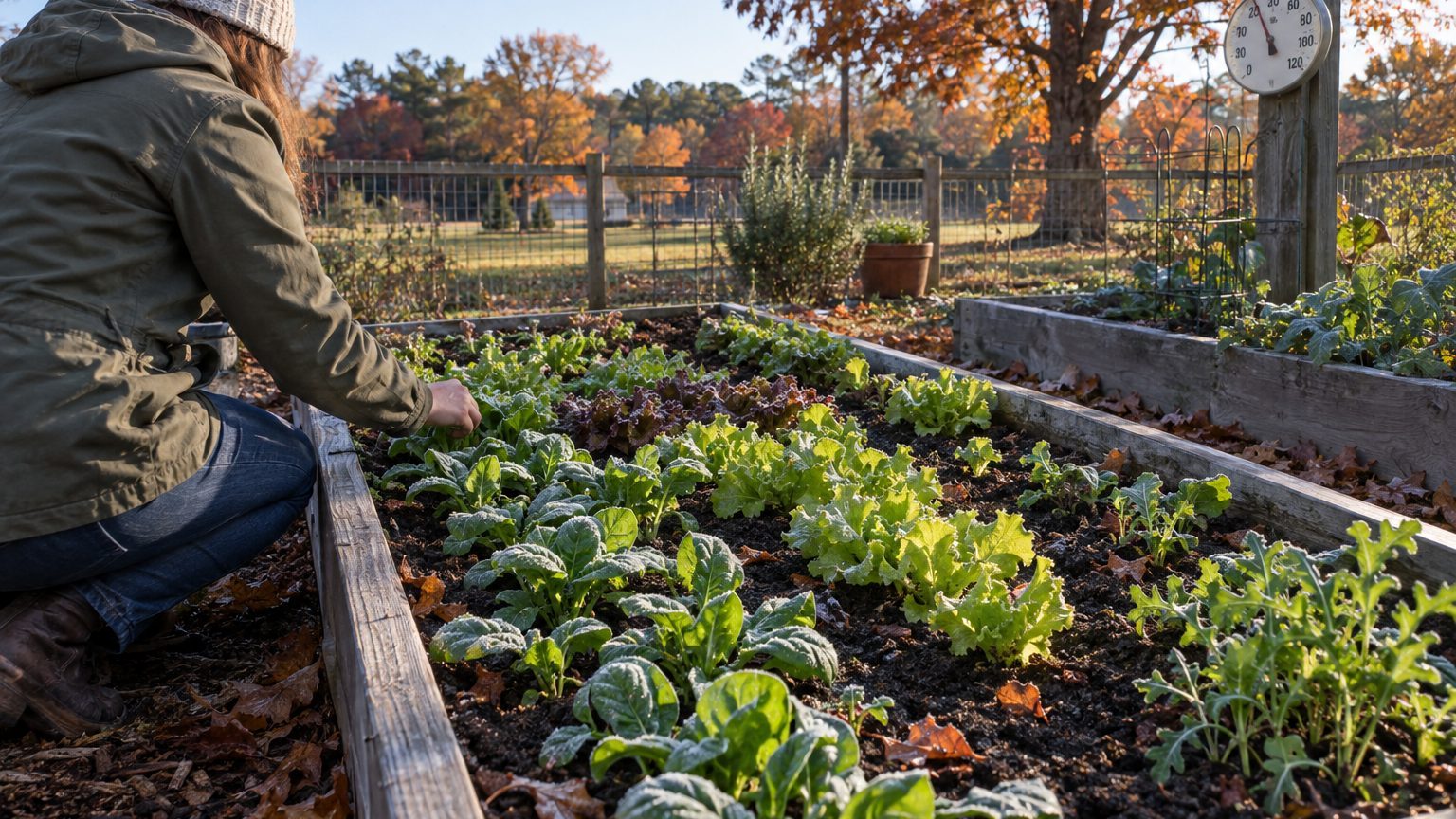

Start winter salads in early October and keep sowing through November in the Charleston area, ahead of a first fall freeze that typically arrives between November 20 and December 5. A second, smaller sowing in late winter fits before spring warmth turns lettuce bitter. Inland and upstate, shift everything earlier.
The short answer for South Carolina
Sow winter salads from early October through November, using Charleston as the reference point. Those dates come from NOAA’s 1991-2020 Climate Normals for the Charleston station (USW00013880), and they need careful reading. The first fall frost window, November 20 to December 5, is the 30 to 70 percent band of probability for a 32°F freeze. It is a probability of a freeze, not a promised date. Somewhere inside that band, the odds of having seen a freeze go from roughly one in three to better than two in three.
The spring end works the same way. The last spring frost band runs February 28 to March 17, again the 30 to 70 percent band for a 32°F freeze. Plan around the band, and treat any single date inside it as a coin flip.
The window opens when the soil cools enough for seed to germinate, and it closes when growth slows too much to reach a harvestable size before the dead of winter. Salad greens sown in October have weeks of mild weather to build roots and a few true leaves before the first freeze. Seed sown in late December sits nearly still for weeks. That is why the useful sowing window runs before the frost band, not inside it.
One more number explains why the Lowcountry is forgiving. The mean daily minimum of the coldest month at the Charleston reference is 38.9°F. The average coldest night in winter stays above freezing, which means many cold-tolerant greens keep growing through January and February with little or no cover. Averages hide the cold snaps, of course, and a hard freeze can still arrive.
| Measure (Charleston reference) | Value | What it is |
|---|---|---|
| Last spring frost | February 28 to March 17 | 30-70% probability band, 32°F freeze |
| First fall frost | November 20 to December 5 | 30-70% probability band, 32°F freeze |
| Coldest month, mean daily minimum | 38.9°F | Average night, not the record low |
For the full picture of how the crop fits the state, start with Winter Salads for South Carolina Gardens.
What will not work here
Waiting for the first frost to start sowing is the classic mistake. In much of the country that logic holds, because cold is the signal that the season has turned. Here, with the first fall freeze not expected until late November or early December at the reference station, a gardener who waits for that cue has lost most of the productive fall. Seed sown after the band gets short days and cold nights, and growth crawls.
Sowing too early fails too, in the opposite way. South Carolina autumns start hot, and lettuce seed pushed into warm ground in September germinates poorly or produces seedlings that stall and bolt. Starting in early October, once nights cool, avoids much of that. If you want to sow earlier, shade the bed and water the seed row, not the whole garden.
Humidity and tight spacing
Coastal and Piedmont air holds moisture well into winter, and that punishes crowded beds. Salad greens sown as thick as a seed packet allows will shade each other, stay damp after dew or rain, and invite rot, mildew and slugs. Thinning is not optional in this climate. Give heading types room, and cut baby leaves early so air moves through the bed.
Spring is a short runway
A late-winter sowing has to finish before warmth arrives, and the last frost band (February 28 to March 17) sits close to the end of the cool season. Sow in late February and you may be harvesting just as March warms. Long-season crops such as full heads of romaine or the slowest-maturing types run out of time. Fast cut-and-come-again mixes and radishes make the better late bet. The variety choices are covered in The Best Winter Salads for South Carolina.
Finally, a mild winter keeps pests alive. With a coldest-month average night of 38.9°F, aphids and slugs never fully shut down, and a bed left unwatched in January can be shredded. Check the undersides of leaves each time you harvest.
What changes across South Carolina
There is no single answer for the state. The USDA Plant Hardiness Zone Map (2023, built on 1991-2020 normals) places South Carolina in zones 7a to 9a. That is five half-zone steps, and each step is a 5°F difference in the average annual extreme minimum temperature. A gardener on the coast and a gardener near the mountains are working with very different winters.
The frost dates in this article come from a Charleston-area station, and that station matters. Peninsular Charleston is milder than the airport reading, so the downtown band runs later in fall and ends earlier in spring. Upstate South Carolina runs several weeks tighter at both ends: the first freeze comes sooner, the last one lingers longer. The page does not have a published band for those areas, so no exact upstate dates are given here.
What follows from that is directional, not numerical. In the Upstate and at elevation, start sowing earlier than the Charleston calendar suggests, because the autumn growing window closes sooner. Expect to rely on cold-hardy types such as kale, spinach, mache and arugula, and plan row cover or a cold frame for the hardest stretch of winter. The spring sowing moves later, since cold lingers. On the coast, the opposite applies: you can sow later in fall and push into the winter with fewer protections.
Zone alone is also a blunt tool. It measures the extreme minimum, not the length of the season, and a salad crop cares about both. To see where your own address falls, use the USDA Plant Hardiness Zone Map and enter your ZIP code. Do not guess from a neighbor’s garden, because a few miles and a few hundred feet of elevation can move the answer.
Where to check this for your own county
Your state extension service is the next stop. In South Carolina that is Clemson Cooperative Extension, listed in the USDA NIFA land-grant extension directory. A county office knows your soils, your frost pockets and what actually grew in nearby trials last year.
Look for two things. First, the local planting calendar for vegetables, which should give sowing windows for fall and late winter. Second, the varieties trialled in your county, because a lettuce that holds in the Pee Dee may bolt in the Upstate.
A caution about how Clemson organizes its material. The publications I could verify for this page are Clemson Home & Garden Information Center lawn calendars (HGIC 1215 through 1218), published one per turfgrass species, not one per state. They are lawn calendars, not salad calendars, and this page does not have a Clemson winter salad calendar to quote. The pattern is still useful: Clemson tends to publish by crop and species, so search for the specific vegetable or salad green you plan to grow and use the one that matches.
Say it plainly: a county recommendation beats a state one, and this page is the state one. It gives you the shape of the season and the logic behind it. The county agent can tell you whether your frost band runs closer to the coast’s or the mountains’.
Checking this against your own garden
Your own observations outrank every date on this page. Three habits will tell you more than any calendar, and none needs equipment.
- Soil warmth by feel. Push your hand into the bed in the morning. If it feels warm like a bath, lettuce seed will struggle. When it feels cool and pleasant, you are in the window. A bed that stays warm longer than a neighbor’s tells you your garden is sheltered or sunny.
- Time to first true leaves. After the round seed leaves come the first true leaves. If they appear quickly, your soil and light are doing their job. If they lag, you sowed late or the bed is cold and shaded.
- Where frost shows up first. On the first cold mornings, look for frost on the lawn, car roof or low corners. The spots that frost first are your cold pockets, and the spots that stay clear are where tender greens last longest.
Write down what you see, with dates, for a couple of seasons. That record will place your garden inside the band better than the band can.
Common questions
When is the best time to sow winter salads in South Carolina?
For the Charleston reference, early October through November, ahead of the November 20 to December 5 first-frost band. Upstate gardeners should start earlier.
Can I sow salad greens after the first frost?
You can, but growth is slow in short, cold days. Cold-hardy greens fare best, and expect small harvests until late winter.
What does the frost date actually mean?
It is a probability. The band is where the chance of a 32°F freeze falls between 30 and 70 percent, not a guaranteed date.
Do I need row cover on the coast?
Often not. The coldest-month mean daily minimum at the Charleston reference is 38.9°F, but a hard freeze can still arrive, so keep a cover on hand.