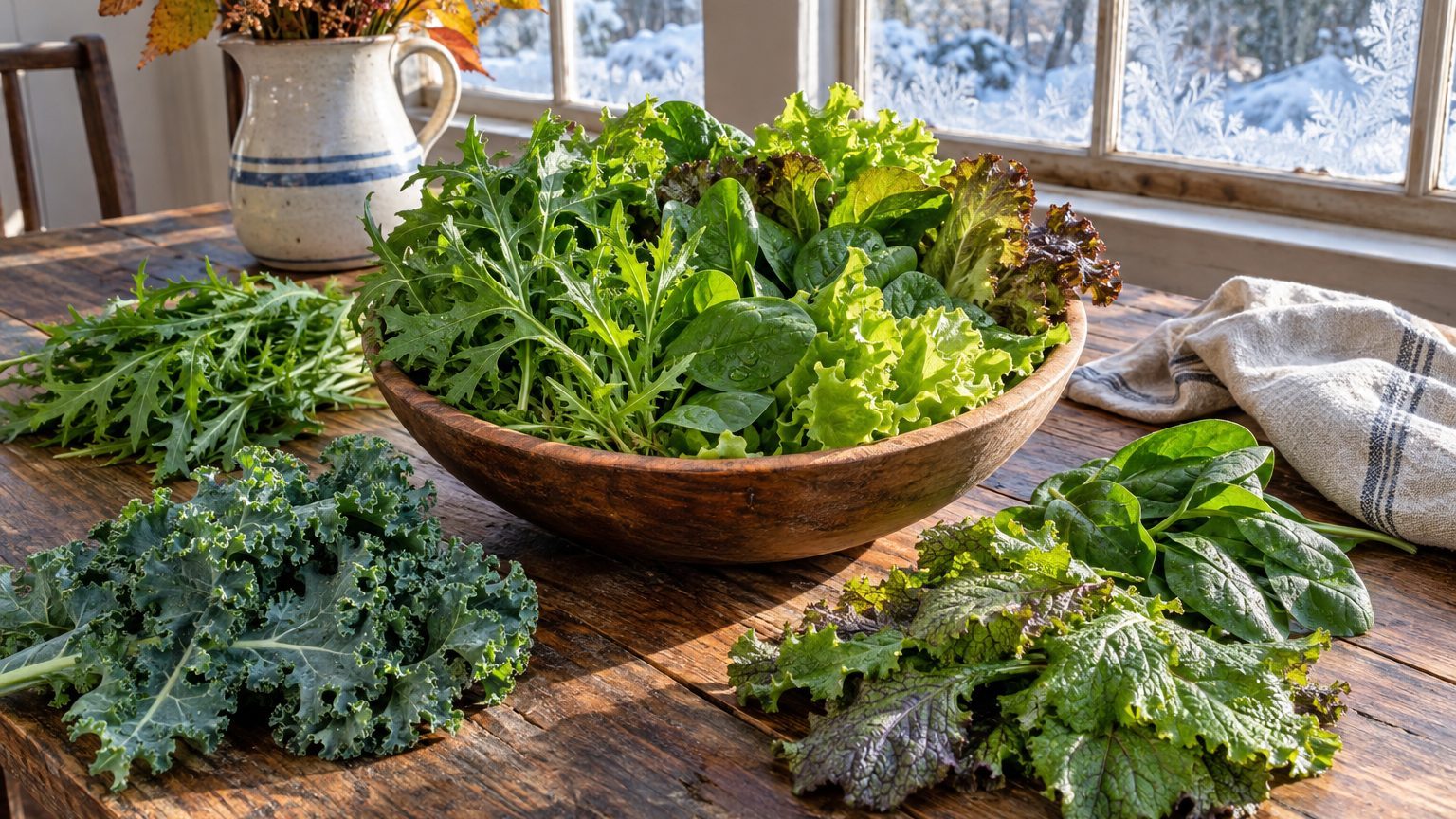

For western Washington, the best winter salads are the cold-tolerant leaf crops that cope with cold, wet soil and thin light: mâche, claytonia, spinach, kale, and the chicories. Tender summer lettuce is the weak link. East of the Cascades, the picture changes enough that this page can only give you a starting point.
The short answer for Washington
Choose by type: hardy, low-growing leaf greens first, bitter chicories second, and quick Asian mustards only for the mild months. The reference numbers here come from the Seattle station, so they describe western Washington and nowhere else. NOAA’s 1991-2020 Climate Normals put the last spring freeze (32°F) between February 27 and March 18, and the first fall freeze between November 13 and November 30. Those dates are the 30-70% probability band of a 32°F freeze, not promises. Some years a freeze lands outside them.
The coldest month there has a mean daily minimum of 37.1°F. That is the number that decides hardiness, and it is gentle. A typical winter night does not even reach freezing, so cold itself rarely kills a hardy salad green on the west side. Light and soggy soil are the real limits, which is why the winners are plants that keep growing slowly in dim, damp weather.
The decision by type
| Type | Examples | Why it fits western Washington | Main risk |
|---|---|---|---|
| Cold-season ground-huggers | Mâche (corn salad), claytonia (miner’s lettuce) | Tolerate low light and cool, wet conditions; claytonia is native to the Pacific Northwest | Slow growth, so pick small and often |
| Hardy leaf greens | Spinach, kale, arugula | Handle winter nights near 37°F with ease | Slugs and rot in soggy beds |
| Chicories | Radicchio, escarole, endive | Cool weather sweetens the leaves; they stand up to damp | Heads can rot if rain sits in them |
| Asian mustards | Mizuna, tatsoi | Fast and productive in the mild shoulder months | Hard freezes and the darkest weeks |
| Winter lettuce | Cold-hardy leaf and butterhead types | Workable under a cloche or low tunnel | Rot and weak growth in open, soggy ground |
If you can only grow three things, make them mâche, spinach, and kale. They cover a mild salad bowl, a cooked green, and a sturdy leaf for massaged salads. For the sowing dates that go with each type, see When to Sow Winter Salads in Washington, and for the bigger picture, the hub page Winter Salads for Washington Gardens.
What will not work here
A mild last-frost date tempts people to plant early in spring. Don’t. With a last freeze between February 27 and March 18, you might expect salads to leap out of the ground in February. They don’t. Cold, wet soil and low light hold spring crops back well past the last freeze, so seed sown on the strength of that date often sits, rots, or stalls. The frost date tells you about frost risk. It says almost nothing about when the soil is ready.
Slow crops started late fail for the opposite reason. The first fall freeze arrives between November 13 and November 30, but growth falls off long before that, because the days shorten and the light weakens. A winter salad sown in November is not going to size up. Whatever you want to harvest in December has to be established before the light fades, which is why a sowing calendar matters more here than a frost date.
Heading lettuce is the usual casualty. Full, tight heads of tender lettuce sit in cold rain and turn to slime from the outside in. Cold-hardy loose-leaf types fare better, and they do best with some cover overhead. Open beds with heavy clay are rougher still. Winter in this part of the state is wet more than it is cold, and a bed that drains slowly will lose more plants to rot than any 37°F night ever will.
Close spacing, a habit from summer, backfires in damp, still winter air. Crowded leaves stay wet for days, and gray mold and slugs move in. Give chicories and kale room, and thin mâche and claytonia rather than letting them carpet the bed solid. Slugs stay active through the mild winters, so a plan that ignores them loses seedlings in the first week.
And then there is the east side. Eastern Washington beyond the Cascades is high desert with a far shorter season, so the Seattle window cannot be applied statewide. A gardener there who copies the western freeze dates will plant into weather that kills the crop. This page does not carry frost dates for eastern stations, so it does not offer any. What it can say is that the failure mode flips: instead of rot from wet and gloom, the risk is hard cold that outlasts a mild-climate plan.
What changes across Washington
Washington is not one garden. The USDA Plant Hardiness Zone Map (2023 edition, built on 1991-2020 normals) runs from 4a to 9a across the state. That spread is huge: the zone number is based on one variable, the average annual extreme minimum temperature, and it covers everything from mild Puget Sound shorelines to cold interior and mountain country. There is no single answer for the whole state, only a spread.
Because of that range, the dates on this page belong to the reference city, Seattle. They are a fair guide for the mild, maritime west side. They are not a guide for a high valley, a mountain town, or the dry interior. In those places, winters bite harder and the growing season shrinks, and the hardy greens in the table above stop being a question of rot and start being a question of survival.
If you garden in the north, at altitude, or east of the Cascades, shift your plan in three ways. Favor the toughest types, especially spinach, kale, mâche, and claytonia, and drop the fussy ones. Count on cover, like a low tunnel or cold frame, to carry crops through the hard weeks instead of treating it as a bonus. And start earlier in fall, because your window to establish plants closes sooner than the Seattle dates suggest.
Which zone you are in is a question for the map, not for this page. Look up your own location on the USDA Plant Hardiness Zone Map and read the zone for your exact address or ZIP code. Neighbors a few miles apart, or a few hundred feet apart in elevation, can land in different zones.
Where to check this for your own county
The best next stop is Washington State University Extension, the state’s land-grant extension service. Its county offices exist to answer exactly this kind of question, and the staff and Master Gardener volunteers know the local soil, the local slugs, and the local weather in a way no statewide page can.
Once you are there, look for two things. The first is a local planting calendar for your county, which will give sowing windows that fit your conditions rather than Seattle’s. The second is a list of the varieties that have been trialed in your county. A variety that does well in a coastal county’s damp winters may sulk in a drier or colder one, and trial results tell you that before you spend a season finding out.
A note on what this page lacks: the reference material available to it for planting calendars came from other states’ lawn programs, which do not apply to winter salads in Washington. So there is no Washington county calendar quoted here, and none should be borrowed from elsewhere. Use the WSU county resources for that.
A county recommendation beats a state one. This page is the state one. It is built from a single reference station and a statewide zone range, and it exists to point you in the right direction: which types to favor, which mistakes to avoid. Where the two disagree, trust the county office.
Checking this against your own garden
Your own observations outrank every date above. A frost probability describes a long-term average at a weather station, not your back bed under a fir tree or beside a south-facing wall. Three things are worth watching, and none needs equipment.
- Soil warmth by feel. Push your hand into the bed in the morning. If it feels cold and sticky, seed will sit and rot. Soil that crumbles and feels merely cool is ready. A bed that warms sooner than your neighbor’s tells you it has better drainage or more sun.
- The first flush of male flowers. On early spring-flowering plants like hazel, catkins loosening and shedding pollen mark a turn toward spring. If the ones near you open earlier than the calendar suggests, your spot runs mild. If they lag, it runs cold.
- The first true leaves. After the seed leaves, the first true leaves show whether a seedling is actually growing. If true leaves come slowly or the seedlings stretch pale, light is the constraint. If they appear fast and sturdy, your spot gets enough sun.
Keep a few notes across a season: the date you sowed, when true leaves showed, and when rot or slugs appeared. After a year or two, those notes tell you more about your microclimate than any map.
Common questions
What is the most reliable winter salad green in western Washington?
Mâche and claytonia are hard to beat, because they grow slowly but steadily in cool, damp, low-light conditions. Spinach and kale follow close behind.
Does the last frost date tell me when to sow in spring?
No. The February 27 to March 18 window is the 30-70% probability band of a 32°F freeze at the Seattle station. Cold, wet soil and low light hold spring crops back well past that range.
Can I use these dates in eastern Washington?
No. Eastern Washington is high desert with a far shorter season, and this page does not carry dates for it. Check with your local WSU Extension office.
Do I need a hoop house or cold frame?
On the mild west side, hardy greens often manage without one. A cloche or low tunnel helps with lettuce and keeps rain off chicories. In colder or higher areas, cover moves from optional to expected.