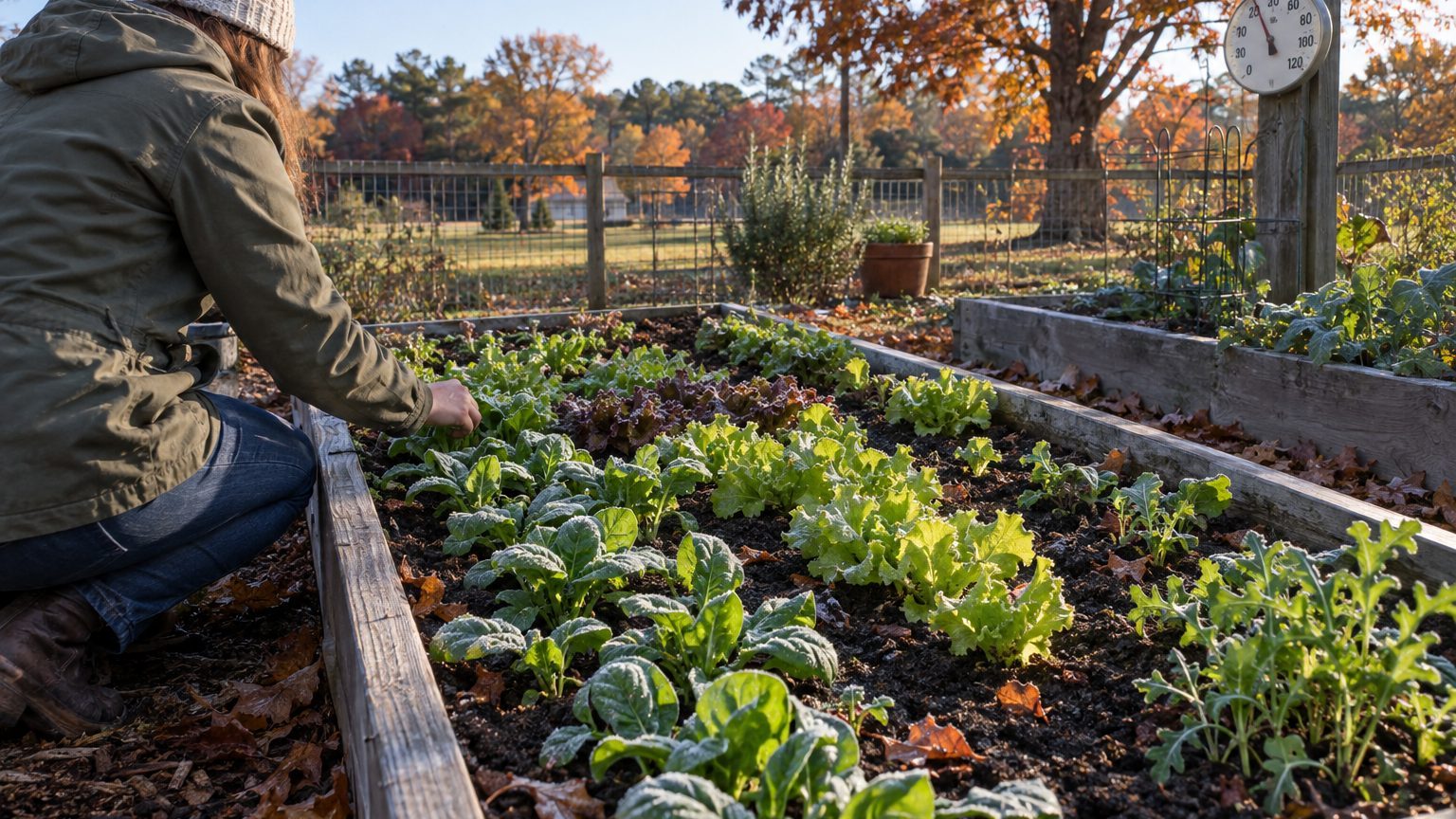

In western Washington, sow winter salads early enough that the plants are nearly full size before the first fall frost, which arrives in mid-to-late November. Sowing after that point mostly produces seedlings that sit through the dark weeks. Eastern Washington runs on a different, much shorter clock. And a mild last-frost date in spring does not mean you can sow early.
The short answer for Washington
For western Washington, work backward from a first fall frost window of November 13 to November 30, and forward from a last spring frost window of February 27 to March 18. Both ranges come from the NOAA NCEI 1991-2020 Climate Normals for the Seattle reference station, and both are probabilities of a 32°F freeze. They mark the stretch of dates where the odds of that freeze run between 30 and 70 percent. They are not dates when frost is guaranteed or ruled out.
| Marker | Window | What it is |
|---|---|---|
| Last spring frost | February 27 to March 18 | 30-70% odds of a 32°F freeze (Seattle reference station) |
| First fall frost | November 13 to November 30 | 30-70% odds of a 32°F freeze (Seattle reference station) |
The practical move is simple. Take the days to maturity printed on your seed packet and count back from November 13, the early edge of the fall window. Then give yourself a cushion, because that packet number assumes good growing weather. Salads put on size slowly once the days shorten and the soil cools, so a sowing that is “just in time” on paper usually ends up small in practice.
The cold itself is rarely the problem. The mean daily minimum of the coldest month at the reference station is 37.1°F, which sits above freezing. A typical winter night is cool, not killing, and the hard freezes are the exceptions. That figure is what decides whether hardy greens survive here, and for most of them it is a comfortable number.
Spring is where the frost date misleads people. February 27 to March 18 sounds early, but cold, wet soil and low light hold spring crops back well past the last freeze. A seed sown on the last-frost date is not a head start. This page does not have a soil-temperature date for spring sowing, so judge that by the soil itself (more on that at the end). For what to grow once you know when to sow, see Winter Salads for Washington Gardens and The Best Winter Salads for Washington.
What will not work here
Waiting for the frost window to arrive before you sow fails. Frost is the end of the easy growing, not the start of the winter-salad season. A bed sown in late November sits at seedling size through the shortest, dimmest weeks, and by the time the light returns it has little to show for the months.
Tender lettuce left bare through the November window also fails. With the first fall frost landing somewhere between November 13 and November 30, an open bed of soft-leaved lettuce is gambling on a mild year. Hardier leaves shrug off the same night. If you want lettuce through the cold months, plan a cover from the start rather than after the first frost warning.
Close spacing is the next casualty. Western Washington winters are damp for months, and crowded leaves stay wet, which invites gray mold and gives slugs a sheltered buffet. Thin seedlings harder than feels natural. Air moving between plants does more for a winter bed than any spray.
Then there is the spring trap. Sowing right at the last-frost window (February 27 to March 18) feels like good timing, but cold wet soil rots seed and stalls the ones that sprout. Plenty of gardeners blame the seed packet when the real culprit is the calendar. Waiting a few weeks often gets you a stronger crop than sowing early.
Late-summer sowing has its own failure. The sowings that matter most for winter go in during the dry months, and a seedbed that dries out between waterings never germinates evenly. A once-a-week soak will not do it. Light, frequent watering until the seedlings are up is the difference between a full row and a patchy one. Shade cloth over the bed on hot afternoons helps keep the surface moist.
Finally, the biggest mistake of all is applying this window statewide. The dates above describe maritime western Washington. Eastern Washington, beyond the Cascades, is high desert with a far shorter season, and this page does not have frost dates for it. Borrowing the Seattle numbers for an eastern garden would put sowings in the ground far too late for the cold that arrives there.
What changes across Washington
Washington does not have a single hardiness answer. The USDA Plant Hardiness Zone Map (2023 edition, built on 1991-2020 normals) places the state across zones 4a to 9a. That is a spread of more than five zones, from cold mountain and interior country to mild Puget Sound shoreline. The system uses one variable only, the average annual extreme minimum temperature, so it tells you how cold the worst nights get, not how wet, dim or short the growing season is.
That spread is why the dated advice here is tied to the Seattle reference station and nowhere else. For a garden in the north of the state, or at altitude in the Cascades, the direction of the shift is clear even if the exact dates are not on this page: the first fall frost comes sooner and the last spring frost lingers later. Sow earlier in late summer and give the seedlings more time to size up before the cold arrives. Count your own safety margin in weeks, not days.
Gardeners east of the Cascades should treat the Seattle window as a different region’s data. Winters there are colder, summers drier and the growing season is shorter. A winter-salad plan in that country leans on season extension, such as cold frames, low tunnels and cover, rather than on a long open-bed autumn.
Even inside western Washington, a low spot where cold air pools can behave like a different zone from a hillside twenty minutes away. A garden near saltwater is typically gentler than one inland. I will not tell you which zone you are in, because the page cannot see your address. Look it up on the USDA Plant Hardiness Zone Map, enter your ZIP code, and use the result as a rough guide to how far to move the Seattle numbers.
Where to check this for your own county
The best next stop is Washington State University Extension, the state’s land-grant extension service, with offices serving counties across Washington. Look there for two things. First, a local planting calendar for your county, which will give dates tuned to your elevation and rainfall rather than a single reference station. Second, the varieties that have been trialled in your county, since a salad that performs well in a coastal garden may sulk in the foothills.
If your county has a Master Gardener program run through extension, its volunteers are often the fastest route to practical answers. They know which local microclimates run cold, where slugs are worst and which sowing dates have worked in recent seasons. Ask what they would sow first for fall and what they would never sow in early spring.
A county recommendation beats a state one, and this page is the state one. It is built on frost-probability data from a single reference station plus a statewide hardiness range, and it is meant to put you in the right season, not on the right day. When your county calendar and this page disagree, trust the county. The disagreement is likely a sign that local conditions differ from the Seattle reference, not a mistake in either source.
This page does not have a county-by-county salad calendar for Washington, and I would rather say so than pad it with numbers borrowed from somewhere else.
Checking this against your own garden
Your own observation outranks every date above. Three things are worth watching, and none needs equipment.
Soil warmth by feel. Push your hand a couple of inches into the bed. If it feels cold and clammy and the soil clumps in a sticky ball, seeds will sit and rot. Soil that crumbles and feels merely cool is ready. In spring, a bed that reaches that point weeks after a neighbor’s tells you about your drainage and sun.
The first true leaves. Seedlings open with a pair of smooth seed leaves, and the first true leaves follow. If your autumn sowings stall at the seed-leaf stage as the days shorten, you sowed late for your spot. Next year, move the date earlier by the weeks it took them to catch up.
Where frost shows first. On a clear, cold morning, walk the yard. White grass in one corner and green grass by the south wall is a free map of your microclimate. Put tender lettuce in the protected places and hardier greens in the cold ones. If you see male flowers opening on squash or cucumbers in summer, treat that as a sign your site is running warm, and expect the cold to arrive later there too.
Common questions
Can I still sow winter salads after the first frost?
You can, but the plants will stay small through the darkest weeks. Under a cover they fare better, and a late sowing may still give you young leaves by late winter. The fall window is November 13 to November 30 for western Washington, so sowing well before it is the safer plan.
Does the Seattle frost window apply to eastern Washington?
No. The dates come from the Seattle reference station and describe western Washington. Eastern Washington is high desert with a far shorter season, and this page does not have frost dates for it.
Is 37.1°F cold enough to kill winter salads?
No. That figure is the mean daily minimum of the coldest month at the reference station, and it sits above freezing. Hard freezes still happen, so choose hardy leaves for open beds and cover tender ones.
Should I sow in late February because the last frost is near?
Not on that basis alone. The last spring frost window is February 27 to March 18, but cold wet soil and low light hold spring crops back well beyond it. Check soil by feel before you sow.