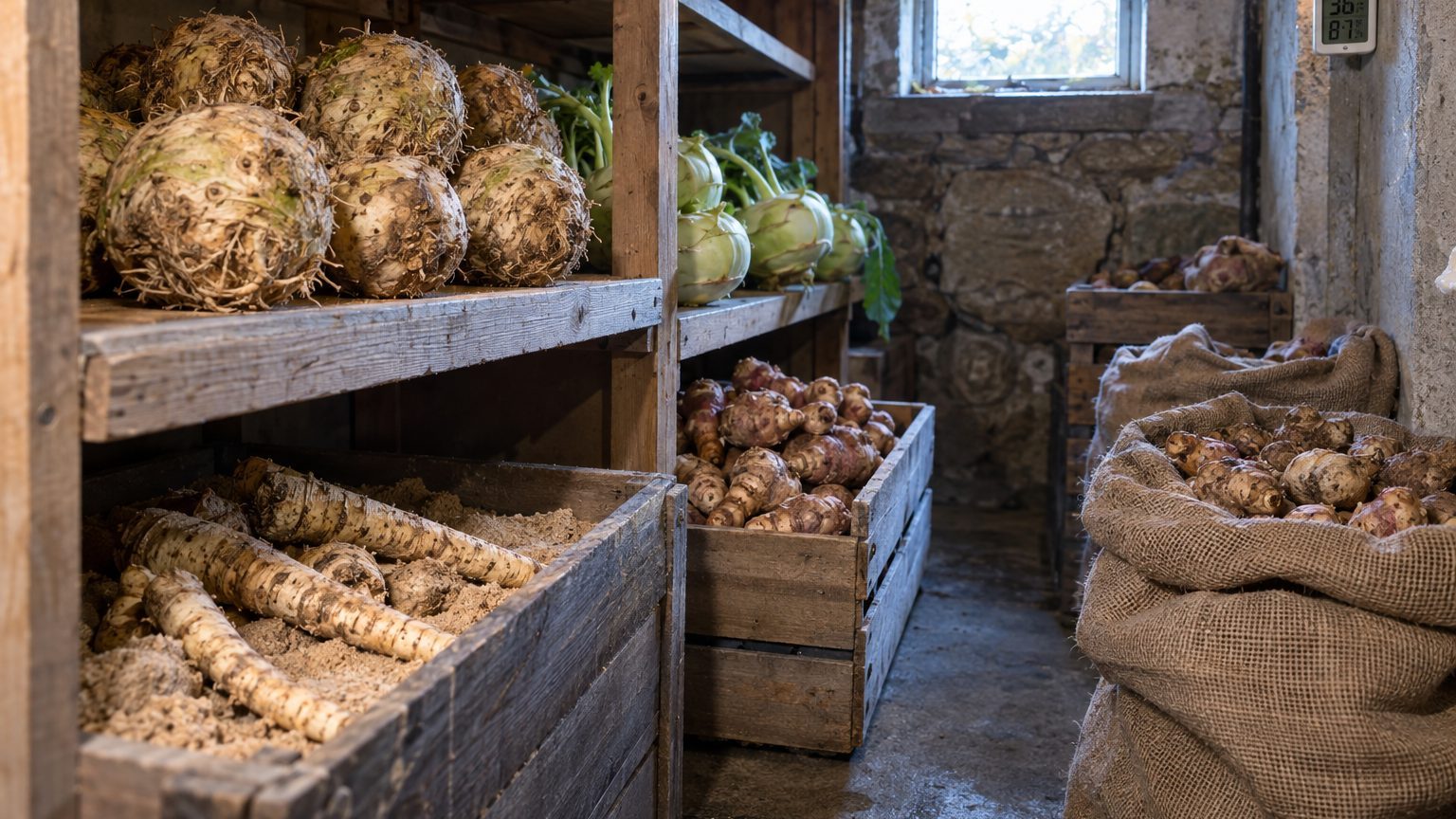

Cold, damp and dark: that is the recipe for storing unusual roots, and it works for most of them. Aim for 32 to 40°F with humidity around 90 percent, keep the roots away from ripening fruit, and check them every couple of weeks. The details change from crop to crop, though. Celeriac and horseradish settle in for months, kohlrabi manages a couple of months at best, and Jerusalem artichokes barely last a few weeks once they leave the soil.
This page covers the storage side of the group profiled in Celeriac, Kohlrabi, Horseradish and Jerusalem Artichokes. Whether a crop should come out of the ground at all is a separate question, and Leaving These Roots in the Soil Over Winter handles it. Here the assumption is that the roots are already out, or soon will be.
The conditions that matter, and why
Roots are living things. A celeriac sitting on a shelf is still breathing, burning through its own sugars, and losing water through its skin. Cold slows the breathing. Humidity slows the water loss. Get both right and a root can coast for months; get either wrong and it shrivels, sprouts, or rots.
Temperature first. The sweet spot is just above freezing, 32 to 40°F. An unheated basement, a root cellar, a cold corner of an attached garage, or a window well bin can all hit that range for part of the winter. A cheap indoor/outdoor thermometer tells you more than guessing does. Some people are surprised to learn how erratic a garage is: a sunny January afternoon can push a south-facing wall well past 50°F, then a single night drops it into the teens.
Humidity is the harder half. Most basements run dry in winter, especially with a furnace going. Roots in open air lose moisture fast, and a limp, rubbery kohlrabi is the result. The fix is packaging. Layer roots in slightly damp sand, sawdust, or coir in a bin or bucket, or use perforated plastic bags that hold moisture without sealing it airtight. Sealed bags with no holes trap condensation and invite mold.
Two more rules apply across the board:
- Harvest on a dry day, brush off loose soil, and skip washing until you cook.
- Store roots away from apples and pears, which give off ethylene gas and can speed sprouting and off flavors.
One bruised or cut root will spoil faster than its neighbors, and it can pass rot along. Sort at harvest. Anything nicked by a fork goes in the kitchen bowl, not the storage bin.
Root by root: what each one wants
Celeriac is the long-haul champion of this group. Dug after a light frost (it handles mild cold but not a hard freeze), trimmed of its tops, and stripped of the wiry side roots, it can hold in a cold cellar for three to six months. Leave a bit of the stalk stub rather than cutting flush with the crown, since a cut surface rots more readily. Pack it in damp sand or loose in a ventilated crate. In a refrigerator crisper, a bagged celeriac typically lasts a few weeks to a couple of months, though the outside will get a little leathery. Peeling takes care of that, and the flesh underneath is usually fine. A brown ring or soft hollow center is the sign to compost it.
Kohlrabi sits at the opposite end. It is a swollen stem, not a true root, and it stores like a dense cabbage cousin, which means it is happiest cold and wet but never indefinite. Golf-ball to tennis-ball sizes keep best, and oversized ones tend to turn woody whether in the ground or the cellar. Twist off the leaves (they wilt fast and pull moisture from the bulb), leave the taproot on if you like, and bag the bulbs in perforated plastic. Expect roughly two to three weeks in a typical fridge and longer in a properly cold, humid cellar, often a couple of months for the later-maturing storage types. The Kohlrabi: The Fastest Crop Here, and a Stem Not a Root guide explains why timing the sowing for a fall harvest sets you up for better storage than a summer glut does.
Horseradish is the easy one, nearly the opposite of finicky. Dig the roots after a few hard frosts in fall, when the flavor compounds are strongest, wash lightly if you must, and store them in a perforated bag in the fridge or buried in damp sand in a cold spot. Whole roots keep for several months. The trouble starts after grating. Horseradish gets its bite when the cells are crushed and an enzyme reaction produces the sharp compounds; left alone, that heat fades within minutes, then keeps fading. Cooks control it with vinegar. Add vinegar right after grating and you lock in a milder sauce, wait two or three minutes and the result is hotter. Prepared horseradish in a jar in the fridge holds its punch for weeks, then slowly dulls and darkens, though it stays safe much longer than it stays strong. Grated horseradish can also be frozen in small portions.
Jerusalem artichokes are the problem child. The skin is thin, the tubers dry out in days, and a bag of them in the pantry turns into a bag of wrinkles. In the fridge, in a perforated bag or wrapped in a damp towel, they last perhaps one to two weeks, sometimes a bit longer. The practical answer, and the one most growers land on, is to leave them in the ground and dig as needed. Mulch heavily with straw or leaves so the soil does not lock solid, which matters most in states with deep frost. In Minnesota, Wisconsin or the Dakotas, frost depth can reach four feet or more, and a thick blanket of mulch is the difference between a pitchfork job and a pickaxe job. Cold also converts some of the tubers’ starch-like inulin into sweeter sugars, so winter-dug tubers often taste better than fall ones. Inulin is also why some people get gassy after a big serving. Start with a small portion.
No root cellar? Workable substitutes
Most households do not have a dirt-floored cellar. That is fine. A refrigerator handles small amounts of everything here, and a second fridge in the garage, if you already own one, can serve as a dedicated root locker. Set it to the low end of the safe range and use produce drawers or lidded bins to hold moisture.
For larger harvests, a bucket works better than most people expect. Pack roots in layers with damp (not wet) sand or sawdust, with no root touching another, cover loosely, and park it somewhere that stays reliably above 25 to 28°F and below 40°F. Unheated basements and north-wall closets often fit. Some gardeners in milder places, such as coastal Virginia or western Oregon, use an outdoor trench or an old chest freezer buried upright, lidded, and mulched. This only suits climates where the soil stays above about 20°F and drains well, since standing water ruins everything.
Beyond the cold, a few preservation routes extend the harvest further:
- Freezing. Peel and cube celeriac or kohlrabi, blanch briefly (about a minute for small kohlrabi cubes, a few minutes for celeriac), cool in ice water, drain, and freeze in bags. Texture softens, so use them in soups, mash and braises.
- Drying thin slices of celeriac for powders and soup mixes, or Jerusalem artichoke slices for chips.
- Pickling or fermenting kohlrabi and Jerusalem artichokes. Follow a tested recipe from a state extension service or the National Center for Home Food Preservation, because acidity and salt levels determine safety.
Blanching matters because enzymes keep working in frozen vegetables and eventually produce off flavors and a dull color. Skipping the step saves ten minutes and costs you flavor by February.
Checking, culling and troubleshooting
Storage is not set-and-forget. Plan a check every two weeks, more often early on. Pull out anything soft, slimy, moldy or sprouting heavily, and wipe or replace damp packing that has gone sour. One rotten celeriac can contaminate a whole bucket in a surprisingly short time.
Shriveling means the air is too dry, so mist the packing lightly or switch to a tighter container. Condensation dripping inside a bag means the opposite: add holes, or let the roots air for an hour before rebagging. Sprouting at the crown, common in celeriac and horseradish by late winter, means warmth is creeping in. Sprouted roots are still edible if firm, but they get less tasty, so move them to the front of the menu. A strong sulfur or cabbage smell from kohlrabi usually signals breakdown, and the bulb should go to the compost.
Mind the sequence in which you eat things. Kohlrabi and Jerusalem artichokes first, since they fade quickest, then celeriac through midwinter, and horseradish last because it will outlast the rest. Rotating that way costs nothing and uses nearly the whole harvest.
One last bit of horseradish trivia that pays off in spring: when you dig in fall, trim off the pencil-thick side roots, about 8 to 12 inches long, and store them in damp sand alongside the main crop. Those cuttings are next year’s planting stock, and they will root readily once the soil thaws.