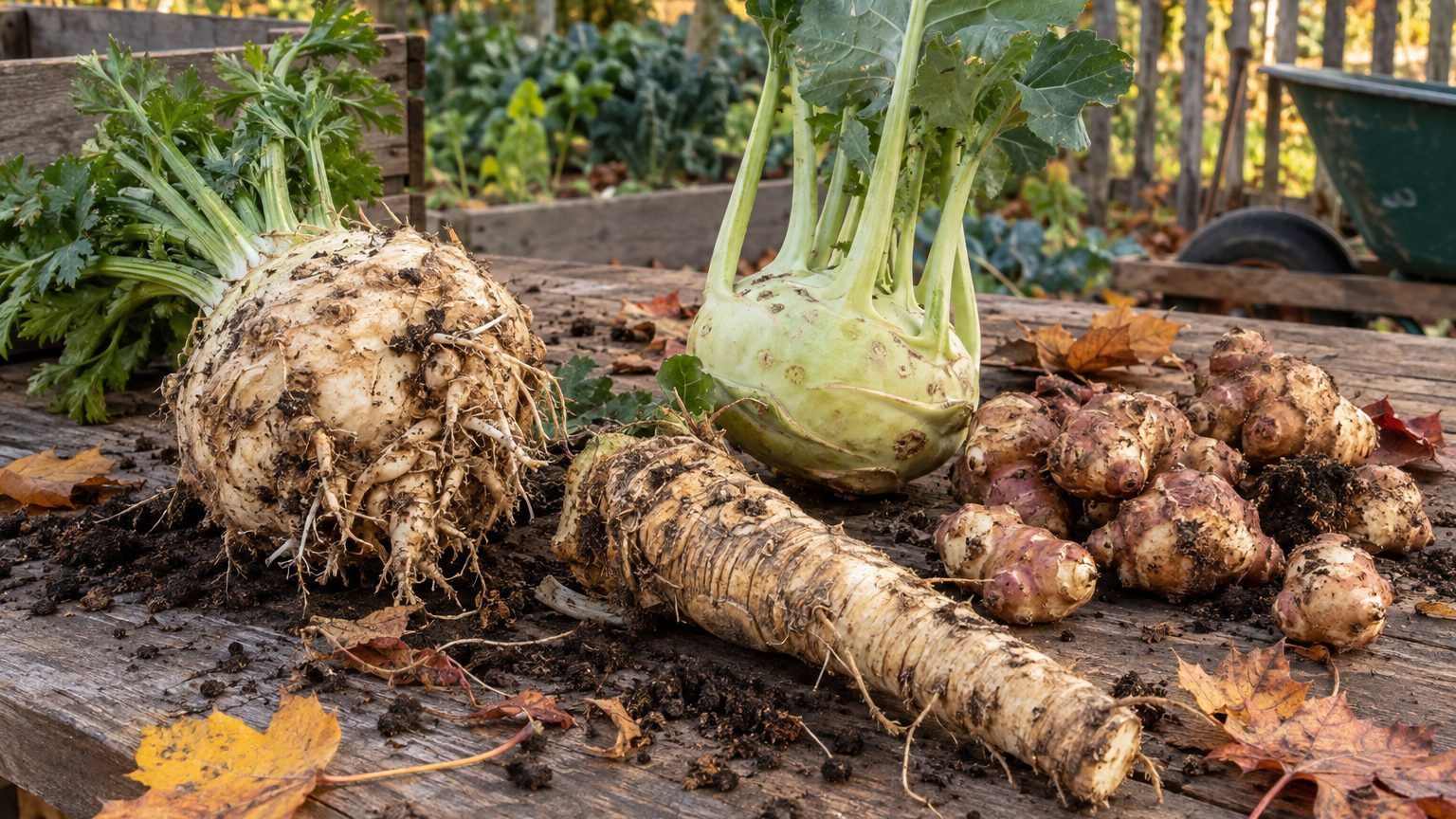

Celeriac, kohlrabi, horseradish and Jerusalem artichokes are the unusual root vegetables most likely to show up in a fall farm-share box and leave people staring. They are not a set. Three botanical families are in play, only two of the four can share a bed, and two can become permanent residents of your garden. Sort out which is which before you order a single plant or tuber.
Four crops, four families, one season
What these vegetables share is an autumn harvest and a face most shoppers don’t recognize. That is the whole of it. The heading is a touch generous, too: kohlrabi and horseradish are both brassicas, so the count is really three botanical families.
Celeriac is an apiaceous root, a relative of carrots, parsley and celery. Kohlrabi is a swollen brassica stem that sits above the soil like a pale green or purple orb, not a root at all. Horseradish is a perennial brassica root. Jerusalem artichoke is a tuber from a sunflower relative, and it has nothing to do with Jerusalem or with artichokes.
| Crop | Family | What you eat | Time needed | How it is harvested |
|---|---|---|---|---|
| Celeriac | Apiaceae (carrot, parsley, celery) | Knobby, swollen root base | A long season, usually started indoors well ahead of planting out | Lifted whole with a garden fork in fall, before the ground freezes hard |
| Kohlrabi | Brassicaceae (cabbage family) | Swollen stem above ground | Short; fits a spring or a fall window | Pulled whole while the bulb is still tender, before it turns woody |
| Horseradish | Brassicaceae (cabbage family) | Thick, pungent perennial root | A full growing season before the first real digging | Dug in late fall or very early spring |
| Jerusalem artichoke | Asteraceae (sunflower) | Knobby, thin-skinned tubers | A full season, until the tops die back | Dug after the foliage dies back, with a fork worked wide of the clump |
The cabbage-bed rule
The family column matters more than it looks, because it decides rotation. Kohlrabi and horseradish belong with the cabbage bed. They share its troubles: clubroot in the soil, flea beetles on young leaves, and caterpillars chewing the foliage. Celeriac and Jerusalem artichoke do not share those problems, so they can move through other parts of the rotation.
Turnip and rutabaga are brassicas as well. A gardener who rotates kohlrabi into the spot where turnips grew last year has rotated nothing, since the same soil pathogens carry over. The practices that help are the dull, reliable ones: keep brassicas off a bed for several seasons, cover young plants with floating row cover to keep pests off, and check soil pH through your extension service if clubroot has ever shown up. The rotation page in this series lays out the full sequence.
Choosing types without guessing names
Seed catalogs offer more kohlrabi and celeriac choices than any one page can vet, and a variety that thrives in Vermont can sulk in Georgia. So think in types. Kohlrabi comes in green and purple skins, and in quick-maturing and larger, slower types. Jerusalem artichokes run from knobbier to smoother tubers, with red or white skins. Celeriac types differ in how smooth the root is and how well it holds up. For specific names, ask your state’s cooperative extension service which varieties have been trialed where you live. Those trial results beat any catalog adjective.
One planting deserves its own warning before anything else gets said about growing it, and that is the Jerusalem artichoke. The next section explains why.
Two things to know before planting
Warnings first, because these are the two things gardeners regret. Neither is a reason to skip the crop. Both are reasons to choose the spot with care.
Jerusalem artichoke: plan for forever
Jerusalem artichoke is effectively permanent once planted. Every tuber fragment left in the soil regrows, and the clump widens each year. Dig a bed carefully, miss a few marble-sized pieces, and next spring you have a patch of shoots that grow taller than most people. Tilling makes it worse, since it chops tubers into more planting stock. Of all the plantings gardeners regret, this one tops the list.
The sensible approach is to site it where spreading is acceptable. That means a back corner, a fence line, or a strip next to a lawn you mow, away from the vegetable beds. Or grow it in a large container. Even then, set the pot on a hard surface, not on bare soil, because tubers can escape through drainage holes. At harvest, sift the potting mix for every last piece.
Horseradish: the deep one
Horseradish behaves the same way, and its root goes deep enough that removing it completely is very difficult. Any piece of root left behind sprouts. Cutting the leaves back doesn’t end it, and a spading fork rarely reaches the bottom of the root. Pulling it out of a bed where you’ve changed your mind can take several seasons of persistent digging.
Give it a dedicated patch at the edge of the garden, or a deep container where you can empty and sift the whole root run each year. It is also a brassica, so keep it out of ground you plan to rotate cabbage through.
Celeriac and kohlrabi carry no such risk
Plainly put, celeriac and kohlrabi are not like this. Celeriac is a biennial grown as an annual. Kohlrabi is an annual. Pull either one, and the plant is gone. You can plant them in a good bed without worrying about next year. The only commitment they ask for is the care covered in the next section.
What each one asks for
Celeriac wants a long season and constant moisture. Kohlrabi is fast and forgiving. Horseradish and Jerusalem artichoke need almost nothing, which is exactly why they cause problems.
| Crop | Time to harvest | Difficulty | What most often goes wrong | Page |
|---|---|---|---|---|
| Celeriac | Longest of the four | Moderate | Uneven watering, which leaves small, tough or pithy roots; slow seedlings; bolting after a cold snap | Celeriac page |
| Kohlrabi | Quick, spring or fall | Easy | Woody or split bulbs from heat or waiting too long; flea beetles and caterpillars | Kohlrabi page |
| Horseradish | A full season before first digging | Easy to grow, hard to contain | Spreading beyond its patch; lifting only part of the root | Horseradish page |
| Jerusalem artichoke | A full season, until tops die back | Easy | Regrowth from missed tubers for years afterward | Jerusalem artichoke page |
Celeriac is the one that punishes neglect. Mulch it, water it steadily, and don’t let the bed swing between soaked and bone dry. Kohlrabi rewards a cool start and a quick harvest: pull it while the bulb is young, around tennis-ball size, and it stays crisp. Floating row cover keeps flea beetles and cabbage moths off. Horseradish and Jerusalem artichoke want sun and ordinary soil, and that is about all.
At the cutting board and in storage
Horseradish vapors are genuinely irritating. Grating a fresh root releases compounds that burn the eyes and airways, much more sharply than onions do. Open a window or run a fan, keep your face well back, and keep your eyes away from the bowl. In a food processor, let the vapor clear before lifting the lid.
Jerusalem artichokes store carbohydrate as inulin instead of starch, and in many people it causes gas and digestive discomfort. That is a plain fact about the vegetable, not a verdict on it. Start with a small first portion to find out where you land.
Storage is a food-safety question, so no keeping time is promised here. Inspect every root before it goes away and again whenever you take one out. A soft patch, a weeping spot or a moldy crown ends the question, and the root goes in the compost. A root that looks sound on the outside isn’t proven safe, and that’s especially true of thin-skinned Jerusalem artichoke tubers, which dry out and spoil faster than the others.
Why the answer changes with where you garden
These four crops split along two lines that your location decides: how long your season is, and how cold your winter gets.
Season length
Celeriac needs a long, steady season, and not every state offers one. In short-summer places such as northern New England or the Upper Midwest, gardeners start seed indoors early and still watch the calendar. In hot-summer regions like much of the Southeast, the problem flips: heat and dry spells stress the plant, and the better window may be a fall crop into mild weather. Kohlrabi sidesteps most of this because it matures quickly, which is why it works as a spring crop in one state and a fall crop in another. Horseradish and Jerusalem artichoke, with their full-season habit, fit nearly everywhere.
Winter in the ground
Whether any of these can overwinter outdoors depends entirely on the winter low. Jerusalem artichoke is native to eastern North America and is hardy across a wide range of cold climates, so tubers often sit safely in the soil and get dug as needed. Horseradish is a hardy perennial that actually benefits from winter cold. Celeriac tolerates light frost but not a deep freeze, and kohlrabi likewise. If your winter drops low, lift both before the ground locks up.
Frozen ground brings its own problem: you can’t dig what you can’t penetrate. A thick layer of mulch over the patch keeps soil workable longer.
To find your own answer, start with your USDA Plant Hardiness Zone and the average first and last frost dates for your county. Then check the state pages in this series for crop timing in your region, and contact your state’s land-grant university extension service for variety trials and local pest alerts.
Common questions
Is kohlrabi actually a root vegetable?
No. The round bulb is a swollen stem that grows above the soil line. It is grouped with the roots because it is eaten raw or cooked like turnip, but botanically it is a cabbage-family stem.
Can I rotate these crops through one bed?
Not all four. Kohlrabi and horseradish belong to the brassica group, along with cabbage, kale, mustard, turnip and rutabaga, and they share its soil and pest problems. Celeriac and Jerusalem artichoke sit outside that group. Horseradish and Jerusalem artichoke are hard to remove once established, so neither fits a true rotation.
Can I keep Jerusalem artichoke or horseradish under control?
With effort, yes. A large container on a hard surface works for both, provided you sift out every tuber or root piece at harvest. In the ground, a dedicated corner away from the main beds is the realistic choice. Cutting the tops back is not control.
How do I know a stored root is still good?
Look and feel before every use. A soft patch, a weeping spot or a moldy crown means discard it. Looking sound doesn’t prove a root is safe, so treat any doubt as a reason to throw it out.