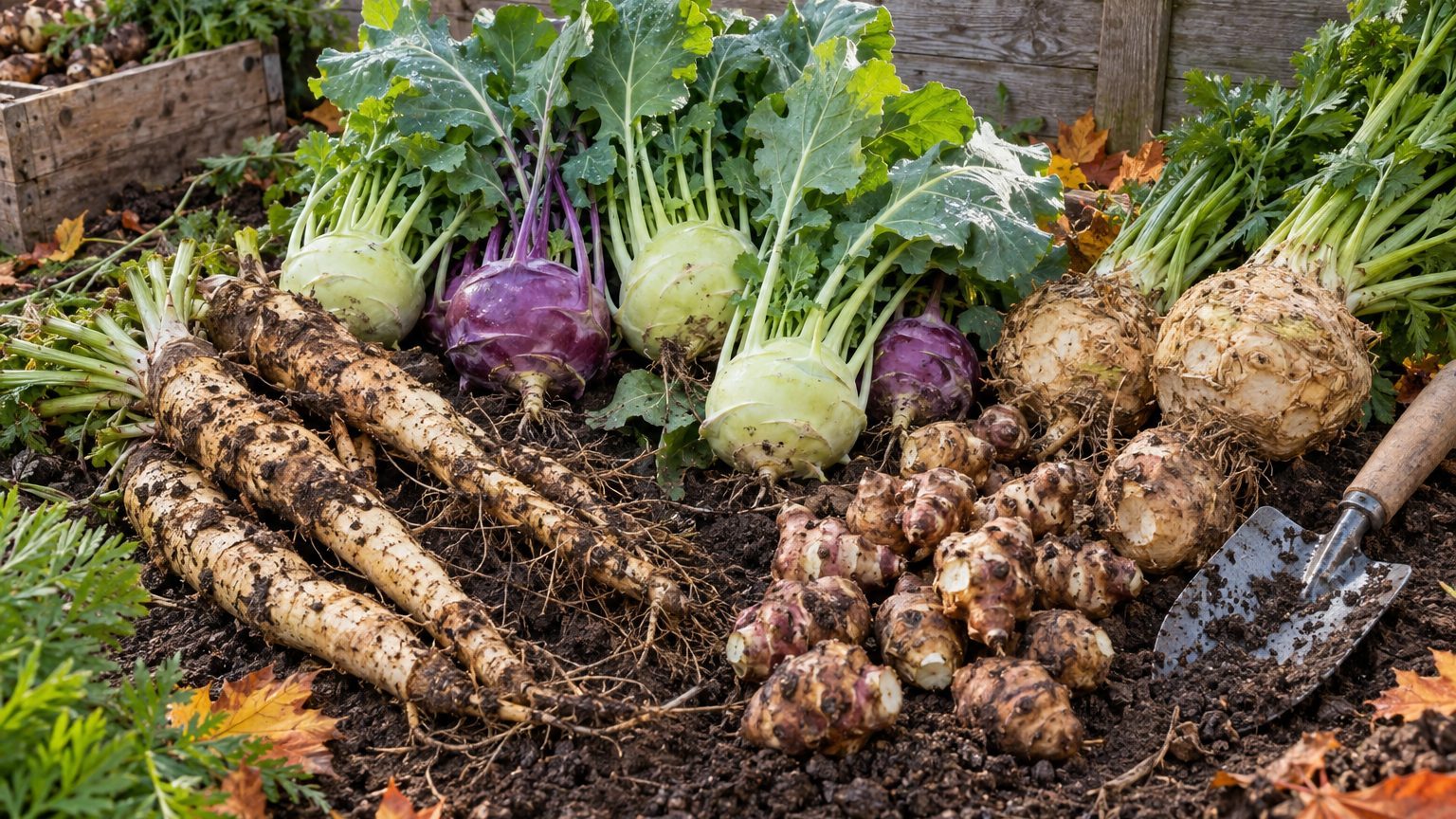

Kohlrabi and horseradish earn their spot in almost any yard. Celeriac does too, as long as you can give it a long growing season and steady water. Jerusalem artichokes produce the most food per square foot of the four, and they also cause the most trouble if you plant them in the wrong place. Whether unusual roots are worth growing depends less on the vegetable than on three things: how much room you can spare, how many frost-free days you get, and what you actually cook.
The full lineup is covered in the guide to Celeriac, Kohlrabi, Horseradish and Jerusalem Artichokes. This page is the filter: a straight comparison of what each one asks for and what it gives back.
Kohlrabi and horseradish: the low-risk picks
Kohlrabi is technically not a root at all. The round, pale green or purple globe is a swollen stem, grown above the soil line, and it belongs to the cabbage family. Kitchens lump it in with roots anyway. What matters for a small garden is speed. Most varieties are ready 45 to 60 days after sowing, which means a spring planting is finished before tomatoes need the bed, and a late-summer sowing gives you a fall crop in the same spot.
That short clock is the whole argument for it. You can tuck plants 4 to 6 inches apart in a raised bed, sow a short row every couple of weeks for staggered harvests, and be eating by the time a celeriac seedling has barely put on size. Pick bulbs when they reach about 2 to 3 inches across, roughly the size of a tennis ball or a little smaller. Let them go much past that and many varieties turn woody and fibrous. A few large-type varieties hold up better, but small and tender is the safe bet.
The catch is the same pest list that plagues cabbage and broccoli. Flea beetles pepper young leaves with tiny holes, and cabbageworms show up as the weather warms. Lightweight row cover laid over the bed right after sowing handles most of it. The payoff in the kitchen is real, too. Peeled and cut into matchsticks, kohlrabi is crisp and mildly sweet, closer to a broccoli stem than a turnip, and it works in slaw, roasted wedges, or eaten raw with salt. The leaves cook like collards.
Horseradish asks for even less, but it plays a longer game. It is a perennial hardy across a huge range of the country (roughly zones 3 through 9), planted in early spring from root pieces rather than seed. Set them in the ground at a slight angle, spaced about 18 to 24 inches apart, with the top an inch or two below the surface. Then leave them alone. The big, coarse leaves grow all summer, and you dig the roots in late fall after frost has knocked the foliage back.
One or two plants is plenty for a household. A single root yields a surprising amount of condiment, and the flavor of freshly grated horseradish makes the jarred version taste like a rumor. Grate it outdoors or near an open window, because the fumes sting the eyes like onions on steroids. Stirring in white vinegar right away gives a milder result, while waiting a few minutes first lets the heat build before the vinegar locks it in. Homemade horseradish keeps in the refrigerator for a month or two, but the bite fades steadily.
The warning is persistence. Any piece of root left in the soil will sprout the following spring, so dig thoroughly, or plant it in a spot where a few strays won’t matter, like the edge of the yard or a large container sunk into the ground.
Celeriac: worth it only if you can meet its terms
Celeriac has the highest ceiling and the lowest tolerance for neglect. It is the ugly, knobby cousin of celery, grown for a swollen base that tastes like celery crossed with parsley and a hint of nuttiness. Roasted, mashed with potatoes, or simmered into soup, it adds depth that few other cool-weather vegetables can match. Grocery stores tend to charge a premium for it compared to carrots or potatoes, which helps explain why home gardeners bother.
The work comes up front. Seeds are tiny and slow, often taking two or three weeks to sprout, and they need to be started indoors about 8 to 10 weeks before your last spring frost. After transplanting, the crop needs roughly 100 to 120 days to size up to a 3 to 4 inch root. That is nearly a full season of watering, mulching, and feeding, since celeriac is a hungry plant. If the soil dries out repeatedly, the roots turn small, hollow, or tough. Full details on that schedule are in Celeriac: A Long Season and Constant Water.
Climate matters here more than for the others. Celeriac prefers cool conditions and handles light frost without complaint, so it does well in the northern tier of states, the Upper Midwest, New England, and the Pacific Northwest. Gardeners in the hot, humid South often find that summer heat stalls growth and invites disease. If you live there, treat it as a fall crop or skip it. A good window to harvest is just before the ground freezes hard, though a thick mulch can stretch that by a few weeks.
The reward for those who succeed is storage. Trimmed roots kept in a cold, humid spot near freezing (a basement corner, a root cellar, or a crisper drawer) can last for several months. That makes celeriac one of the few vegetables that can still be coming out of your garage in February.
So is it worth it? For someone with a long enough season, a mulch pile, and a hose that reaches the bed, yes. For someone who travels in July or who gardens in the Gulf South, probably not.
Jerusalem artichokes: big yield, bigger commitment
Jerusalem artichokes, also sold as sunchokes, have nothing to do with Jerusalem and are not true artichokes. They are a native North American sunflower grown for knobby tubers, and they are the most productive plant on this list by a wide margin. A handful of seed tubers pushed into the ground in early spring, 4 to 6 inches deep, will turn into a stand of stalks that reach 6 to 10 feet tall and finish with small yellow flowers in late summer. Underneath, each plant sets a cluster of tubers.
That productivity is also the problem. Every small tuber missed at harvest becomes a new plant next year. The species has naturalized along roadsides, ditches, and stream banks across much of the country, and it is considered a nuisance in some places. A bottomless raised bed, a large buried container, or a dedicated corner far from the vegetable garden keeps it in check. Check with your state extension service before planting if you live near wild land.
The tubers also behave differently from potatoes. Their thin skins shrivel quickly once dug, and they last only a week or two in the refrigerator. The usual approach is to leave them in the ground after the tops die back in fall and dig only what you plan to cook, as long as the soil isn’t frozen solid. A heavy layer of mulch or straw keeps the ground workable into winter.
In the kitchen, they are sweet and nutty, a bit like a cross between a water chestnut and a potato, and good raw in salads, roasted until the edges brown, or blended into soup. One thing to know: sunchokes are high in inulin, a fiber that some people find hard to digest, and large servings can cause gas and bloating. Start with a small portion before committing to a big harvest.
In its favor, a row of sunchokes also doubles as a living privacy screen or windbreak for the summer months. That is a bonus few other root crops offer.
Matching the root to your yard
A simple way to decide is to ask what limits you most.
- Tight on space: kohlrabi, grown in succession, or a single horseradish plant in a corner.
- Short growing season: kohlrabi, which matures in under two months, and horseradish, which survives cold winters without any help.
- Long, cool season with good water access: celeriac.
- A spare corner you can sacrifice: Jerusalem artichokes.
Most gardeners are better off adding one or two of these rather than all four at once. A sensible first-year combination is kohlrabi in spring, plus either horseradish or sunchokes in a spot where they can spread without consequence. Celeriac can wait until you have a season or two of watering habits behind you.
Soil is the quiet deciding factor behind all of this. Horseradish and Jerusalem artichokes will put up with average or even rough ground, while celeriac wants loose, rich, moisture-holding soil and kohlrabi falls somewhere in between. The notes in The Soil These Roots Want explain how to prepare for each. If your yard is heavy clay or rocky fill, starting with the two tough perennials is the easier route, and you can build up a bed for celeriac over time.