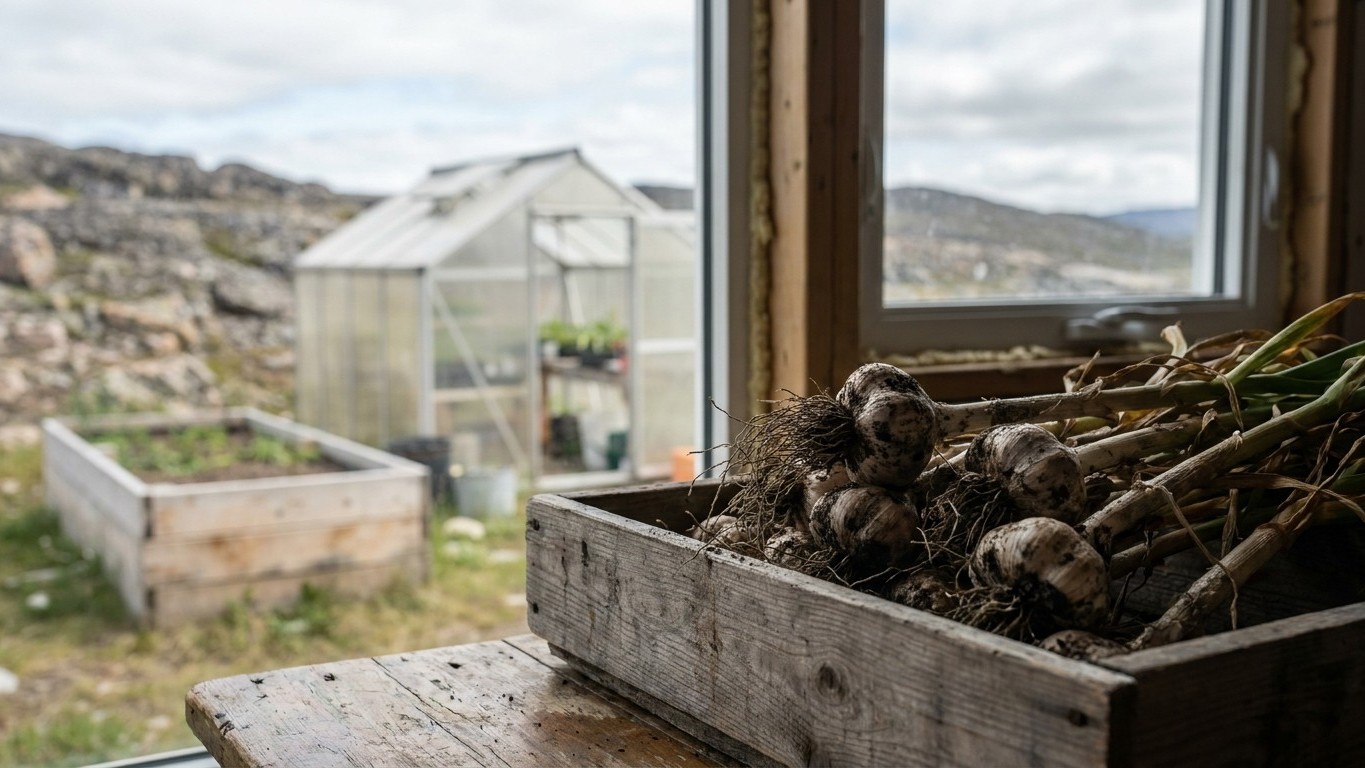

Anchorage’s last spring freeze falls between May 3 and May 12, and unusual roots such as celeriac, kohlrabi, horseradish and Jerusalem artichokes go in after that, once the soil has warmed. About 143 frost-free days is enough for most of this group and a stretch for celeriac. In Alaska the winter minimum, more than any summer heat, decides what can stay in the ground. Everything below is anchored to Anchorage; the Interior and the north run much shorter.
When the soil is warm enough in Alaska
The date first. At the Anchorage station (USW00026451), NOAA’s 1991-2020 Climate Normals put the last spring 32°F freeze between May 3 and May 12. That span is the 30 to 70 percent probability band. A frost date is a probability, not a promise, so a cold night after May 12 would be unusual but not shocking.
Treat that date as a proxy. Celeriac, kohlrabi, turnips, horseradish and Jerusalem artichokes respond to warm soil, and soil warms after the frost risk ends, not with it. Air can clear 32°F in early May while the top few inches of a bed stay cold and soggy, which is when seed sits and rots and transplants stall. A cheap soil thermometer pushed to planting depth beats the calendar. Check the minimum soil temperature on the seed packet, and expect raised beds and dark mulch to warm sooner than a flat, shaded bed.
The group splits by temperament. Kohlrabi and turnip-type roots tolerate cool soil and can go in early. Celeriac wants a long run, so it is usually started indoors and set out once the cold has truly passed. Horseradish and Jerusalem artichokes are planted as root pieces or tubers once the ground is workable. Cultivars matter a great deal in a short season, but this page cannot source locally trialled ones, so it names none. Your state extension service does that job, and the University of Alaska Fairbanks Cooperative Extension Service is the place to ask.
Site Jerusalem artichokes before you plant them
Decide where Jerusalem artichokes go before they touch soil, because they are effectively permanent once planted. Every fragment of tuber left behind regrows, and digging the patch only scatters more pieces. It is the planting gardeners most often regret. Give them a corner you can fence off with a mower strip or a deep barrier, away from beds you rotate. Many people also get digestive discomfort from them, since the tubers store inulin rather than starch. A small first portion is the sensible way to find out where you stand.
Gardeners comparing northern territories can read Growing Unusual Root Crops in Yukon for a colder inland case, and the general Celeriac, Kohlrabi, Horseradish and Jerusalem Artichokes guide covers each crop in detail.
How long the season lasts here
Both ends of the Anchorage window come from the same NOAA normals. The first fall freeze lands between September 22 and October 1. Count from the latest spring date (May 12) to the earliest fall one (September 22) and you get 133 days. Count from the earliest spring date (May 3) to the latest fall one (October 1) and you get 151. The station’s own figure of about 143 frost-free days sits between the two, which is the number to plan around.
What does that length allow? Enough for one full crop of nearly everything in this group, and for a second sowing of the quick ones if you move fast. A fast kohlrabi or turnip-type sowing in early summer can still finish before late September. A second sowing of anything slow will not. Past the Anchorage area the arithmetic tightens. The Interior and the north have far shorter windows, and there the first sowing is the only one.
The same subtraction settles the transplant question. A celeriac seedling that sulks for two weeks after a root check has spent about a tenth of a 133-day window doing nothing. Short season argues for indoor starts, but it also argues for gentle handling: pots that let roots out without tearing them, hardening off over several days, and planting into soil that has actually warmed. Direct-sown roots such as turnips skip the check entirely.
Long summer daylight partly compensates for the short calendar, since plants get far more hours of light each day than at lower latitudes. It does not replace warmth in the root zone, though, so soil temperature still sets the pace. For how to stagger sowings across a window like this, see the succession sowing guide on this site. Newfoundland gardeners face a different kind of short, cool season, covered in Growing Unusual Root Crops in Newfoundland and Labrador.
Heat and water in Alaska
This page carries no verified count of days above 90 F or summer rainfall total for the Anchorage station, so it quotes neither. Heat stress is not the usual worry in the Anchorage area, and that changes what a gardener should plan for. The hot-climate advice of deep shade cloth and midday relief mostly belongs to other states. Here the risks are a cool summer, wet foliage and slow ripening, and the diseases that come with them, including mildew and rots in cold, soggy beds.
Two facts govern this group. The first is season length. Celeriac is the long one, and with 133 to 151 frost-free days it is the crop most likely to fall short. It can be worth trying with early indoor starts and warm beds, but a modest crop is a fair expectation. Ask the extension service which types finish in your area. Kohlrabi, turnips, horseradish and Jerusalem artichokes sit more comfortably inside the window.
Turnip and rutabaga are brassicas. They share their troubles, clubroot among them, with cabbage, kale and mustard. A gardener who rotates them into a cabbage bed has rotated nothing. Keep them on a separate rotation from the cabbage family, using the rotation guide on this site, and favor airy spacing so leaves dry quickly after rain.
Winter decides what stays in the ground
The second fact is cold. At Anchorage the mean daily minimum of the coldest month is 11.0 F. That is an average low, not a record, and it is the figure that decides winter hardiness here. The USDA Plant Hardiness Zone Map, which rests on the average annual extreme minimum, spans zones 1a to 8a across the whole state. Other parts of Alaska differ sharply from Anchorage, so look up your own location rather than borrowing a range.
The perennials, horseradish and Jerusalem artichokes, are the usual candidates to overwinter under mulch. Celeriac is the one to lift and store before the soil freezes, and any root you cannot protect should come out too. Storage touches food safety. Inspect every root before and during storage. A soft patch, a weeping spot or a moldy crown ends the question, and a root that looks sound is not proof that it is safe. Never promise yourself a keeping time, and discard anything doubtful.
Which these root crops suit Alaska
Choose by type. A short season favors the earliest types, so lean toward quick kohlrabi and turnip-type roots, and treat celeriac as the experiment. A cool, damp summer makes disease resistance the first thing to look for on a seed packet, ahead of size or flavor. Airflow at the root, from generous spacing and clean beds, does more than any feeding schedule.
| Type | Fit for a short, cool season | Watch for |
|---|---|---|
| Celeriac | Needs the longest run; start indoors | Finishing before the first fall freeze |
| Kohlrabi | Quick, tolerates cool soil | Brassica diseases |
| Turnip and rutabaga | Cool-season roots | Brassica diseases; never follow cabbage |
| Horseradish | Perennial, usually overwinters under mulch | Spreading beyond its bed |
| Jerusalem artichoke | Perennial, returns every year | Permanence; digestive discomfort |
Horseradish asks for care at the kitchen counter. Grating a fresh root releases compounds that burn the eyes and airways, and the effect is real. Work near an open window or fan, keep your face away from the bowl, and do not treat it as a joke.
No variety names appear on this page, on purpose. The cultivars trialled in Alaska are the only recommendation worth having, and this page cannot source them. A name borrowed from another state or a seed catalog can be wrong for your soil and light, and gardeners spot that quickly. The University of Alaska Fairbanks Cooperative Extension Service can tell you which types have been grown near you.
Common questions
When can I plant unusual root crops outdoors in Alaska?
After the soil has warmed, which comes after the last frost. At Anchorage that frost falls between May 3 and May 12, a probability band rather than a guarantee. Use a soil thermometer and the seed packet’s minimum temperature. Cooler inland areas run later.
Can celeriac finish in an Alaska summer?
It is the hardest crop in the group. Anchorage’s window runs 133 to 151 frost-free days, and celeriac needs a long run. Start it indoors, harden it off and plant into warm soil. Ask your extension office which types have worked locally.
Do turnips and rutabagas count as brassicas for rotation?
Yes. They share pests and diseases with cabbage, kale and mustard, so following cabbage with turnips is not a rotation. Keep them on a separate rotation from the whole cabbage family.
Can I leave roots in the ground over winter?
Horseradish and Jerusalem artichokes usually overwinter under mulch, though Anchorage’s coldest-month mean minimum is 11.0 F and other parts of Alaska run colder. Lift celeriac before the soil freezes, and discard any stored root with a soft patch, a weeping spot or a moldy crown.