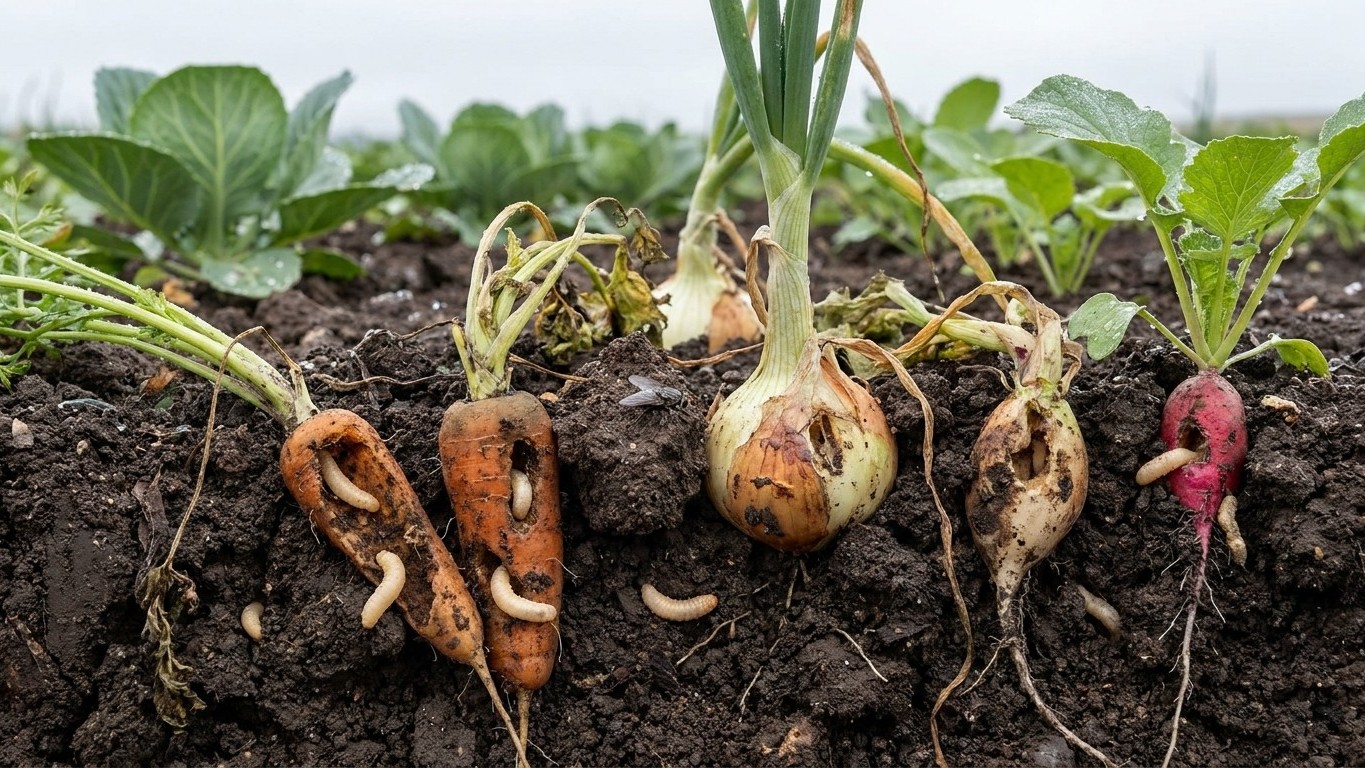

In South Carolina, celeriac, kohlrabi, horseradish and Jerusalem artichokes mostly go in during late winter and early spring, when the soil has warmed, not on the day the frost forecast clears. The state’s mild winters give these crops a long runway. Its summers are the harder part. For the full crop profiles, start with Celeriac, Kohlrabi, Horseradish and Jerusalem Artichokes.
When the soil is warm enough in South Carolina

Start with the date everyone asks about. At the Charleston airport station, the last spring frost falls between February 28 and March 17, according to the NOAA NCEI 1991-2020 Climate Normals (32°F freeze probabilities, 30-70% band, station USW00013880). That is a probability band, not a promise, so a late freeze in any given year is still possible.
Treat the frost date as a proxy, though. Celeriac, kohlrabi, horseradish and Jerusalem artichokes care about the temperature of the soil, and soil lags the air. It warms after the frost risk ends, not at the same moment. A bed can be frost-free in early March and still be cold and wet two inches down, where seed sits and sulks.
Reading the soil instead of the calendar
A basic soil thermometer, pushed in at planting depth in the morning, tells you more than any date. Compare the reading with the germination range on the seed packet or the planting guidance from your county extension office. Raised beds and dark, well-drained ground warm sooner than heavy, shaded clay, so two gardens ten miles apart can be a week or two out of step.
Location matters too. Those dates belong to the Charleston airport station, and the peninsula itself is milder. Upstate South Carolina runs several weeks tighter at both ends of the season, so a Greenville-area gardener should expect a later spring start and an earlier fall close than the figures above suggest.
By type, kohlrabi is the one that wants the earliest start, because it prefers cool weather and a spring sowing has a short run before heat arrives. Celeriac is usually started well ahead and set out as transplants. Horseradish goes in as root cuttings or crowns once the ground can be worked. Jerusalem artichokes go in as tubers, and they need a decision before anything else.
Site Jerusalem artichokes before you plant them
Jerusalem artichoke is effectively permanent once planted. Every fragment of tuber left in the ground regrows, and digging the patch over tends to scatter more pieces. This is the planting gardeners most often regret. Choose a spot you are willing to give up for good, away from vegetable beds and tidy borders, with a mowed or paved edge on every side. Then plant the tubers, in the same early window as the others, and expect them to stay.
How long the season lasts here
The first fall frost at the same station arrives between November 20 and December 5 (same NOAA NCEI normals, same probability band). Subtract, and the frost-free window runs from 248 days, counting March 17 to November 20, up to 280 days, counting February 28 to December 5. Those are the edges of the bands, not a forecast. A real year lands somewhere between, and an Upstate garden gets a noticeably shorter one.
The useful question is what that length allows. A window of more than eight months allows a second sowing, which a short northern season never would. Kohlrabi is the clear case. A spring sowing can be followed by a fall sowing that matures as summer heat breaks, and the fall crop often eats better than the spring one.
A long window also changes the transplant question. Root crops resent having their roots disturbed, which is why most are sown in place. Celeriac is the exception, since it is started early and moved, so you take the root check seriously and handle the plugs gently. In a short-season state, transplanting is often the only way celeriac finishes. Here, the length of the season gives you room to be careful and to replace a failed seedling instead of living with it.
Upstate, the arithmetic reverses. If both ends close in by several weeks, the first sowing carries more weight, a second sowing becomes a gamble, and a slow crop such as celeriac has less margin. The state extension service can tell you how your own county’s dates compare with the Charleston figures.
Heat and water in South Carolina

What any South Carolina gardener knows is that summers are hot and humid, with heavy, sometimes irregular rain. That combination decides how this group of crops behaves, and it is a different problem from the dry heat covered in Growing Unusual Root Crops in Arizona or the soggy conditions in Growing Unusual Root Crops in Louisiana, which has more in common with South Carolina.
Two facts govern the group. The first is season length. Celeriac is the long one, and the window of 248 to 280 days is long enough on paper to carry it, but the tail end of that window runs through the hottest weeks. Celeriac is happiest cool and evenly watered, so the realistic plan is a crop that spends summer growing slowly under mulch and finishes in the cooler fall. Whether it finishes at all depends on how well you manage July and August.
Heat and humidity also bring disease. Kohlrabi, horseradish and the turnip family are brassicas, and they share their troubles with cabbage, kale and mustard. A gardener who rotates kohlrabi into a bed where cabbage grew has rotated nothing. Mulch to keep the root zone cool, water deeply and evenly to avoid splitting, and give plants room so air can move through the foliage.
The second fact is the winter low. Charleston’s coldest month has a mean daily minimum of 38.9°F (NOAA NCEI Climate Normals 1991-2020). That is a mean and not a record, and freezes still occur, as the frost dates above show. The USDA Plant Hardiness Zone Map (2023) puts the state across zones 7a to 9a, which is a territory-wide range, so other parts of the state differ from the coast.
On the coast, horseradish and Jerusalem artichokes, both perennials, can stay in the ground under mulch, and hardy roots can often be left in the bed and pulled as needed. Upstate, check more carefully. Where the soil freezes, lift what you intend to keep before it does.
Stored roots deserve inspection, not trust. Look at every one: it should be firm, and a soft patch, a weeping spot or a moldy crown ends the question. A root that looks sound on the outside is not thereby safe, and no storage period can be promised. When in doubt, throw it out.
Which these root crops suit South Carolina
Choose by type, and let the state’s three pressures guide you: a long but hot season, mild winters and humid disease conditions. Humidity makes disease resistance the first criterion for any variety you buy. Heat favors types given airflow and shade at the root. A long window favors crops that can be sown twice.
| Type | What South Carolina presses on | What to favor |
|---|---|---|
| Celeriac | Summer heat during a long grow-out | Early transplants, mulch, even water, a fall finish |
| Kohlrabi | Heat that ends the cool season quickly | Two sowings, spring and fall |
| Horseradish | Little; mild winters suit it | A permanent bed with airflow |
| Jerusalem artichoke | Nothing slows it; spread is the risk | A boundary you can live with |
A variety performs the way it does for local reasons: disease pressure, soil, heat. Only the ones trialled in your own region mean anything. Clemson Extension does, and its county offices can tell you which types have been grown near you and how they fared.
Two preparation notes. Grating fresh horseradish releases compounds that burn the eyes and airways, and it is no joke. Work with the windows open or a fan running, and keep your face away from the bowl. Jerusalem artichokes cause digestive discomfort in many people, because they store inulin instead of starch. Start with a small first portion to find out how you react.
Common questions
Do the frost dates apply across all of South Carolina?
No. The dates come from the Charleston airport station, and the peninsula is milder still. Upstate runs several weeks tighter at both ends, so spring comes later and fall closes sooner.
Which varieties should I buy?
Ask Clemson Extension for varieties trialled near you.
Can I keep Jerusalem artichokes in check?
Assume not. Every tuber fragment regrows, so the only reliable control is choosing a site you can give up before planting. Mowed or paved edges help, but they do not guarantee anything.
Is a stored root safe if it looks fine?
Not automatically. Inspect each one, and discard any with a soft patch, a weeping spot or a moldy crown. Appearance alone does not make a root safe, and no keeping time can be promised.