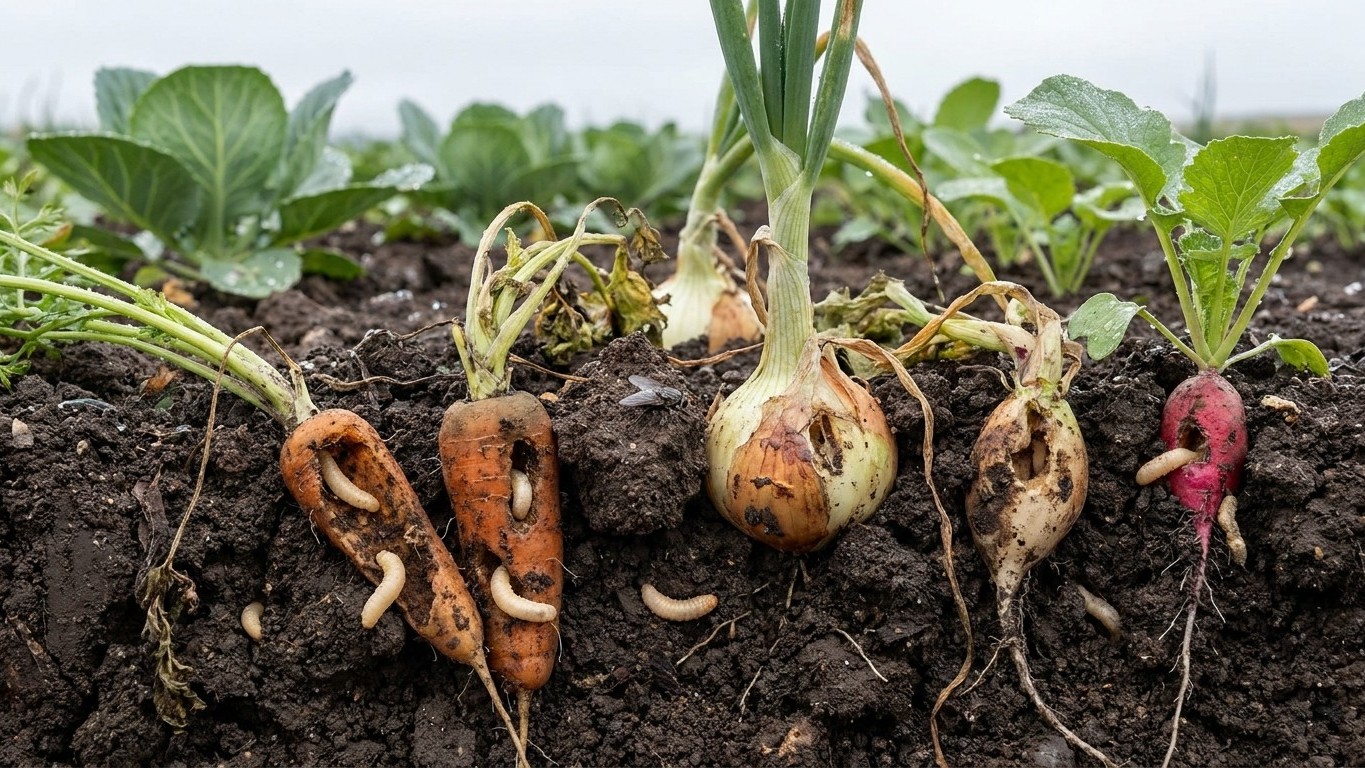

In Virginia, plant these roots once the soil has warmed, not on the day the last freeze passes. At the coast that means starting around the end of the March 20 to April 3 window, and weeks later in the Blue Ridge and southwest. Celeriac, kohlrabi, turnips, rutabagas, horseradish and Jerusalem artichokes each read the calendar differently. Most of them come down to one question: how much soil warmth, and how much summer, do they need?
When the soil is warm enough in Virginia

The NOAA NCEI 1991-2020 Climate Normals, for station USW00013769 at NAS Oceana, put the last spring 32F freeze between March 20 and April 3. That is the 30-70% probability band, so a freeze after the later date is possible in any given year. Treat it as odds, then move on, because the date is only a stand-in for what the plants care about.
Frost is a proxy, soil is the real clock
Air and soil keep different schedules. Soil holds winter’s cold long after a mild afternoon feels like spring, and it warms after the freeze risk ends, not at the same moment. A seed sown on April 1 into soil that is still cold sits there, and cold, wet ground is where seed rots. A cheap soil thermometer pushed a few inches down beats any printed date. For the exact temperature each crop wants, Virginia Cooperative Extension is the right source, and it publishes guidance by region.
Know where this number comes from, too. NAS Oceana sits in coastal Virginia Beach, which is the mild end of the state. The Blue Ridge and southwest Virginia run weeks later in spring. A gardener in Roanoke, Abingdon or Charlottesville should not borrow the Oceana window as it stands. Shift it later, and watch the soil rather than the calendar.
What each type does with warming soil
The group splits into three behaviors. Kohlrabi, turnips and rutabagas are cool-season brassicas, so they go in as soon as the ground can be worked and does not stick to your boots. Celeriac is the opposite in temperament: it needs the longest run of any of them and is normally started indoors and set out after the freeze risk has passed. Horseradish and Jerusalem artichokes are perennials, planted from root pieces or tubers once the ground is workable, and they are far more forgiving about timing.
Site the Jerusalem artichoke before anything else
Decide where a Jerusalem artichoke goes before you buy a single tuber, because it is effectively permanent once planted. Every fragment of tuber left in the soil regrows, and digging the patch over only scatters more pieces. Gardeners regret this planting more than any other in the vegetable garden. Give it a bed at the edge of the property, or a bordered area you are willing to give up for good, and keep it away from the vegetable rows. Plant it in spring when the soil is workable. Then expect it to be there for years.
How long the season lasts here
The same NOAA station gives the first fall freeze between November 10 and November 24. Put that beside the spring window and the arithmetic is straightforward. From April 3, the later end of the spring range, to November 10, the earlier end of the fall range, is 221 days. From March 20 to November 24, the generous pairing, it is 249 days. So the freeze-free stretch at Oceana runs from about 221 to 249 days, depending on which ends of the two ranges the year gives you.
What does a window that size allow? Mostly a second sowing. In a short climate, the first sowing is the only one, and every decision rides on it. At the Virginia coast, the window is long enough to sow cool-season roots such as turnips and kohlrabi in spring, then sow again in late summer for a fall harvest, with plenty of cool weather left to finish them.
Length also changes whether transplanting is worth the trouble. Celeriac resents root disturbance and is slow to settle, so in a short season a check at transplanting costs weeks you do not have. With 221 days or more, a seedling can lose a little time and still finish. That margin shrinks fast uphill. In the mountains, where spring comes weeks later and fall earlier, the same subtraction would produce a much smaller number. Gardeners there should ask the extension service for their county’s frost dates before deciding.
Neighbors tell the story from both sides. The tradeoffs in Growing Unusual Root Crops in Tennessee look much like the Virginia coast, while Growing Unusual Root Crops in Minnesota shows what happens when the window closes to a fraction of this length and the first sowing really is the only one.
Heat and water in Virginia
Virginia summers are warm and humid. That kind of weather rarely kills a root crop outright. It does the slower damage of foliar disease, rot in wet soil and poor root development when plants stall in the heat. A gardener who wants the numbers should pull them from the extension service for the nearest weather station.
Two facts govern the rest of the decision. The first is season length. Celeriac, the long one, has 221 to 249 freeze-free days at the Oceana station to finish, and the coast gives it room. Farther inland and uphill, where the season is shorter, whether it can finish at all becomes a real question that depends on the local dates.
The second is the winter low. The NOAA NCEI Climate Normals for Virginia Beach give a mean daily minimum of 31.6 F in the coldest month. That is an average of the nightly lows, not the record cold, and it says nights there hover right at freezing. On the coast, hardy roots and perennials like horseradish and Jerusalem artichokes can usually stay in the ground under a layer of mulch, and be dug as needed. The USDA Plant Hardiness Zone Map 2023 places Virginia anywhere from zone 5a to 8b, so the state is not one climate. In the mountains, the winter low is far harder, and ground that freezes solid changes the answer: roots may need to be lifted and stored before the soil freezes.
Storage is where food safety enters. Before putting any lifted root away, inspect it. Look for soft patches, weeping spots and moldy crowns. A root that looks sound on the outside is not proof it is safe, and any of those signs ends the question: it goes to the compost, not the pantry. Keeping time varies with storage conditions and variety, so the extension service is the place for storage guidance.
Humid summers also bring a pest note. Turnip and rutabaga are brassicas, so they share their troubles with cabbage, kale and mustard. A gardener who rotates them into a bed that held cabbage has rotated nothing.
Which these root crops suit Virginia
The choice here comes down to type, not cultivar, and there is a reason for that. The varieties tested in your own region are the only recommendation that means anything, and Virginia Cooperative Extension keeps that information. Ask your county office what has performed well locally, then buy those.
Reason from the facts instead. Virginia’s coast has a long window, so even slow crops like celeriac are possible there. Inland, where the season shortens, the earliest-maturing types make more sense, and kohlrabi and turnips, which have a quick turnaround, come out ahead. Summer here is warm and humid, so give plants airflow and shade at the root, and mulch to keep soil cooler. Humidity makes disease resistance the first thing to look for on a seed packet. Here is how the group compares:
| Root | What Virginia asks of it | What to watch |
|---|---|---|
| Celeriac | Needs the longest run; suits the coast best | Short-season mountain sites; check local dates |
| Kohlrabi | Quick cool-season crop; fits spring and fall sowings | Brassica pests and diseases; rotate |
| Turnip and rutabaga | Cool-season; sow spring and late summer | Brassica family; never follow cabbage or kale |
| Horseradish | Perennial; stays in the ground under mulch on the coast | Humid summers; mountain winters |
| Jerusalem artichoke | Perennial; tolerant of the climate | Spreads permanently; site it with care |
Two kitchen facts belong in this decision. Grating fresh horseradish releases compounds that burn the eyes and airways, so work with good ventilation and keep your face away from the bowl. And Jerusalem artichokes store inulin instead of starch, which causes digestive discomfort in many people. A small first portion is the sensible way to find out how you respond. Cooking and frost are not guaranteed to change that.
Common questions
When should I plant unusual root crops in Virginia?
Wait for warm soil, not just the end of frost. At the NAS Oceana station, the last spring 32F freeze falls between March 20 and April 3, but that is the mild coastal end of the state. The Blue Ridge and southwest Virginia run weeks later, so check your own county’s dates with the extension service.
Can celeriac finish in Virginia?
At the coast, the freeze-free window of 221 to 249 days gives it room. In the mountains, where spring comes later and fall earlier, it is less certain, and local frost dates decide the answer.
Can I leave roots in the ground over winter?
On the coast, where the coldest month averages a 31.6 F daily minimum at Virginia Beach, hardy roots and perennials can usually stay under mulch. In the mountains, ground that freezes solid calls for lifting and storing before the freeze. Inspect everything you lift, and discard any root with a soft patch, a weeping spot or a moldy crown.
Which varieties should I buy?
Ask Virginia Cooperative Extension for the ones trialed near you. Only locally tested varieties are a meaningful recommendation. For the wider picture on the group, see Celeriac, Kohlrabi, Horseradish and Jerusalem Artichokes.