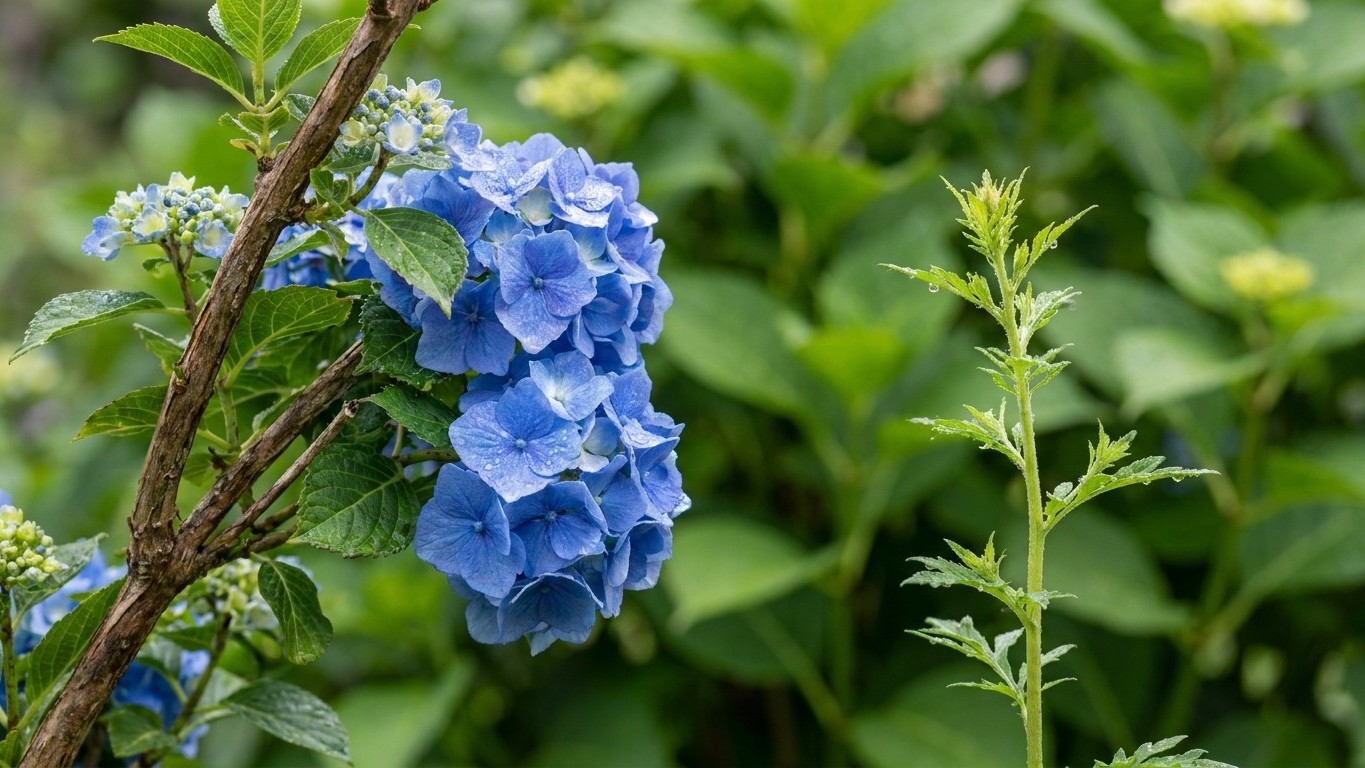

Growing hydrangeas in Missouri comes down to choosing the right type. Smooth and panicle hydrangeas bloom on new wood and shrug off the late freezes that wipe out bigleaf flower buds. Plant container shrubs after the last spring frost (April 6 to April 20 at Kansas City’s airport station) or in early fall. Give them morning sun and soil that holds moisture. Watch for Japanese beetles from late June. Bigleaf types can work here too, with some protection.
When to plant Hydrangeas in Missouri

The dates below come from Kansas City International Airport (MCI), the reference station for this guide. NOAA NCEI’s 1991-2020 Climate Normals put the 32°F freeze probability between 30 and 70 percent from April 6 to April 20 in spring, and from October 18 to October 29 in fall (station data). That is a window, not a deadline. MCI sits well north of the city, and the downtown station runs about five days earlier in spring. Southern Missouri is milder still. Northern counties and higher ground run later than the airport, so check your own county before you set a planting date.
Seeds are the wrong starting point
Most plant guides tell you to start seeds indoors six to eight weeks before the last frost. Hydrangeas don’t work that way. Seed-grown plants take years to flower and rarely match the parent. Nearly everyone buys a container shrub or roots a cutting. If you take softwood cuttings in early summer, pot them up in fall, keep them somewhere cold but unfrozen (an unheated garage works), and treat them as nursery plants the following spring.
Count-back arithmetic for hardening off
A potted hydrangea from a greenhouse or a store’s heated entrance has never felt wind or direct sun. Start hardening it off about a week to ten days before the planting date. Set it outside in shade for a few hours, then lengthen the time each day, and finish with a night or two outdoors if no frost is forecast. If you plan to plant the day after the late edge of the window (April 21 at MCI), start hardening off around April 11 to 14. Gardeners in the south can shift earlier by a week or more. Northern and higher-elevation gardeners should shift later.
Florist hydrangeas sold around Easter are usually forced bigleaf plants. They can survive in the ground, but they were bred for the pot, not for a Missouri winter, so expect mixed results.
Fall planting works, with limits
Fall is a fine time to plant because roots grow while the air cools. Count back from the first fall frost window: roughly six weeks of root growth before October 18 means planting by the first week of September. Today is October 7, so you are at the tail end. Hardy panicle and smooth types planted now do fine with a thick mulch layer and steady watering until the ground freezes. A new bigleaf is safer waiting until spring. This guide has no ground-freeze date for Missouri, so don’t treat the frost window as the finish line for root growth.
Soil and site preparation
Morning sun and afternoon shade is the formula most Missouri hydrangeas want. Summer heat here is hard on leaves, and bigleaf and oakleaf types will scorch and wilt under all-day western exposure. Panicle hydrangeas handle more sun, and a full-sun spot with consistent water suits them well. Choose a site protected from the harshest winter wind, which is another reason to plant a bigleaf near a wall or foundation rather than in an open lawn.
Texture and drainage decide most outcomes. Clay-heavy yards are common across much of the state, and hydrangeas like moisture but not standing water. Dig a hole about 12 inches deep, fill it with water, and let it drain. If water still sits there the next morning, build a raised bed or mound the planting area a few inches. Skip the sand shortcut. Sand mixed into clay can make a concrete-like mass.
Amend the whole bed, not just the hole. Work several inches of compost into an area two to three times the width of the root ball. A hole full of rich soil in a clay yard acts like a flowerpot and the roots circle inside it. Do the work in the weeks before planting, in fall or very early spring, so the compost settles and you can see how the bed drains after a rain.
Soil pH and flower colour
Only bigleaf hydrangeas change colour with the soil. Acidic soil (around pH 5.5 or lower) lets the plant take up aluminum and the flowers turn blue. Near-neutral or alkaline soil keeps them pink. Smooth, panicle and oakleaf types are white or green-to-pink by genetics, and no amendment changes that. Soil chemistry varies across Missouri, so a soil test through your county extension office tells you where you start. Shifting pH takes months, and the colour may drift back, so most gardeners pick the colour their soil already favours.
Spacing is simple. Plant at the mature width on the tag, and keep the crown level with the soil surface. Too deep is a quiet killer.
Varieties that suit Missouri
Traits matter more than names. The big one is whether the plant flowers on old wood (last year’s stems) or new wood (this year’s growth). A Missouri winter or a freeze after April can kill old-wood buds and leave you with green leaves and no blooms. New-wood bloomers flower regardless. Next comes sun and heat tolerance, then stem strength, since large heads can flop after summer storms.
| Type | Widely sold examples | Blooms on | Good for |
|---|---|---|---|
| Smooth (Hydrangea arborescens) | Annabelle, Incrediball | New wood | Reliable white blooms, shade, cold tolerance |
| Panicle (H. paniculata) | Limelight, Little Lime, Quick Fire, Pinky Winky | New wood | More sun, heat, late-summer colour |
| Bigleaf, reblooming (H. macrophylla) | Endless Summer | Old and new wood | Blue or pink flowers with a second chance |
| Oakleaf (H. quercifolia) | Snow Queen | Old wood | Fall leaf colour, shade, a woodland look |
Annabelle is the old standby and wild smooth hydrangea is native to parts of Missouri, so it feels at home here. Its weakness is floppy stems under heavy blooms, which Incrediball was bred to improve. Limelight and its relatives are the choice for a sunnier yard. Their flowers age from green to cream to pink, and they tolerate trimming in early spring. Reblooming bigleafs give you a fallback if a freeze takes the old-wood buds, though they still sulk after a hard winter.
Bigleaf plants are the gamble in this state. Plant one if you love the colour, protect it, and don’t build your whole garden around it. If you are deciding between types in general, the complete guide to growing hydrangeas covers the species side by side.
What to plant alongside
Good neighbours for hydrangeas share their need for moist, humus-rich soil and part shade. Hostas, ferns, astilbe, heuchera and Japanese forest grass fill the ground layer and shade the soil, which keeps roots cooler. Woodland phlox, columbine and Solomon’s seal add spring colour before the shrub leafs out fully. Spring bulbs planted around the crown also work, since their foliage fades just as the hydrangea takes over.
The pollinator draw is more limited than people assume. Big mophead and panicle blooms are mostly sterile showy sepals with little nectar. Lacecap types and wild smooth forms carry fertile flowers in the center, which bees visit. For pollinators, add native perennials at the sunnier edge of the bed rather than expecting the shrub to do the work.
What to keep away is a matter of competition. Mature maples and other shallow-rooted trees steal water and nutrients, and hydrangeas lose that fight in July. Avoid planting near black walnut. Reports on how hydrangeas respond to juglone, the compound walnut roots release, are mixed, so distance is cheaper than finding out. Anything that needs dry, lean soil, such as lavender or sedum, wants the opposite of what hydrangeas want.
One pairing claim has no real evidence: that garlic, chives or marigolds around the shrub confuse pests and protect it. Nothing solid supports it for hydrangeas. Mulch and healthy soil do more good.
Watering, feeding and support
Water deep, not often. Roughly an inch a week from rain and the hose together is a sound baseline, more in a hot dry spell, applied slowly at the base. Shallow daily sprinkling keeps roots near the surface, where Missouri heat bakes them. The leaves wilt on hot afternoons even in moist soil, and that is normal. Check the soil before you water. If the wilting plant still looks limp the next morning, it needs a drink.
Mulch two to three inches deep, shredded bark or leaf mold, and keep it a few inches off the stems. It holds moisture and keeps roots cool. Refresh it each spring.
Feeding needs restraint. One application of slow-release balanced fertilizer in spring is plenty for most plantings, and compost already does much of the job. Heavy nitrogen produces leaves at the expense of flowers. Stop feeding by midsummer. Late feeding pushes soft growth that the first fall frost, due October 18 to 29 at MCI, will burn.
Support helps the big-headed smooth types most. Stems that flop after rain can be corralled with a ring of stakes and soft ties in spring, or avoided by choosing a stiffer variety.
Pruning depends on the type, and it explains most “my hydrangea won’t bloom” complaints. Smooth and panicle hydrangeas bloom on new wood, so cut them back in late winter or early spring. Smooth types can be cut nearly to the ground, and suckers around the base are just new stems you can thin or dig up. Bigleaf and oakleaf types bloom on old wood, so prune right after flowering and otherwise only remove dead stems once leaves show where the life is.
Common problems

No flowers on a healthy shrub is the top complaint. Check the type first. A bigleaf or oakleaf whose buds were killed by winter or a late freeze will leaf out lush and bloom little. Wrong-time pruning does the same. Too much nitrogen and too much shade are the other usual causes. For a bigleaf, wait until spring growth shows before cutting anything, because live buds are easy to remove by accident.
Wilting at midday is heat stress. Wilting that persists at dawn after watering suggests either dry roots or the opposite, soggy soil that has suffocated them. Dig down a few inches and feel the soil. Poor drainage that rots roots shows up as yellowing leaves and a plant that fails to recover.
Leaf spots appear as brown or purple blotches, often after wet weather. They are common on hydrangeas and rarely kill the plant. Water at the base rather than overhead, space plants for airflow, and rake up fallen leaves in autumn. White powdery coating, mostly on leaves in humid, crowded conditions, is powdery mildew. Better airflow usually handles it without sprays.
Brown, crispy leaf edges in July mean scorch from sun, wind or dry soil. The fix is mulch, deeper watering and, if the spot is too hot, moving the plant in fall. Browned flower heads that never fully opened often point back to cold damage to buds or severe drought stress when they formed.
Green flowers on varieties that should be pink or blue can be natural ageing. Panicle blooms shift colour as they mature. In bigleafs, pale or washed-out colour sometimes signals a soil pH mismatch, which is where the soil test pays off.
Chewed or stippled leaves are a separate category with their own culprits, covered next.
Pests that actually show up in Missouri
University of Missouri Extension’s Missouri Environment and Garden newsletter highlights a long list of home garden pests. Most of that list is vegetable trouble: squash vine borer, squash bug, cucumber beetles and the hornworms attack squash, cucumbers and tomatoes, not hydrangeas. Three entries do matter for the shrubs. The peak season for all of them runs June through August.
Japanese beetles are the most visible. What you see first is leaves turning into lace, with veins left and the flesh between them eaten. In mid-Missouri the adults emerge mid to late June, peak the second week of July and decline by early August. The control that works on a shrub is hand-picking into a bucket of soapy water in the cool morning when they are sluggish. Pheromone traps tend to draw more beetles than they catch.
Spider mites arrive when summer turns hot and dry. The first sign is a fine speckling or bronzing on leaves, then thin webbing on the undersides. Hold a sheet of white paper under a branch and tap. Tiny moving specks are mites. A strong spray of water on the undersides, repeated every few days, knocks populations down, and keeping plants watered in drought makes them less attractive. Note that the extension calendar mentions mites only briefly, so treat this as general practice rather than a state ranking.
Bagworms are the one to catch early. You see small, spindle-shaped bags of silk and bits of leaf hanging from branches. Control them in June, because by July the caterpillars are almost too big to treat. A spray of Bt (Bacillus thuringiensis var. kurstaki) on young caterpillars works. Later in the season, hand-pick the bags. The sources here carry only a brief calendar mention for bagworms, and they feed on many shrubs, so hydrangeas are an occasional target, not a favourite.
Brown marmorated stink bugs also appear on the list and may sit on foliage, but they are a minor concern on hydrangeas. Your county extension office can identify anything unfamiliar.
Harvest and end of season
Hydrangeas don’t ripen off the vine the way vegetables do, but the same patience applies to cutting. For fresh bouquets, cut in the cool morning, once blooms have firmed and the colour is fully developed, then plunge stems straight into water. Panicle and smooth types hold up well. Bigleaf blooms wilt fast unless conditioned in cool water.
For drying, wait until late summer, when the petals feel papery and the colour has aged to antique shades of green, rose and burgundy. Cut with a foot or so of stem, strip the leaves, and hang the bunches upside down in a dry, dark spot with moving air. Dried heads last for months. Panicle types dry especially well. Leave a few blooms on the shrub for winter interest if you like.
As the first fall frost approaches (October 18 to 29 at MCI, earlier in the north), stop feeding and water the plants deeply before the ground freezes. Rake leaves off the bed to cut down on leaf spot spores, then add a fresh layer of mulch. For bigleaf types, which bear their flower buds on old wood, protect those stems with a cage of chicken wire stuffed with leaves or straw, and do not cut them back. Smooth and panicle types need no wrapping, and you can prune them in late winter.
If you garden near the border, the neighbouring-state guides for Iowa and Illinois show how the same advice shifts with colder winters, while the Maryland guide shows the eastern version. More state pages live in the Missouri guides.
Local help
Frost dates, soil pH and pest pressure shift from county to county. University of Missouri Extension runs county offices that offer soil testing, pest identification and planting dates for your area. Bring a leaf sample or a clear photo of the damage, and ask about timing for your location.
Common questions
What is the best hydrangea for Missouri?
Smooth hydrangeas such as Annabelle or Incrediball and panicle hydrangeas such as Limelight are the most dependable here because they flower on new wood. Bigleaf and oakleaf types can do well but risk losing flower buds to winter cold or a late freeze.
Can I get blue hydrangeas in Missouri?
Only with bigleaf varieties, and only if your soil is acidic enough, around pH 5.5 or lower. Test first through your county extension office. Where soil leans neutral or alkaline, blooms stay pink unless you amend, and amendments need regular repeating.
When should I prune hydrangeas in Missouri?
Prune smooth and panicle types in late winter or early spring. Prune bigleaf and oakleaf types right after they flower, since they set buds on old wood. If you’re unsure which type you have, wait until spring growth shows and remove only dead wood.
Why are my hydrangea leaves turning to lace in July?
Japanese beetles, most likely. In mid-Missouri they peak around the second week of July and fade by early August. Hand-pick them in the morning into soapy water. The damage looks bad, but a healthy shrub generally leafs out again.
Do hydrangeas need protection for a Missouri winter?
Smooth and panicle types do not. Bigleafs benefit from a wire cage filled with leaves or straw and a deep mulch layer before the first frost, which arrives October 18 to 29 at Kansas City’s airport station. Remove the cage once the spring freeze danger passes, after the April 6 to 20 window and a bit later in northern counties.