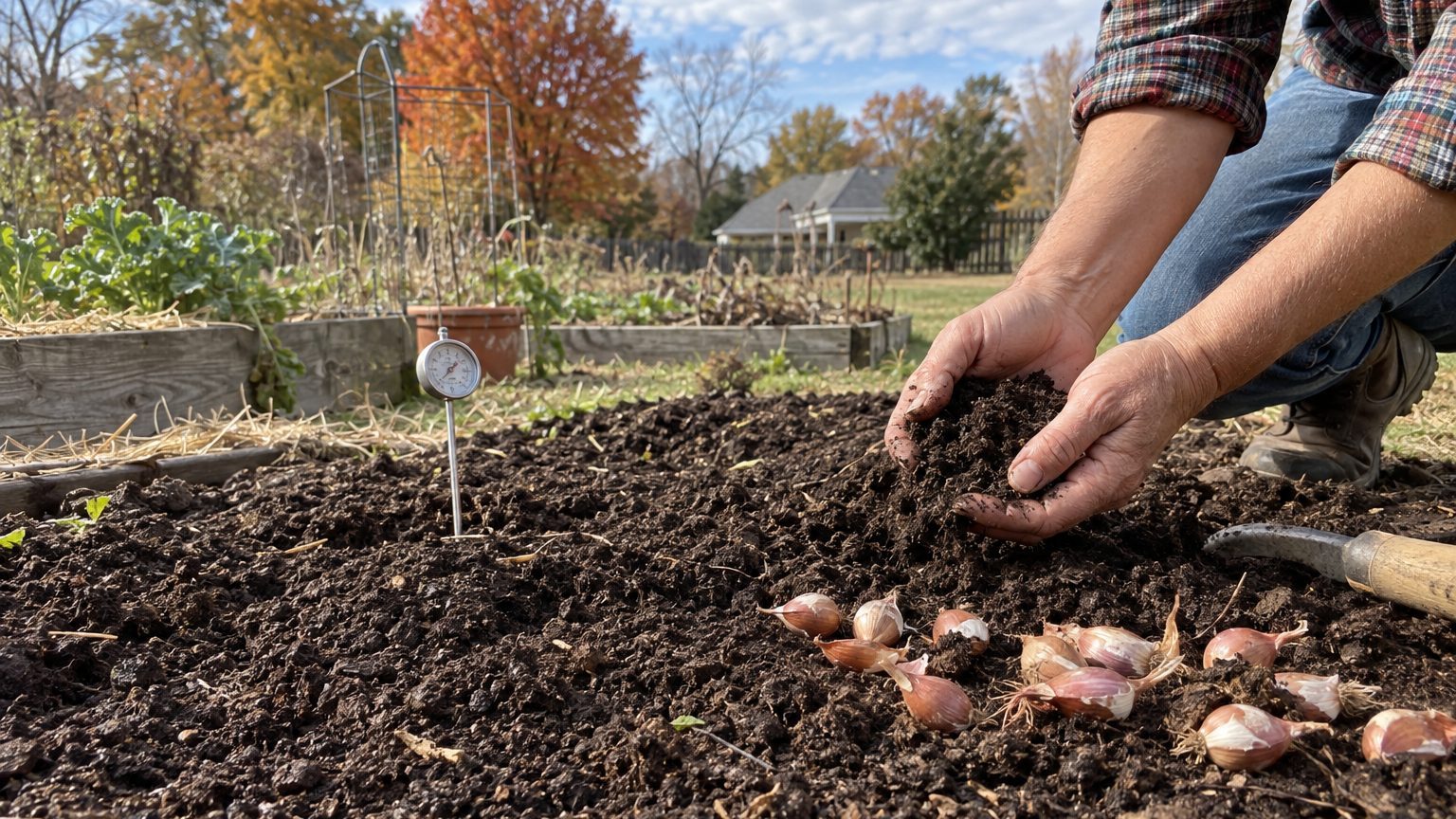

Shallots are a workable crop in Alberta. Plant sets in spring, once the ground has thawed and dried enough to dig, and expect to harvest before the first hard frost of September. At the Calgary airport station, the average gap between the last spring frost and the first fall frost is 118 days. That is enough for one good crop, and the rest of this page covers how to use it. For the basics of the crop itself, start with Growing Shallots: One Bulb In, a Handful Out.
When the soil is warm enough in Alberta
The date most people ask about is May 21. That is the average last spring frost at the CALGARY INT’L A station (climate ID 3031093), from Environment and Climate Change Canada’s Canadian Climate Normals for 1981-2010. It is a mean, which means that in one year out of two the last frost lands later than May 21. Treat it as the middle of a window, not a safe date. A frost date is a probability, not a promise.
Frost is also only a proxy. Shallots care about the soil, and soil warms after the frost risk ends, not at the same moment. A bed can be frost-free on paper and still be cold, sodden and sluggish three inches down. Roots barely move in that kind of ground, and sets sitting in cold, wet soil are the ones that rot. The practical test is simple: dig a handful. If it crumbles instead of smearing, and the bed has drained after the last snowmelt or rain, you can plant. I won’t give you a single soil temperature to chase, because a thermometer reading at one depth on one afternoon tells you less than how the bed behaves in your hand.
Location matters as much as the calendar. The station sits at Calgary’s airport, and Alberta is not one climate. Northern districts, foothills and higher ground run weeks behind that figure. Note too that Canadian normals cover 1981-2010, while the US figures elsewhere on this site cover 1991-2020, so don’t line the two up as if they were the same yardstick.
What carries over from garlic, and what doesn’t
Shallots and garlic share a lot of practice: autumn planting, curing, storage and allium rotation. The garlic section of this site covers each in depth, so this page won’t repeat it. What differs for shallots is the scale. Each set is small, each plant multiplies into a cluster, and the bulbs are thinner-skinned and smaller than a garlic head, so they dry down faster in a good year and have less margin when it turns wet.
Curing is where food safety enters. When tops have fallen and yellowed, lift the clusters, dry them somewhere airy and out of rain, and then inspect each bulb. Look for a dry, tight neck, papery skins and a firm base. A soft neck or a moldy base ends the question for that bulb, and a bulb that merely looks fine is not proof it is sound. I won’t promise a keeping time. It depends on the year, the curing and the storage, and you check the bulbs rather than trust a number.
As for what to plant, this page talks in types and not named varieties. Alberta Agriculture and Irrigation is the place to ask which ones have been trialled in the province.
How long the season lasts here
Count from May 21 to September 16, the average first fall frost at the same Calgary station and from the same ECCC normals. That is 118 days: ten left in May, then 30 in June, 31 in July, 31 in August and 16 in September. Both dates are averages, so both can slip. A cold, late spring and an early frost in the same year can shave the window noticeably, while a kind year can stretch it. And the 118 days run from the last frost, so you start the clock when the soil is ready, not when the calendar says so.
What does 118 days allow? One crop, planted early, with little room for improvisation. Think of it as roughly four months, which is shorter than the stretch between Labor Day and New Year’s Day in the pace it feels. A second sowing in midsummer would be racing a September frost with plants that have had only weeks to build a bulb. In a mild year that might yield something eating-sized, and in a typical one it yields small bulbs that cure poorly. For a longer window, a second sowing starts to make sense. Here, the first planting is the one that counts.
That also shifts the calculus on transplanting. Starting shallots from seed indoors and moving them out is a way to buy back weeks, and in a window this tight it can be worth the effort. The price is the root check: seedlings that get set back by disturbed roots, or by cold ground after planting out, lose time you don’t have. If you plant sets, there is no transplant to worry about, since the set is already a bulb with a head start. Whichever route you take, get plants into the ground as early as the soil allows, then protect them from a late cold snap with cover if frost is forecast.
If you are weighing whether a staggered planting could work in your own bed, the succession sowing guide on this site walks through the logic of spacing plantings and when the later ones stop paying off. Alberta sits on the short side of that logic.
Heat and water in Alberta
This page can’t give you a count of days above 90 °F (32 °C) or a summer rainfall total, because verified figures for either are not among the data behind it, and I’d rather leave them out than guess. Any count would also come from one reference station, not from the whole province. What this page can say with confidence is that the real question for Alberta isn’t summer heat. It’s winter.
At the Calgary reference station, the mean daily minimum of the coldest month is -13.2 °C (8.2 °F), from ECCC normals for 1981-2010. That is an average, not a record low, and cold snaps go well below it. Calgary’s Canadian hardiness zone is 4a, from Natural Resources Canada’s plant hardiness site (1991-2020 normals). That is a Canadian zone and not a USDA zone, and the two don’t convert. NRCan itself notes that Canadian zone 4a overlaps nine USDA zones, from 3a to 7a, because the Canadian system weighs seven climate variables instead of one.
Autumn against spring
That winter is what decides the planting season. Autumn planting is popular because it produces larger, earlier bulbs, as roots establish in fall and growth resumes at the first thaw. The trade-off is that sets spend the whole winter in the ground. Where the soil freezes hard and stays wet, autumn-planted sets can rot, or they heave out of the ground in repeated freeze and thaw cycles. In most of Alberta, with cold winters and variable cover, spring is the safer call. If you want to try autumn planting anyway, plant a small test row, mulch it thickly with straw after the ground has frozen, and treat the result as an experiment before committing the whole bed. The garlic pages on this site cover autumn planting in more depth.
Summer is more forgiving, though it has its own quirks. A cool, damp summer brings mildew, slow ripening and disease, and tops that refuse to fall over. A hot, dry one stresses plants that need steady moisture while the bulbs swell. Either way, water consistently through bulbing, then ease off as the tops begin to yellow, so the bulbs can finish and cure. Spacing and a bed that drains well do more for a crop in a wet summer than any treatment, and avoiding wet foliage in the evening helps too. If disease does show up, rotate alliums away from that bed for several years instead of reaching for a spray.
Which shallots suit Alberta
Choose by type, since a short season rewards some kinds more than others. With 118 days between average frosts, the earliest-maturing types come first. A late type that needs every day of a long summer is a gamble here, and a gardener at a cooler, higher-elevation site is gambling more. Sets of early types, planted as soon as the bed is ready, give the crop its best shot at curing before the weather turns.
The second criterion is disease resistance, particularly if your summers run damp. A type that holds up to mildew and rot matters more than a few extra days of size. After that, look for plants that tolerate airflow and some shade at the root if your summers run hot, because bulbs cooked at the soil line stall. Seed-grown types and set-grown types behave differently too. Seed-grown types are often hardier against disease but need an early indoor start and transplanting, with the root check that goes with it. Set-grown types are simpler but may carry more disease risk if the stock is poor, so buy sets from a reputable supplier.
I won’t name a variety, and the reason is a good one. The only recommendation that means anything is the one tested in your conditions, and this page doesn’t have those trial results. A name I made up would look helpful and send you to a seed rack for something that doesn’t exist, or to a variety that failed in a district like yours. Alberta Agriculture and Irrigation is the right place to ask which ones have been trialled in the province, and its staff can tell you what suits your region and your elevation.
For comparison, Growing Shallots in Saskatchewan deals with a similar prairie winter, and Growing Shallots in New Hampshire shows how a humid climate changes the whole checklist.
Common questions
Can I plant shallots in fall in Alberta?
You can try, but spring is the safer call. The coldest month’s mean daily minimum at Calgary is -13.2 °C (8.2 °F), and hard-freezing, wet ground rots or heaves autumn-planted sets. If you experiment, use a small trial row and a thick mulch.
Is May 21 safe to plant?
Not as a guarantee. May 21 is the average last spring frost at Calgary’s airport station, so in one year out of two the last frost falls later. Plant when the soil is thawed and crumbly, and keep cover handy for a late cold night.
Is there time for a second planting?
Rarely. The average gap between last spring and first fall frost at the Calgary station is 118 days, and a midsummer sowing would be racing the September frost. The first planting is the one to put your effort into.
How do I know my cured shallots are safe to store?
Inspect each bulb for a dry, tight neck, papery skins and a firm base. A soft neck or a moldy base ends the question, and a bulb that only looks sound isn’t proof that it is. Storage times vary from year to year, so check your bulbs often instead of relying on a number.