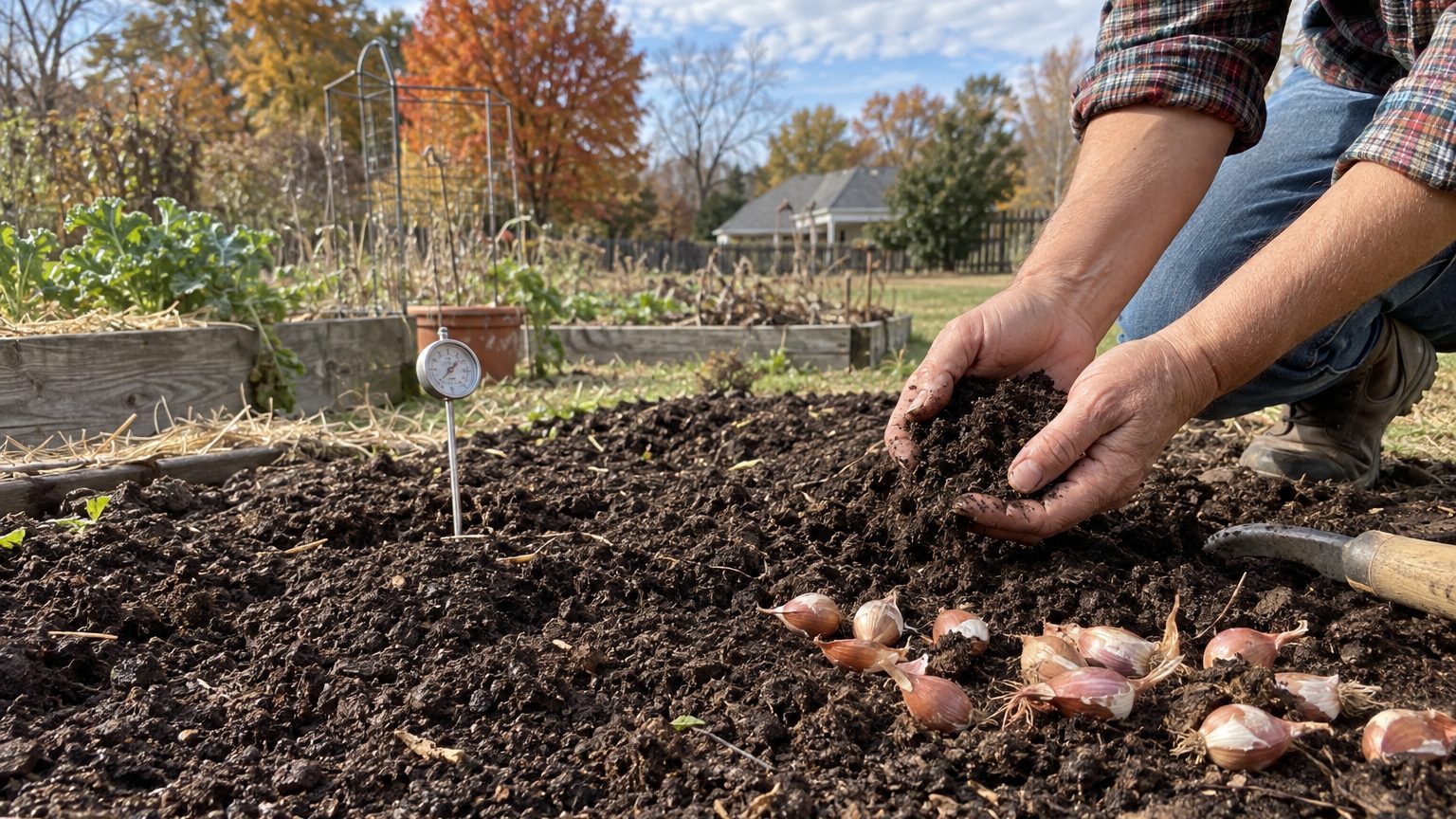

Arkansas gardeners can plant shallots twice a year: in autumn for earlier, larger bulbs, or in spring once the ground is workable. The spring clock starts with a last 32°F freeze that falls between March 12 and March 28 at the Little Rock reference station. Winters across most of the state are mild enough to make autumn planting realistic. Where you sit inside Arkansas decides which season wins.
When the soil is warm enough in Arkansas
The number to anchor on comes from NOAA’s 1991-2020 Climate Normals for Little Rock (station USW00013963): the last spring freeze at 32°F falls between March 12 and March 28, measured across the band of 30% to 70% probability. A frost date is a probability, not a promise. Treat it as the middle of a range, and keep row cover handy for the years that land on the wrong side of it.
Why the soil sets the day, not the frost date
Frost is a proxy. Shallots respond to the ground, not the air, and soil warms more slowly than the air does. It warms after the frost risk ends, not with it. A bed can be frost-free in late March and still be cold, soggy clay that rots a set before it roots. The practical test is simple: pick up a handful from planting depth and squeeze. If it crumbles, you can plant. If it smears into a ribbon, wait. A soil thermometer helps, and your extension office can tell you the soil temperature it recommends for alliums in your county.
One caution about the weather service’s other dates. For the 36°F light-frost threshold, NWS Little Rock gives April 3 and October 31. Those are the dates tender crops like tomatoes need. Shallots are hardy, so the 32°F band above is the more useful guide for them.
Arkansas is also not one climate. The USDA Plant Hardiness Zone Map (2023 edition, built on the average annual extreme minimum temperature) places the state between zones 6b and 8a. Little Rock is the reference city here, so treat its dates as a starting point. The Ozark hills run colder and later than the south and the Delta, and your own yard may differ again.
Autumn planting, curing and storage
Autumn planting, curing, storage and allium rotation work much as they do for garlic, so the garlic section of this site covers the shared groundwork. The shallot differences are mostly about habit. One planted bulb divides into a cluster, so spacing has to leave room for a handful rather than a single head. The rotation rule is the same, though: keep shallots out of any bed that held onions, garlic or leeks recently.
At harvest, cure the bulbs somewhere dry, shaded and airy. Then inspect each one. The neck should be tight and dry, the skins papery, the base clean. A soft neck or a moldy base ends the question: that bulb does not go into storage. A bulb that looks fine is not proof it is sound, and no one can promise how long a cured crop will keep. Check the stored bulbs regularly and pull any that soften.
How long the season lasts here
The arithmetic
Both ends of the window come from the same Little Rock station and the same 32°F band. The last spring freeze falls between March 12 and March 28, and the first fall freeze between November 7 and November 20. Counting calendar days between them gives 240 days if you pair the two early dates, and 237 if you pair the two late ones. Mix the extremes and the window runs from 224 to 253 days. For comparison, the 36°F dates (April 3 to October 31) give 211 days, which is the number a tomato grower should use.
That is a long window by national standards. Some northern gardeners get fewer than half as many frost-free days.
What that length allows
Length matters because of what it permits. A short season makes the first planting the only one, and every setback costs the whole crop. Arkansas does not work that way. A window of 224 to 253 days leaves room to stagger plantings a few weeks apart, so the whole crop does not mature in the same hot week. It also leaves room for a separate autumn planting if a spring one disappoints. The sowing guide on this site walks through how to space those plantings.
The long window also changes the transplant question. Where the season is tight, buying or starting transplants only pays off if the roots are healthy, because a stalled plant has no time to recover. In Arkansas, a transplant that sulks for two weeks still has time to make a bulb, so a transplant is worth buying. Still do the root check at the nursery or when you pull seedlings from the tray: roots should be white and firm, not brown or mushy. Rotten roots carry disease into your bed.
One caution keeps the arithmetic honest. The window measures frost-free time, not bulbing time. Shallots do their growing in the cool months and finish before summer’s worst heat, so most of those 224 to 253 days are about when you plant and what you do afterward, not how long the bulbs spend growing.
Heat and water in Arkansas
The count of days above 90°F at the reference station and the summer rainfall total are not among the figures verified for this page. I will not guess at them. NOAA’s Climate Normals carry both for the weather station nearest you, and they are worth looking up. What can be said honestly is that Arkansas summers are hot and humid. For a crop that dislikes wet feet and heat while the bulbs finish, that humidity is the larger worry, because it feeds foliar disease.
Autumn or spring?
The winter low decides this choice. The mean daily minimum of the coldest month at Little Rock is 30.9°F, just below freezing. That is a mean, not a record: it tells you most winter nights hover near the line and the ground thaws and refreezes, not that it never gets colder. Where the ground freezes hard and stays wet, autumn-planted sets rot or heave out of the soil, and spring is the safer call. Where winter is milder, autumn planting rewards you with larger, earlier bulbs, which is why people do it.
| Choice | What you gain | What you risk in Arkansas |
|---|---|---|
| Autumn planting | Roots settle over winter and bulbs are larger and earlier | Rot in wet clay, heaving after freeze-thaw cycles, a hard cold snap |
| Spring planting | Safer on cold hillsides and poorly drained ground | Heat can arrive before the bulbs finish, so they come out smaller |
For most of central and southern Arkansas, autumn is the better bet if drainage is good. In the Ozarks, or in any bed that holds water, lean toward spring. A raised bed and a layer of mulch tilt the odds toward autumn nearly anywhere. For comparison, Growing Shallots in Alabama covers a warmer winter, and Growing Shallots in New Mexico covers a dry climate where irrigation matters more than drainage.
Watering and shade at the root
Keep the soil evenly moist while the bulbs are sizing up, then ease off as the tops start to yellow and fall. Wet soil at that stage invites rot and slows curing. Mulch keeps the root zone cooler and the soil from baking in a hot week. Spacing matters too: crowding traps humid air around the leaves, and in Arkansas that is how foliar disease gets started. The main shallot guide covers the growing basics that apply everywhere.
Which shallots suit Arkansas
This page names no varieties, and that is deliberate. The only recommendation worth following is one based on trials in your own part of the state, and this page does not have those trials. Arkansas spans hardiness zones 6b to 8a, so a type that performs well in one corner can fail in another. Guessing a name would only look helpful, and a gardener who tries it learns the hard way.
What can be said reliably is how to choose by type, working from the state’s conditions.
| Arkansas condition | What to look for in a type |
|---|---|
| Humid summers | Documented disease resistance, put first |
| Heat arriving before bulbs finish | Earlier-maturing types that size up before the worst heat |
| Hot, bright afternoons | Types that do well with mulch, shade at the root and open spacing for airflow |
| Mild, wet winters | Sets that tolerate autumn planting without rotting, in well-drained soil |
Between planting from sets (small bulbs) and growing from seed, sets are the usual route for home gardeners because they establish faster and are easier to time. Seed-grown types exist and can suit gardeners who want to start their own transplants. In either case, disease resistance should be your first criterion in a humid state like this one.
When you call or visit the University of Arkansas Cooperative Extension Service, ask which shallot types have been trialled in your county or region, how they handled disease, and how they stored. Ask about the planting dates it recommends for your soil, too. A county agent knows what failed last year in your area, and that is worth more than a catalog description.
Common questions
Can I plant shallots in the fall in Arkansas?
Yes, in much of the state. A coldest-month mean minimum of 30.9°F at Little Rock is mild enough for autumn planting. The risks are rot in wet soil and heaving after freeze-thaw cycles, so good drainage and mulch matter. In the colder Ozarks, spring is the safer choice.
What date should I plant shallots in spring?
Anchor on the Little Rock last-freeze band of March 12 to March 28, then wait for soil that crumbles in your hand instead of smearing. The soil, not the calendar, gives the signal, and your location in the state shifts the timing.
Should I use the April 3 and October 31 dates?
No. Those are the NWS Little Rock dates at the 36°F light-frost threshold, and they are meant for tender plants. Shallots are hardy, so the 32°F dates are the better guide.
How do I know a cured shallot is safe to store?
Inspect each bulb for a tight, dry neck, papery skins and a clean base. A soft neck or a moldy base means the bulb goes in the trash, not the pantry. A good appearance is not a guarantee, so keep checking the stored bulbs and remove any that soften, since one bad bulb can spoil the ones beside it.