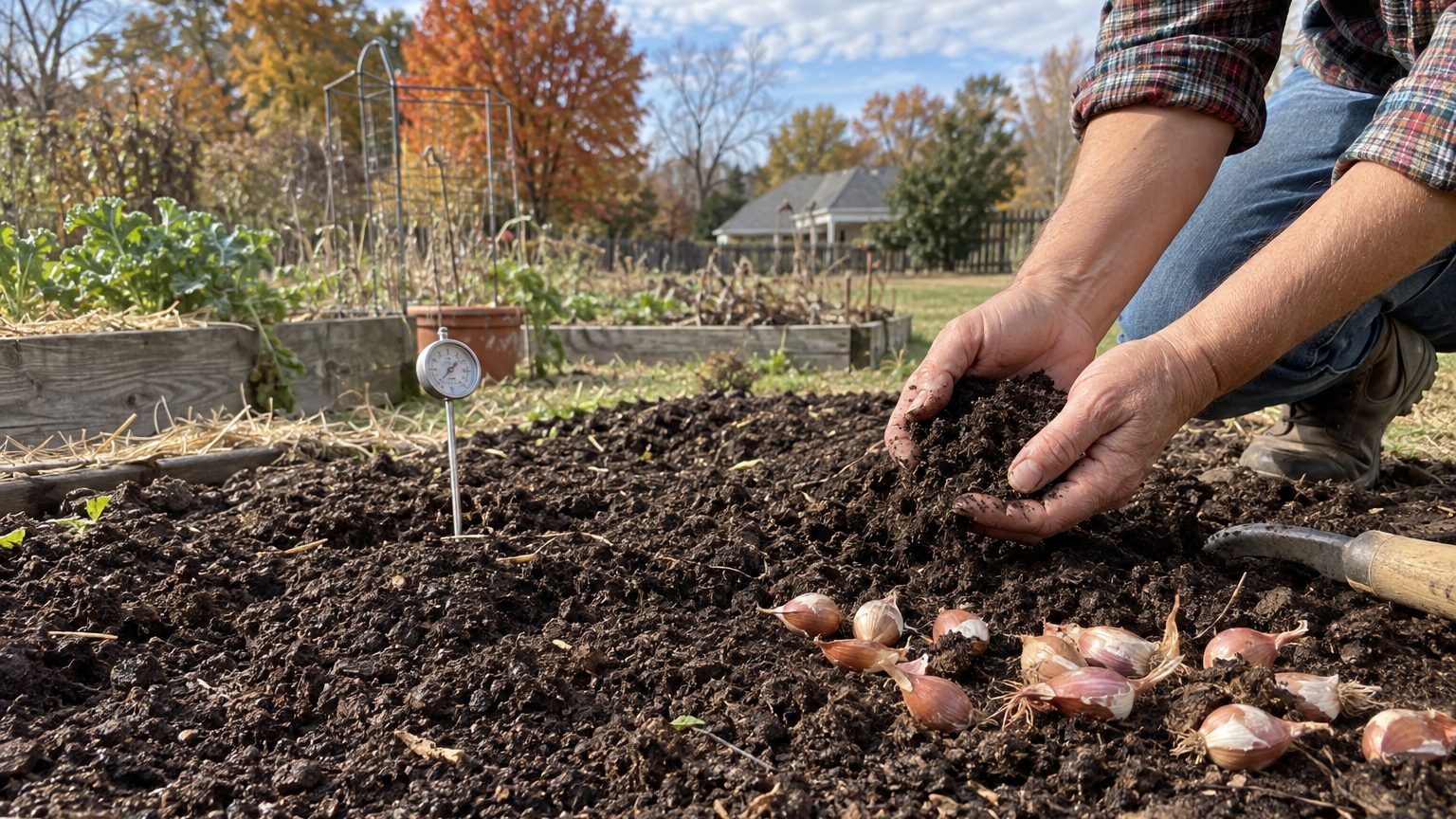

Kansas gardeners get two planting windows for shallots: autumn, a few weeks before the ground locks up, or early spring, as soon as the soil is workable. The calendar anchor is Wichita, where the last spring freeze falls between April 4 and April 18 and the first fall freeze between October 23 and November 2. Your garden will differ. The winter low and the summer heat decide which season suits it.
When the soil is warm enough in Kansas
The reference-city answer comes from the Wichita airport station. NOAA’s 1991-2020 Climate Normals put the last spring freeze (32°F) between April 4 and April 18, the 30 to 70 percent probability band. That is a probability, not a promise, and some springs will freeze after the later date.
Suburban and rural gardens usually see the last spring frost later than an airport does, often by one to two weeks, and more at elevation. If you garden outside Wichita, shift your expectations accordingly and check your own county’s normals before writing a date on the calendar.
Frost is a proxy, though, and a rough one. Shallots care about the soil, not the air. Soil lags behind air temperature, so it warms after the frost risk ends, not at the same moment. Two things matter more than any date: soil that crumbles in your hand instead of smearing into a ribbon, and soil that has stopped swinging between frozen and thawed. A cheap soil thermometer pushed in to bulb depth settles the argument faster than a calendar. Working or walking on wet clay compacts it, and compacted clay is hard on shallot roots for the whole season.
That shapes the spring plan. Sets (small bulbs) go in once the bed is workable and the worst freezes are behind you, because established roots handle a late cold snap far better than newly planted ones. Waiting for truly warm soil costs you time, since the plants need leaf growth before the lengthening days trigger bulbing. Planting into cold mud costs you rot.
Autumn runs on a different clock. The goal is roots before winter but not a tall green top. Many growers aim for the weeks around the first fall freeze, which at Wichita lands October 23 to November 2, again with the one-to-two-week earlier shift for rural gardens. Planting too early sends up leaves that winter then burns. Planting too late leaves the sets sitting in cold ground without anchoring. Garlic follows the same autumn logic, and the garlic guides on this site cover timing, depth and mulching for fall planting in detail. For shallots the difference is the set itself: a shallot set is smaller and shallower-seated than a garlic clove, so it heaves out of the ground more easily and needs a firm press-in and a mulch layer.
On varieties, this page names none. Kansas State University’s trials are the only source that means anything for your county, and the Kansas State University Research and Extension service is where to ask. Talk in types when you shop: sets for planting, or seed-grown types started indoors, and ask whether the type suits fall planting at all.
How long the season lasts here
Both dates come from the same NOAA normals, so the subtraction is honest. From the latest last-spring freeze (April 18) to the earliest first-fall freeze (October 23), the frost-free window is 188 days. From the earliest last freeze (April 4) to the latest first freeze (November 2), it is 212 days. The Wichita airport window therefore runs from 188 to 212 days.
| Scenario (Wichita reference) | Last spring freeze | First fall freeze | Frost-free days |
|---|---|---|---|
| Shortest window | April 18 | October 23 | 188 |
| Longest window | April 4 | November 2 | 212 |
Rural gardens, as noted, tend to lose time at both ends, so your own window may be a few weeks tighter than the table. Treat these as the ceiling.
What does that length allow? It is long by northern standards, and it opens a real choice. A garden here can take an autumn planting and still plant a spring batch for comparison. Bulbing is triggered by lengthening days, so what matters is how much leafy growth a planting has behind it when the days stretch out. An early spring planting has time to build tops. One planted in late spring has less, and the bulbs come out smaller, sometimes by a wide margin.
That is why succession sowing works differently for shallots than for lettuce. Staggered plantings give you a stream of green shallots, harvested young like scallions, while only the earliest plantings reliably make full cured bulbs. The succession sowing guide on this site walks through how to space those plantings and what to expect from each.
Transplanting is the other decision a long window changes. In a short season, a seed-grown shallot started indoors has to go out on time or the bulb never finishes, and every day of transplant shock costs you. With 188 days or more, you can afford to harden seedlings off properly and wait for the root check: the roots should be white, branching and holding the plug together, not circling or brown. A seedling that fails that check is better delayed a week than planted into stress.
For a closer look at the crop’s basic habits, the general guide Growing Shallots: One Bulb In, a Handful Out covers multiplication and spacing, which hold true in Kansas too.
Heat and water in Kansas
This page does not carry a count of days above 90°F or a summer rainfall total for Kansas, and I will not guess at either. What the verified numbers do show is winter. At the Wichita reference station, the mean daily minimum of the coldest month is 22.5°F. That is cold enough to freeze the top of the soil, but it is a long way from the deep cold of the northern tier. The USDA Plant Hardiness Zone Map (2023, built on the 1991-2020 normals) places Kansas across zones 5b to 7a. That is a wide range built on average annual extreme minimum temperature alone, so the north and west of the state sit colder than Wichita and the southeast sits milder.
The winter low settles the autumn-versus-spring question. In the colder parts of that range, where the ground freezes hard and stays wet, autumn-planted sets are at risk of rot or heaving. Freeze-thaw cycles push shallow sets up and out of the soil, and a set sitting in cold, saturated clay can rot before it roots. There, spring is the safer call. In the milder parts, autumn planting gives the larger, earlier bulbs it is grown for, because the roots work through winter and the plant starts spring with a head start.
What summer does to the crop
Heat arrives just as shallots finish. Warm weather pushes the tops to yellow and fall over and speeds maturity. It also punishes any planting that got a late start, since a small plant has less time to size up. Even watering through the bulb-swelling stretch matters, and so does mulch that keeps the soil cool and the roots moist. As the tops fall, you taper off irrigation so the bulbs can finish and cure rather than sit in wet soil.
Wet spells are the other hazard, especially in the more humid eastern part of the state. Prolonged leaf wetness invites fungal problems such as downy mildew and purple blotch, and white rot, a soil-borne disease, can persist in a bed for years once established. The practices that help are unglamorous: wide spacing for airflow, drip instead of overhead watering, clean tools, and allium rotation so that onions, garlic and shallots do not return to the same soil too soon. The garlic section of this site covers rotation in more depth, and the same rules apply to shallots. Gardeners in wetter, more humid climates will find a parallel in Growing Shallots in Kentucky, while those who want to see how a much colder winter flips the decision should read Growing Shallots in Quebec.
Which shallots suit Kansas
Choose by type, and let your state extension service name the varieties. Cultivar names change, availability shifts from year to year, and a variety that thrives in a trial plot in one county can fail in another. This page does not have Kansas trial data, so naming a variety here would be a guess dressed up as advice. Refusing to name one is the correct answer.
The facts of the territory still point somewhere. The window of 188 to 212 days at the Wichita reference station is long enough that you are not forced to chase the very earliest types, though earlier-maturing types do help where summer heat arrives hard. A hot summer favors plants given airflow and shade at the root zone: wide spacing, a mulch layer, and soil that holds moisture without staying soggy. Where humidity and wet spells run high, disease tolerance becomes the first criterion, ahead of size and flavor, because a resistant bulb that finishes beats a showy one that rots in the bed.
Practical selection looks something like this:
- Ask whether the type is sold for autumn planting, spring planting, or both.
- Ask what disease issues the supplier or trial notes flag, especially mildew and blotch.
- Choose sets of a size you can plant firmly, since very small sets struggle in heave-prone soil.
- Prefer plants raised in conditions similar to yours when you can find them, since local adaptation shows up in the first year.
Then harvest and cure with caution. Pull the bulbs when the tops have fallen and yellowed, and cure them in a dry, shaded, well-ventilated place until the necks are tight and dry. Before storing anything, inspect each bulb. A soft neck or a moldy base ends the question: that bulb does not go into storage, and it should not go into the kitchen either. Looking sound is not proof of being sound, and no duration of storage can be promised, so check the stored bulbs regularly and pull any that soften or sprout. Curing and storage follow the same principles as garlic, which the garlic guides here describe; shallots differ mainly in their thinner skins and smaller size, which make them dry faster and bruise more easily.
Start with the Kansas State University Research and Extension office serving your county. They can tell you which types have been trialled nearby, and what your local frost dates really are.
Common questions
Should I plant shallots in fall or spring in Kansas?
It depends on your winter. In the milder parts of the state’s zone 5b to 7a range, autumn planting gives larger, earlier bulbs. Where the ground freezes hard and stays wet, spring is the safer choice, because fall-planted sets can rot or heave.
When is the last spring frost in Kansas?
At the Wichita airport station, NOAA’s 1991-2020 normals put it between April 4 and April 18. Rural and suburban gardens often see it one to two weeks later, so check your own county.
Can I name the best shallot variety for Kansas?
No variety is named on this page, because it has no local trial data. Ask Kansas State University Research and Extension which types have been trialled near you.
How do I know my cured shallots are safe to store?
Inspect each bulb. If the neck is soft or the base is moldy, discard it. A bulb that looks fine is not guaranteed sound, so keep checking stored bulbs and remove any that soften or sprout.