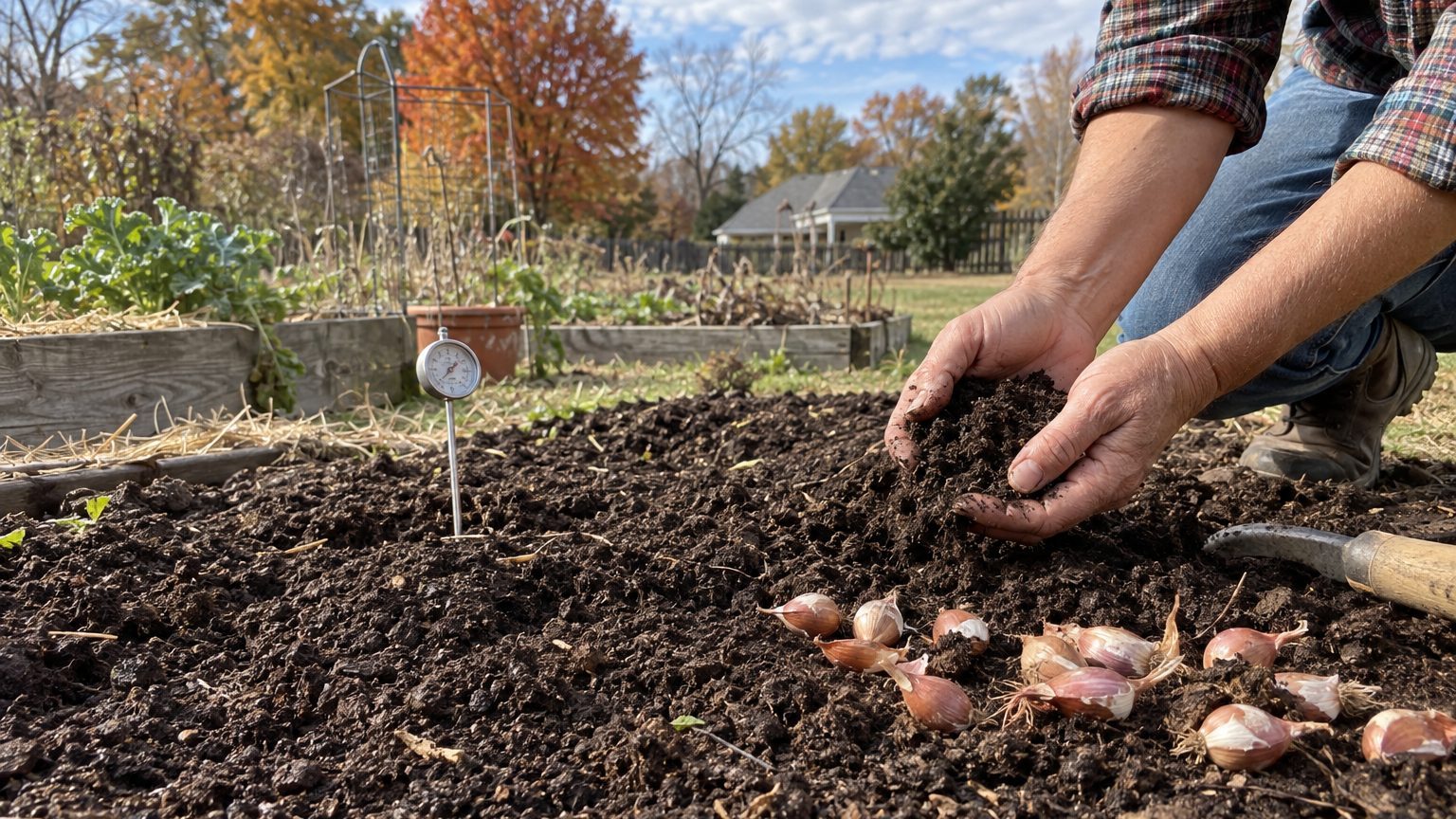

In Kentucky, shallots go in the ground in one of two windows: autumn, for earlier and larger bulbs, or early spring, as soon as the soil can be worked. Both work here, because the winter is moderate by northern standards. The spring window lines up with the end of frost risk in late March and early April. The fall window opens after the first frost has come and gone.
When the soil is warm enough in Kentucky
Start with the number most people search for. At the Louisville reference station, NOAA’s 1991-2020 Climate Normals put the last spring 32°F freeze between March 24 and April 4, using the 30-70% probability band. That is a probability, not a promise, so a late freeze in mid-April would not be unheard of. Keep row cover handy.
The catch is that the frost date is a stand-in. Shallots do not care about the calendar or about the last freeze. They care about the soil. Ground that has just stopped freezing is often still cold and soggy, and a set pushed into it can sit and rot instead of rooting. Soil warms more slowly than air, and it keeps warming after the frost risk ends. So the useful signal is a bed that crumbles in your hand instead of smearing, and a soil thermometer or a few weeks of steady mild weather confirms it.
Reading the date for your own yard
The National Weather Service in Louisville warns that this urban station runs later in spring and earlier in fall than the rural countryside around it. Rural gardens should expect a tighter window. Kentucky also runs from the Mississippi River bottoms in the west to the Appalachian ridges in the east, and the USDA Plant Hardiness Zone Map (2023 edition) places the state across zones 6a to 7a. Louisville is the reference city here. An eastern Kentucky hollow will be colder and later than a Ohio River floodplain garden, sometimes by weeks.
For spring planting, the practical rule is to work the bed once it is no longer frozen or waterlogged, and plant the sets shallowly, with the tips just showing. That is a real difference from garlic, which is planted deeper. Garlic has its own section on this site, and the autumn-planting, curing and rotation practices are covered there, so this page will not repeat them. What changes for shallots is mainly scale: the sets are smaller and shallower, so they are more exposed to heaving and to a wet bed.
Do not try to match your planting date to a variety’s catalog promise. Which types have been trialled where you live is a question for the University of Kentucky Cooperative Extension Service, whose county offices know local conditions better than any regional chart. And if you want the general method before the local detail, Growing Shallots: One Bulb In, a Handful Out covers it from the start.
How long the season lasts here
Subtract the frost dates and you get a window. Using the same Louisville normals, the last spring freeze falls between March 24 and April 4, and the first fall freeze between November 2 and November 12. The earliest spring date paired with the latest fall date gives about 233 days. The latest spring date paired with the earliest fall date gives about 212. So the frost-free stretch runs roughly 212 to 233 days at Louisville, and rural gardens should plan for the shorter end or less, given the caution above.
The number matters less than what it permits. A window that long is generous for a bulb crop. It is long enough for a spring planting to finish and be pulled and cured while the weather is still cooperating, and it leaves room for a second sowing afterward. The second sowing does not have to be shallots. Many gardeners follow the early crop with a late-summer planting of something else, or they use the gap to plant garlic and shallot sets for the following year in fall. Succession timing is covered in the succession sowing guide in our garden section, which walks through how to stagger plantings.
The longer window also changes whether transplanting is worth the trouble. In a short northern season, starting shallots as transplants buys weeks that direct sets cannot spare. In Kentucky, the extra root disturbance is hard to justify for most home gardeners. Sets planted directly go from bed to harvest without a root check, and the calendar does not force the issue. Transplanting makes sense mainly if you are growing from seed, which is a slower route for a crop that is usually propagated from sets or divisions.
Compare this with colder states. In Growing Shallots in West Virginia, higher elevations shorten the clock, and in Growing Shallots in Rhode Island, the coastal influence changes the winter instead. Kentucky sits in between, which is why both seasons are open to you.
Heat and water in Kentucky
This page does not carry a count of days above 90°F or a summer rainfall total for Kentucky, so it will not offer one. A figure from memory would be worse than none. What the verified data does give is the winter side: the mean daily minimum of the coldest month at Louisville is 27.8°F, according to NOAA’s 1991-2020 normals. That is below freezing most nights in the coldest month, but it is a long way from a deep, sustained freeze.
That number decides the autumn-versus-spring question. Where the ground freezes hard and stays wet, autumn-planted sets can rot or heave out of the soil, and spring is the safer call. A milder winter produces the larger, earlier bulbs that autumn planting is grown for. Kentucky leans toward the milder side, but it is not uniformly mild. A mean minimum is an average, and a few nights well below it, combined with a wet bed and freeze-thaw cycles, are what push sets up out of the ground.
| Factor | Autumn planting | Spring planting |
|---|---|---|
| Main benefit | Earlier, larger bulbs | Lower winter risk |
| Main risk | Rot or heaving in a wet, freeze-thaw winter | Less root growth before summer heat |
| Best fit | Well-drained beds, mulch applied | Heavy or poorly drained soil |
If you plant in autumn, drainage and mulch matter more than the date. A raised bed or a sloped site sheds water, and a layer of straw or shredded leaves after the soil cools evens out the freezing and thawing. Fall planting also leans on the first fall freeze, which falls between November 2 and November 12 at the reference station. Sets should have time to root before the ground stiffens, so earlier in the fall is safer than later.
On water, the trouble in a humid state is excess, not shortage. A wet early summer fosters foliar diseases such as mildew and keeps the bulbs from finishing, and bulbs that stay wet in the ground invite rot. Spacing, airflow and a bed that drains are the main defenses, and they cost nothing. A season of dry weather, by contrast, usually calls for no more than a deep soak every week or so while the bulbs size up, then stopping as the tops yellow.
Curing and storage are where food safety enters. Once the tops fall and dry, lift the bulbs and let them cure in a dry, shaded, airy spot. Inspect each one. A soft neck or a moldy base ends the question: discard it. A bulb that looks sound is not proof that it is sound, so check the neck and base by touch as well as by eye, and do not trust a keeping time from anyone, this page included.
Which shallots suit Kentucky
This page names no varieties, and that is deliberate. Variety trials are local work, and the verified information here does not include which types have been tested in Kentucky. A name pulled from a catalog or another state’s list is a guess. Gardeners notice a wrong guess immediately, usually in July. The recommendation that carries weight comes from the University of Kentucky Cooperative Extension Service, which has county agents who know what has done well in your soil and microclimate.
What this page can do is tell you what to look for, by type. Kentucky has a window of roughly 212 to 233 days at Louisville, and probably less in rural areas, so the season is long enough that you are not forced into the earliest types. Still, earlier-maturing types have an edge, because they finish before the worst of summer humidity and heat, and they are easier to cure in dry weather. Later types are fine if you plant in autumn and have the drainage to carry them.
Humidity is the second filter. In a state where wet weather and warm nights are normal, disease resistance should be the first criterion, ahead of flavor or size. Ask the extension office which types hold up against foliar disease locally. For the heat side, favor types that tolerate warm conditions, and give every plant airflow and some root shade: a mulch layer keeps soil cooler, and enough spacing lets leaves dry after rain.
Between true-seed types and set-grown types, sets are the simpler route for most home growers, and they are what most garden centers stock. Whichever you choose, buy planting stock sold for propagation, not grocery-store bulbs, which may carry disease and may have been treated to prevent sprouting.
Common questions
Can I plant shallots in Kentucky in the fall?
Yes. The coldest-month mean minimum at Louisville is 27.8°F, which makes autumn planting workable, and it tends to give earlier, larger bulbs. Plant in a well-drained bed and mulch it, because a wet freeze-thaw winter is what heaves or rots the sets.
What is the last frost date for shallots in Kentucky?
At the Louisville reference station, the last spring freeze falls between March 24 and April 4 (NOAA 1991-2020 normals, 30-70% probability band). Rural gardens can expect a tighter window, and shallots wait for workable soil, not for the date.
Which shallot variety is best for Kentucky?
This page does not name one, because it cannot source local trial results. The University of Kentucky Cooperative Extension Service can tell you which types have performed in your county. As a general guide, favor disease-resistant types and those that mature early enough to finish before summer humidity peaks.
How do I know if a cured shallot is safe to store or eat?
Inspect each bulb. A soft neck or a moldy base means discard it, and a firm, good-looking bulb is not a guarantee. Sort out any questionable ones before you store the rest, and check the stored bulbs periodically, because one bad bulb can spoil its neighbors.