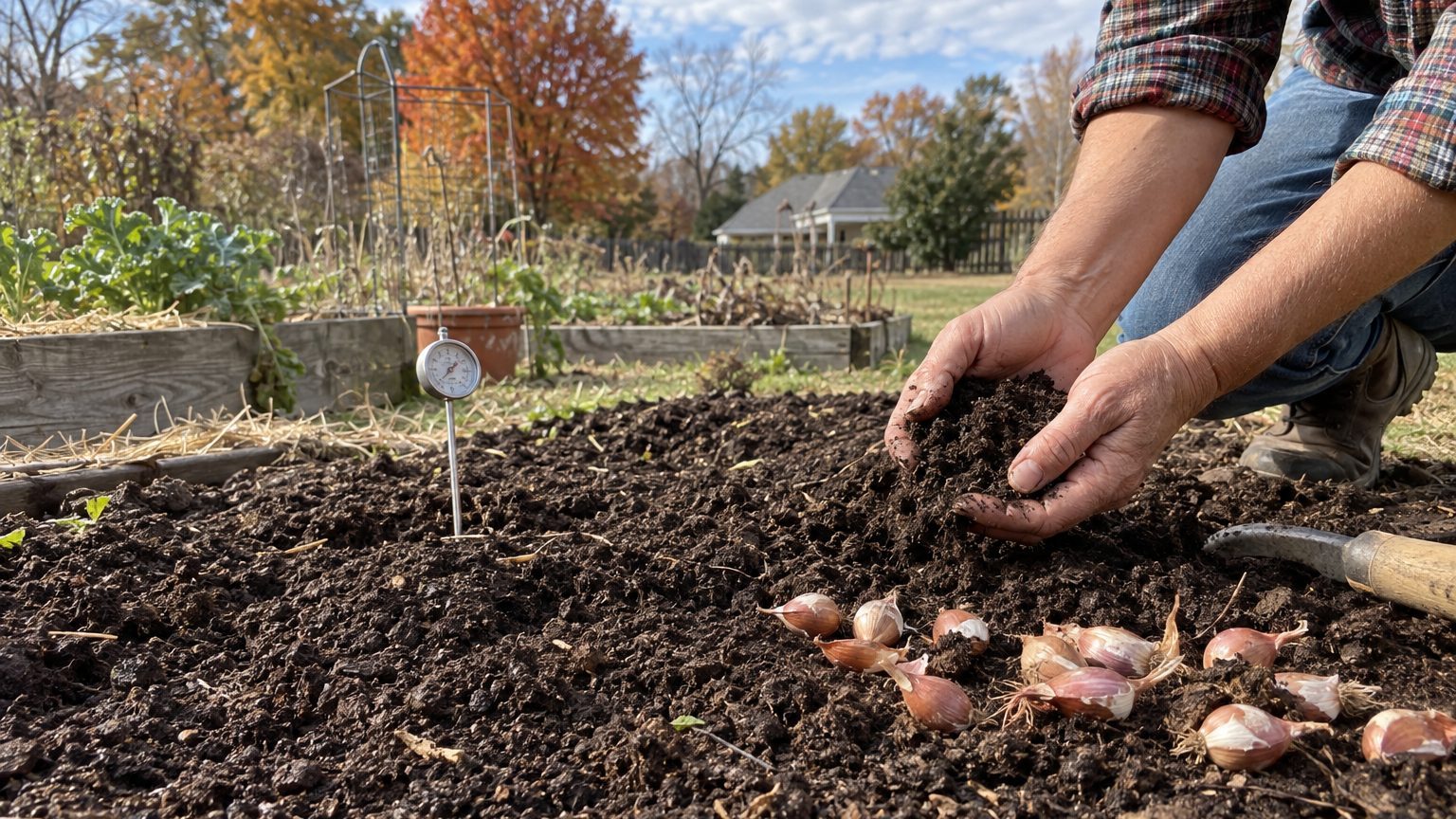

Plant shallots in Manitoba in spring, as soon as the soil is workable and no longer sodden. Autumn planting is a gamble here. The Winnipeg reference station sits in Canadian hardiness zone 3b, and its coldest month averages a daily low of -21.4 °C (-6.6 °F). Between the average last spring frost and the average first fall frost there are about 122 days. That is enough for one good crop of bulbs, and not much more.
When the soil is warm enough in Manitoba
The date most Manitoba gardeners ask about is May 23. That is the average last spring frost at the Winnipeg Richardson Int’l A station (climate ID 5023222), taken from Environment and Climate Change Canada’s Canadian Climate Normals for 1981-2010. It is a mean, so in one year out of two the last frost falls later. A frost date is a probability, not a promise, and May 23 is the middle of a window rather than a safe day.
Why the frost date is only a proxy
Shallots do not read the air. They respond to the soil, and the soil lags behind. Ground that thawed in April still holds winter cold and meltwater in May, and that is where a set either puts out roots or sits and sours. Soil warms after the frost risk ends, not at the same moment. A set pushed into cold, saturated ground in a hurry will often do worse than one planted a week later into soil that has had time to drain.
Two caveats come with the station. A province is not one climate, and northern and upland districts run weeks behind Winnipeg. The normals also cover 1981-2010, while the figures on our US pages cover 1991-2020, so a side-by-side with Growing Shallots in South Dakota compares two different periods.
Test the soil, not the calendar
Dig a trowel’s depth and squeeze a handful. If it holds together as a slick ribbon or drips water, wait. If it crumbles when you poke it, the bed is ready. A soil thermometer gives you a number to track from year to year, but the squeeze test catches the bigger problem, which is wet ground.
For this crop the practical rule is to plant when the bed is workable and drained, and let the frost date act as a rough marker. Light spring frosts will nip leaf tips on sprouted sets without ending the crop, but a waterlogged bed can.
On varieties, this page names none, and that is deliberate. The types trialled in Manitoba are listed by Manitoba Agriculture, the provincial counterpart of a US state extension service. Start there rather than with a catalogue written for somewhere warmer. The general case for why one bulb becomes a cluster is covered in Growing Shallots: One Bulb In, a Handful Out.
How long the season lasts here
Both dates come from the same Winnipeg station and the same 1981-2010 normals: May 23 for the last spring frost and September 22 for the first fall frost. Counting between them gives 122 days. Both are means, so a given year can run shorter or longer, and outside the Winnipeg area the window can shift by weeks.
What 122 days allows
It allows one planting of bulb shallots, planted early and left alone. The sets go in at the start of the window, the leaves do their work through the long days of June and July, and the bulbs size up and ripen before cold ends the season. A second sowing of bulb shallots in midsummer would not have time to finish, and the leaves would still be green when frost arrives.
Where succession does pay off is in green shallots, harvested for their tops. A second or third planting of sets a couple of weeks apart keeps the kitchen supplied without asking anything of the fall frost. The main shallot guide explains how the clusters form. Our succession sowing guide on this site covers the spacing of those repeat plantings.
Is transplanting worth the root check?
Starting shallots from seed indoors and transplanting out can buy weeks, but each transplant takes a check at the roots, and a check costs time. In a window this short the arithmetic is tight. If the plants stall for a week or two after moving, much of the head start is gone. Sets planted straight into the bed skip that pause. Transplants earn their place only where you are growing from seed and want the earliest possible start. Harden them off carefully, and handle the roots as little as you can.
Harvest, curing and storage
Shallots share most of their post-harvest habits with garlic, and the garlic section of this site covers lifting, curing, storing and allium rotation in depth, so those steps are not repeated here. What differs is the cluster. Several bulbs form together, and those in the crowded middle dry slowest. Give the whole clump extra time in a dry, shaded, airy spot before you separate it.
Before storing, inspect every bulb. A neck that is still soft or damp ends the question, because that bulb is not ready to keep. A moldy or mushy base ends it too. A bulb that looks fine on the outside is not proof that it is sound, so squeeze the neck and check the base. Pull out anything doubtful rather than hoping it stays isolated, and do not count on any fixed storage time.
Heat and water in Manitoba
The verified figures behind this page do not include a count of days above 90 °F (32 °C) or a summer rainfall total for Winnipeg, so I will not invent either. What the figures do give is a cold, continental climate: zone 3b in the Canadian system (which does not convert to a USDA zone), with a coldest-month daily minimum of -21.4 °C. Heat is rarely what limits shallots here. Winter and wet ground are.
Autumn against spring
The real decision is when to plant, and the winter decides it. Where ground freezes hard and stays wet, autumn-planted sets can rot or heave out of the soil during repeated freezing and thawing. A milder winter is what gives autumn planting its payoff, which is larger bulbs earlier in the season. At -21.4 °C (-6.6 °F) for the average coldest-month low, Manitoba is on the risky side of that bargain. Growing Shallots in British Columbia is worth a look for contrast, since some parts of that province have far milder winters.
| Question | Autumn planting | Spring planting |
|---|---|---|
| Winter risk | Rot or heaving in wet, freezing ground | None, since the sets are not in the ground |
| Bulb size | Larger and earlier when sets survive | Smaller on average, but dependable |
| Best fit in Manitoba | A small trial, well drained, mulched | The main crop |
If you want to test autumn planting, treat it as an experiment on a well-drained corner, not the whole crop. Keep a spring planting in reserve so one hard winter does not take everything.
What a cool, damp summer brings
A cool, damp summer brings its own problems. Mildew on the leaves, slow ripening and rot at the neck all become more likely when the foliage stays wet and the bulbs are slow to finish. A hot, dry spell is not the usual threat in this climate, though dry stretches do happen and shallots, with their shallow roots, will need water then.
The practical answer is airflow and drainage. Space the sets so that air moves between the leaves. Water at the base rather than over the foliage. Taper off watering as the tops start to yellow, since late moisture is how bulbs end up with soft necks. Plant in a bed where onions, garlic or other alliums have not grown recently, so disease does not carry over from the previous crop.
Which shallots suit Manitoba
Choose by type, not by name. The facts point in three directions. A season of about 122 days at the Winnipeg station favours the earliest-maturing types, because bulbs that need every day of it will be caught by frost in a short year. A damp summer makes disease resistance the first criterion, particularly mildew tolerance and a neck that dries tight. A dry spell favours types with good root vigour, which tolerate a bed that gets less water than you meant to give it.
Beyond that, firm necks and tight skins matter if you want bulbs that hold up in storage, though any bulb has to pass the inspection described earlier before it goes into the pantry. Buy sets from a supplier that sells for northern conditions, not shallots from the grocery store, which may carry disease and were never selected for a cold prairie climate.
No variety is named on this page, and that is the right answer, not a gap. The only recommendation that means anything is one from local trials, and this page does not have them. A name copied from a catalogue written for another climate can fail in a Manitoba spring, and a gardener would find out in July. Manitoba Agriculture is the place to ask which types have been grown and trialled in the province, and a local garden centre that sources from northern growers can usually confirm what has worked nearby.
Common questions
Can I plant shallots in fall in Manitoba?
You can try, but it is a risk. With a coldest-month daily low of -21.4 °C (-6.6 °F) in zone 3b, sets can rot or heave over winter. Try a small, well-drained, mulched patch and keep spring planting as the main crop.
Is May 23 a safe planting date?
No. May 23 is the average last spring frost at the Winnipeg Richardson Int’l A station, so in half of years the last frost comes later. Plant when the soil is workable and drained, and treat the date as a rough marker.
How many days do shallots get here?
About 122 days between the average last spring frost (May 23) and the average first fall frost (September 22) at the Winnipeg station. Districts to the north or at higher elevation usually get fewer.
How do I know shallots are ready to store?
Check each bulb for a dry, tight neck and a firm, clean base. A soft neck or a moldy base means that bulb is out. Looking sound is not proof, so squeeze and inspect, and discard doubtful bulbs.