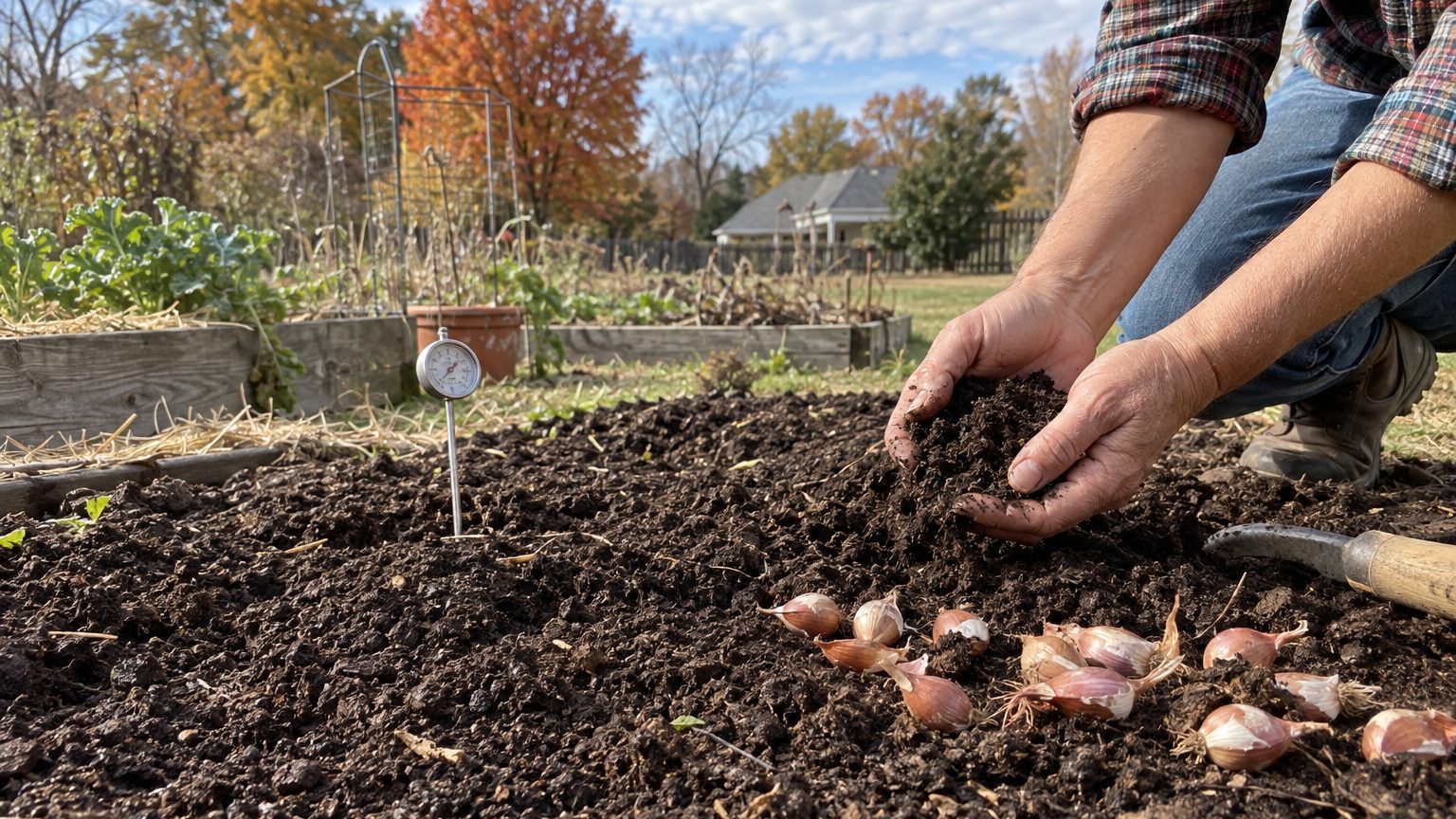

Plant shallots in Minnesota in spring, as soon as the ground has thawed and dried enough to work. Autumn planting can pay off, but only where winters are kind, and most of the state is not that place. In the Twin Cities the last freeze of spring lands between April 17 and April 30, and the soil needs time beyond that to be ready.
When the soil is warm enough in Minnesota
At the Minneapolis-St. Paul reference station, NOAA’s 1991-2020 Climate Normals put the last spring 32°F freeze between April 17 and April 30 (the 30-70% probability band). That is a probability, not a promise, and a late freeze in May is always possible. Treat the window as a planning tool and keep a row cover handy.
Frost is only a proxy, though. Shallots respond to soil, and soil lags the air. A stretch of mild afternoons can leave the top few inches cold and soggy, because the ground warms after the frost risk ends, not alongside it. Planting into a cold, waterlogged bed does the sets no favors. They sit, they stall, and some rot. A basic soil thermometer, pushed in at planting depth in the morning, tells you more than the calendar does. Another test is old-fashioned: squeeze a handful of soil. If it crumbles, you can plant. If it holds as a wet ball, wait.
Those dates describe the mild south of the state. Northern Minnesota runs two to three weeks tighter at both ends of the season, so a gardener near the Canadian border should push the whole schedule later in spring rather than copy a Twin Cities date. Both Minnesota and its northern neighbors share this problem, and the guides for Growing Shallots in Vermont and Growing Shallots in Nova Scotia show how other cold-winter territories handle the same timing puzzle.
What carries over from garlic
Autumn planting, curing, storage and allium rotation all follow the same logic for shallots and garlic, so this site’s garlic guides cover those practices in detail and there is no point repeating them here. A few things differ for shallots. The sets are smaller than a garlic clove and carry less reserve through a hard winter. They also multiply into clusters, which makes spacing and soil drainage matter more than people expect. And the rotation rule still applies: keep shallots out of beds that held onions, garlic or leeks recently, because the same soil diseases attack all of them.
For the specific varieties trialed in your part of the state, ask University of Minnesota Extension. This page names no cultivars on purpose, and the last section explains why.
How long the season lasts here
The same NOAA station gives the first fall 32°F freeze between October 11 and October 23. Set that against the spring dates and the frost-free window runs from about 164 days to about 189 days. The short end pairs the latest spring date (April 30) with the earliest fall one (October 11). The long end pairs April 17 with October 23. Real years land anywhere in that range, and some fall outside it.
| Measure | Earliest | Latest |
|---|---|---|
| Last spring 32°F freeze | April 17 | April 30 |
| First fall 32°F freeze | October 11 | October 23 |
| Frost-free window | 164 days | 189 days |
The numbers matter for what they allow. A window near the long end leaves room for a second sowing: a few weeks after the first planting, a staggered round that stretches the harvest of green shallots and spreads out the workload. The succession sowing guide on this site walks through the spacing of those rounds. Near the short end, the first planting is the only one that will reach a full bulb, so a second round makes sense only as a green-onion crop for the kitchen.
The window also changes the math on transplanting. Starting seed or sets indoors buys back a few weeks, but every move risks the roots, and shallots resent disturbance. In a 189-day year, a check on the roots and a gentle transplant can pay for itself. In a 164-day year, with a clock running toward October, a bruised set that loses two weeks may never size up. The safer plan for most of the state is direct planting, with transplants kept for gardeners who are willing to inspect each root ball and accept some losses.
Remember what these figures are. They describe the south. If northern Minnesota really runs two to three weeks tighter at each end, the window there could be four to six weeks shorter than the Twin Cities range, which pushes a northern gardener firmly into the short-season plan.
Heat and water in Minnesota
The brief for this page called for a count of days above 90°F and a summer rainfall figure. Neither is among the verified facts this page carries, so no number appears here. NOAA’s Climate Normals, the same source as the frost dates, publish both for the Minneapolis station, and your county extension office can tell you how far your site departs from it. A count at one station is not a description of the whole state anyway.
What this page can anchor is the winter. At the Minneapolis reference station, the mean daily minimum of the coldest month is 8.8°F. The USDA Plant Hardiness Zone Map (2023 edition, built on average annual extreme minimum temperature) spans zones 3a to 5a across the state. That is a wide range, and a gardener in the far north lives in a very different winter than one in the Twin Cities.
That winter decides the autumn-versus-spring question. Autumn-planted sets are grown for one reward: bulbs that start early, size up larger and finish ahead of spring plantings. The reward exists only where the ground does not punish the gamble. Where it freezes hard and stays wet, sets rot or heave out of the soil as it freezes and thaws. In most of Minnesota, spring is the safer call. A gardener in a sheltered Twin Cities bed with well-drained soil and a thick mulch might try a small autumn trial alongside a spring planting. Anyone north of that should assume spring first.
With no heat count to lean on, it helps to know what a cool, damp summer does instead, since the state’s climate points that way as often as toward heat. Wet foliage invites mildew and leaf diseases. Ripening drags, and tops that stay green late mean bulbs that finish late and cure poorly. Give plants space for airflow, water the soil rather than the leaves, and keep beds weed-free so air moves through.
Curing is where this matters most for safety. After harvest, bulbs need to dry in a shaded, airy spot until necks and skins are papery. Inspect each one. A soft neck or a moldy base ends the question: that bulb does not go into storage, however firm the rest of it feels. A bulb that looks sound is not proof that it is sound, and this page makes no promise about how long any bulb will keep. The garlic guides on this site cover curing and storage in more depth, and the same inspection applies.
Which shallots suit Minnesota
Choose by type, not by name. Minnesota’s facts point to three criteria, in this order.
- Earliness first. With a window that can shrink to 164 days in the south, and shorter in the north, early-maturing types give the margin that a full-season type cannot.
- Disease resistance next. Cool, damp stretches favor mildew, so types with a good record against foliar disease earn a place.
- Winter toughness only if you plant in autumn. A set hardy enough for a zone 5a bed in the Twin Cities may not survive a zone 3a one.
Between the two propagation methods, sets (small bulbs) are the practical choice for a short season, because they skip the early weeks that growing from seed takes. Seed-grown shallots offer low cost and a disease-free start, but they ask for a long, early start indoors, and a Minnesota gardener has little slack to spend on it.
This page names no cultivar, and that is deliberate. A variety recommendation means something only when it comes from trials run in your climate, and this page does not have those results. Naming a variety from memory or from another region would be a guess dressed as advice, and gardeners spot that immediately. The right source is University of Minnesota Extension, whose horticulture staff and Master Gardener programs know which types have performed in the state’s different regions. Ask them what has been trialed near you, then buy from a supplier who can say where the sets were grown.
For the overview that ties the territory pages together, see Growing Shallots: One Bulb In, a Handful Out.
Common questions
When should I plant shallots in Minnesota?
In spring, once the soil is workable and no longer waterlogged. At the Twin Cities station, the last freeze falls between April 17 and April 30 (a probability band, not a guarantee), and the soil warms after that. The north runs two to three weeks later.
Can I plant shallots in the fall in Minnesota?
Only as a small trial. The coldest-month minimum at the Minneapolis station averages 8.8°F, and hard, wet winters can rot or heave autumn-planted sets. Spring is the safer default, especially in the north.
Is the season long enough for a second planting?
Near the long end of the Twin Cities range (about 189 days between freezes), a staggered second sowing is possible. Near the short end (about 164 days), it is realistic only for green shallots.
Which variety should I buy?
This page names none, because it cannot source locally trialed varieties. University of Minnesota Extension can tell you which types have performed in your region.