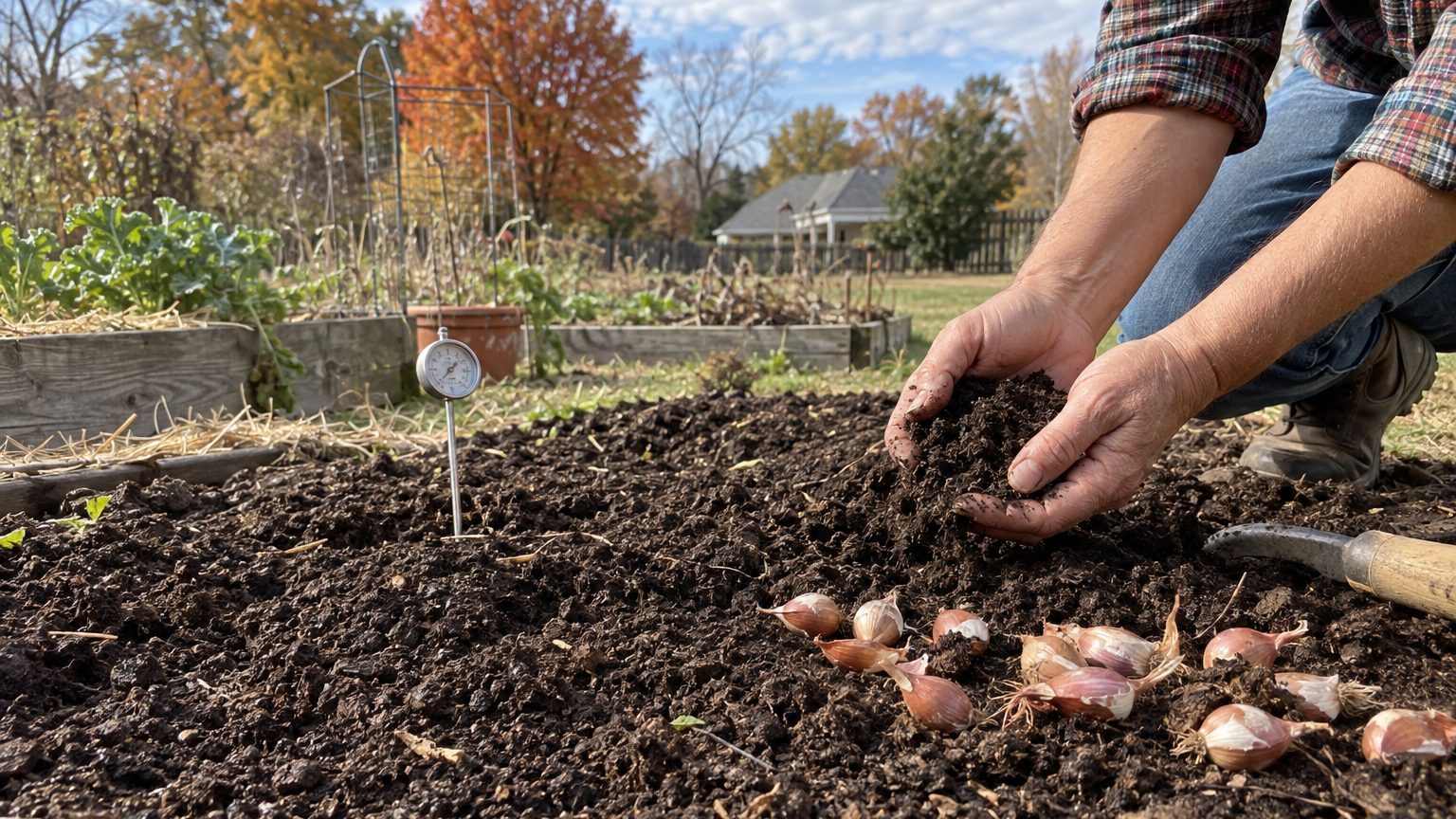

In Vermont, plant shallots in spring as soon as the soil is workable, and treat autumn planting as a gamble that only the mildest corners of the state win. The frost calendar sets the outer limits. The soil, the winter low, and a damp summer decide whether the crop is worth the effort. Here is how those pieces fit.
When the soil is warm enough in Vermont
The Burlington station puts the last spring freeze between April 30 and May 10. That comes from the NOAA NCEI 1991-2020 Climate Normals, using the 30-70% band of 32F freeze probabilities at station USW00014742 (NOAA NCEI data). Those dates are a probability band, not a promise, and a late freeze can still land outside it.
Burlington also sits on Lake Champlain, the mildest corner of the state. The Green Mountains and the Northeast Kingdom run substantially shorter, so a gardener in Craftsbury or Island Pond should expect everything on this page to shift later.
The frost date is only a proxy. Shallots don’t care about air temperature at 2 a.m.; they care about the soil around the roots. Soil trails the air in spring, and it warms after the freeze risk ends, not at the same moment. A bed can be frost-free in early May and still be cold, saturated clay that stalls a freshly set bulb. Shallots are tougher than most vegetables and can go in while the ground is still cool, so the practical test is simple. Plant when you can work the bed without it clumping into wet slabs, and not before.
Spring or autumn timing
Shallots share most of their habits with garlic. Autumn planting, curing, storage, and allium rotation are all covered in the garlic section of this site, so I won’t repeat them here. What differs for shallots is scale. A shallot set is smaller than a garlic clove and carries less stored energy, so it has less margin to survive a winter of frost heave or a cold, waterlogged bed. That is the main reason Vermont’s spring-planting advice leans harder for shallots than it might for garlic.
Rotation carries over directly. Don’t put shallots where onions, garlic, or leeks grew recently, because the soil diseases that attack one allium attack them all.
What to check after harvest
Curing and storage touch food safety, so be strict. After lifting, cure the bulbs somewhere dry with good airflow until the necks are fully dry and the outer skins rustle. Then inspect each one by hand. A soft neck or a moldy base ends the question: that bulb goes in the compost, however good the rest of it looks. A bulb that looks sound is not proof that it is sound, and nobody can promise how long a given batch will keep. Check stored shallots regularly and pull any that soften.
For which varieties have been trialled in Vermont, ask University of Vermont Extension. The Growing Shallots: One Bulb In, a Handful Out guide covers the general method.
How long the season lasts here
Burlington’s first fall freeze falls between October 3 and October 13, from the same NOAA NCEI 1991-2020 normals and the same 30-70% probability band. Pair that with the spring dates and you get a window. Because both ends are ranges, the answer is a range too.
| Spring freeze ends | Fall freeze arrives | Days between |
|---|---|---|
| April 30 | October 3 | 156 |
| April 30 | October 13 | 166 |
| May 10 | October 3 | 146 |
| May 10 | October 13 | 156 |
So Burlington gets roughly 146 to 166 days between freezes. That is the lakeside figure. Move into the Green Mountains or the Northeast Kingdom and both ends close in, so those gardeners start from a smaller number than the table shows.
What does a window that size allow? A shallot is a slow crop. The bulb has to size up and then die back and ripen, and the ripening needs dry, settled weather at the end of the season rather than another flush of growth. Even at the generous Burlington end, there’s room for one full crop, not two. A second sowing of bulb-forming shallots made in midsummer would run out of time before the first hard freeze. Where a second sowing does make sense is for green shallot tops, harvested young like a scallion. The main shallot guide explains the green-harvest option, and this site’s succession sowing guide shows how to stagger plantings so the greens keep coming.
In the colder, shorter parts of the state, the first sowing is the only sowing, and that changes the transplant question. Starting seed-grown shallots indoors and moving them out buys back weeks that the outdoor calendar won’t give you. It only pays if the seedlings are hardened off properly and the roots haven’t circled in the tray. A seedling that sulks for two weeks after transplanting, a delay called root check, has given back the head start it was supposed to provide.
Compare how neighbors handle the same trade-off. The Growing Shallots in Minnesota page deals with a colder interior climate, while Growing Shallots in Michigan shows what a lake-moderated state looks like. Vermont’s lakeside strip resembles the second; its mountain towns resemble the first.
Heat and water in Vermont
Any such number would be a count at a reference station like Burlington, and it wouldn’t describe a hillside farm in the Northeast Kingdom anyway. What I can say is that Vermont is a northern state where heat stress is not the usual shallot problem. Cool, damp summers are, and they bring a different set of troubles: downy mildew and other fungal diseases on the leaves, neck rot in stored bulbs, and slow ripening that leaves the tops green when you want them dry. A wet July followed by a wet August is harder on a shallot bed than a hot one would be.
That points to a few habits. Give the plants space so air moves through the rows. Water at the soil rather than overhead. Pick a site that drains, because a bed that stays soggy after rain invites rot in the root zone and the bulb base. Pull mulch back from the necks in a rainy stretch, since it can hold moisture against the plant.
Autumn against spring
The deciding factor is winter. At the Burlington reference station, the mean daily minimum of the coldest month is 12.9 F (NOAA NCEI Climate Normals 1991-2020). That is an average of the nightly lows, not the record, and individual nights go well below it. Across the state, the USDA Plant Hardiness Zone Map (2023, based on 1991-2020 normals) spans zones 3b to 5b. That is a wide range built on one variable, the average annual extreme minimum, so the zone for your own address may differ a lot from the Burlington reading.
Here is how that plays out for an autumn-planted shallot. Where the ground freezes hard and stays wet through winter and spring thaws, sets rot or heave out of the soil, and the safer call is to plant in spring. A milder winter gives the larger, earlier bulbs that autumn planting is grown for, because the roots establish before freeze-up and the plant starts fast in spring. In Vermont, only the Champlain Valley edge comes close to qualifying. Even there, I’d try a small autumn test row beside a spring planting before committing the whole bed. Elsewhere, spring planting is the better bet.
Which shallots suit Vermont
Choose by type first. Vermont’s facts point in three directions: a short season, a damp summer, and a cold winter.
The short season favors the earliest-maturing types. A late type that needs the whole window at Burlington may not finish in the Green Mountains, where the window is shorter. If you grow from seed, the seed-grown types are worth considering for a short season because they can be started indoors and transplanted. If you grow from sets or small bulbs, favor types described as early or as reliable in cool-season regions. The only recommendation that means anything is a variety trialled in Vermont soil and weather. A name pulled from a seed catalog or another state’s guide is a guess, and gardeners notice a wrong guess immediately.
The damp summer makes disease resistance the first criterion, ahead of size or color. Look for types with a record of staying healthy in wet, humid conditions, with upright foliage that dries quickly and necks that cure down tight. Plan for airflow as well: wider spacing and a bed that gets sun and breeze. Heat is a smaller worry for most of the state, so shade at the root matters less here than it would farther south.
For winter, spring planting avoids most of the risk, so cold-hardiness only becomes a selection issue if you try an autumn row in a milder pocket. In that case, use the largest, soundest sets you can get, mulch after the ground has frozen, and expect some loss.
For the list of varieties that have done well locally, go to University of Vermont Extension. Ask which shallot types have been grown or trialled in your county, and whether they’ve seen losses from winter heaving or foliar disease. Extension staff and master gardeners often know about a problem that never makes it into print.
Common questions
When should I plant shallots in Vermont?
Plant in spring once the soil is workable and no longer waterlogged. At Burlington, the last 32F freeze falls between April 30 and May 10 (NOAA NCEI 1991-2020 normals, 30-70% probability band), but soil usually lags the air. Gardeners in the Green Mountains or the Northeast Kingdom should expect to start later.
Can I plant shallots in the fall in Vermont?
You can, but the odds are mixed. Hard-frozen, wet ground rots or heaves smaller sets, and shallot sets are smaller than garlic cloves. The Champlain Valley is the best candidate for a trial row. Treat it as an experiment next to a spring planting.
Will shallots survive a Vermont winter?
Dormant, well-established bulbs can tolerate cold. The coldest-month mean daily minimum at Burlington is 12.9 F, and the state spans USDA zones 3b to 5b. The usual losses come from rot and heaving in wet soil, not from the cold alone.
How do I know if stored shallots are still good?
Inspect them by hand. A soft neck or a moldy base ends the question, so discard that bulb. A bulb that looks fine on the outside isn’t guaranteed sound, so check the whole batch regularly and remove any that soften. Curing and storage practices overlap with garlic, which is covered in the garlic section of this site.