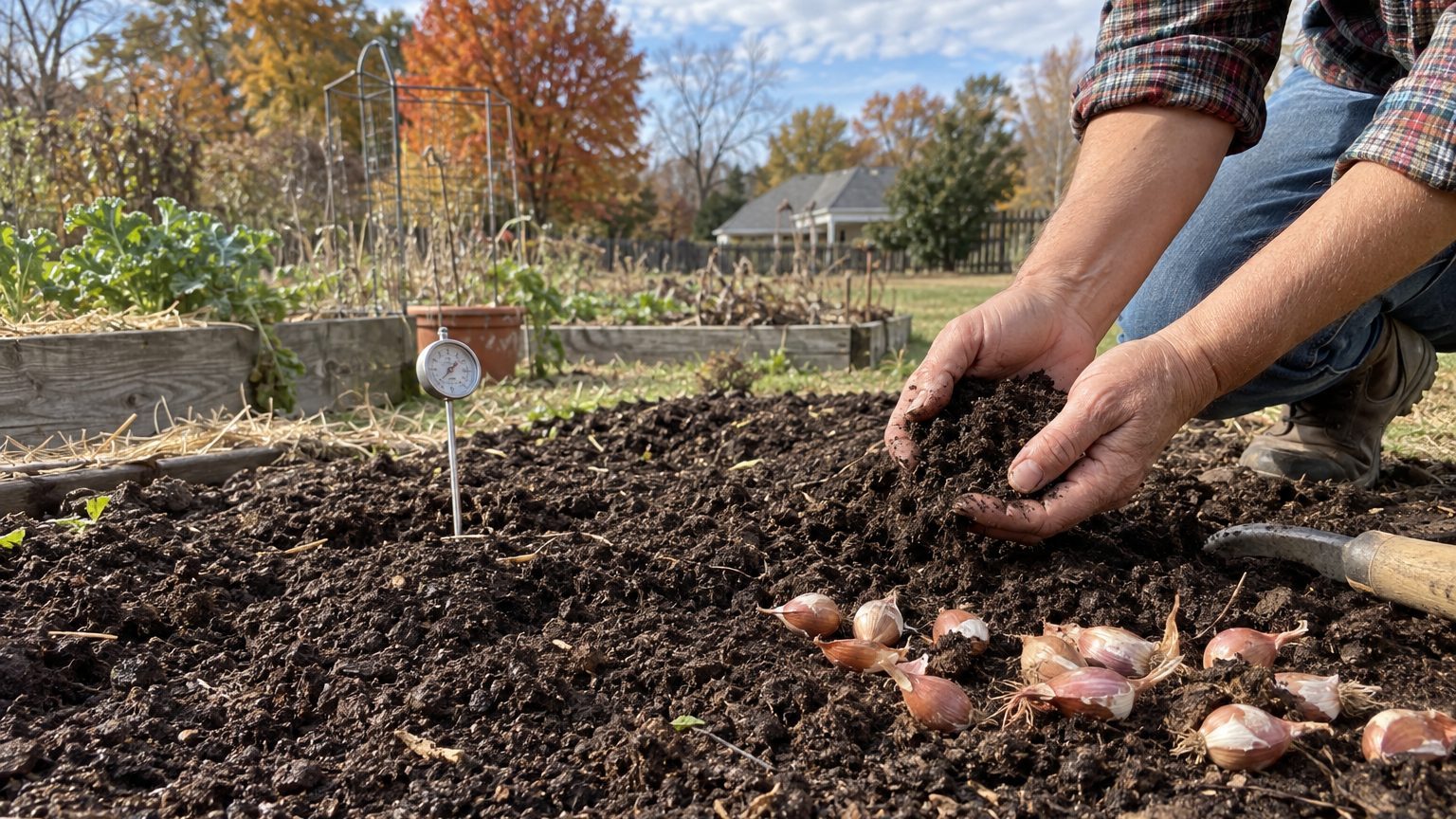

In Missouri, shallots can go in during autumn or early spring, and the winter low decides which is safer for you. At Kansas City International, the last spring freeze falls between April 6 and April 20, leaving a frost-free window of roughly 181 to 206 days. Northern growers lean toward spring planting, while milder southern counties can make autumn pay off.
When the soil is warm enough in Missouri
Start with the number most gardeners ask for. NOAA’s 1991-2020 Climate Normals for Kansas City International (MCI) put the last spring 32°F freeze between April 6 and April 20, using the 30 to 70 percent probability band. That is a probability, not a promise, and some springs will fall outside it. The station sits well north of the city. Downtown runs about five days earlier in spring, and southern Missouri is milder still, so your own date depends heavily on where in the state you garden.
Treat that date as a proxy. A shallot does not read the calendar. It responds to the soil, and soil warms and drains after the frost risk ends, not on the same day. A bed can be frost-free and still be a cold, sodden sponge in mid-April, especially in the heavy clay common across much of the state. Squeeze a handful at planting depth. If it crumbles, you can plant. If it smears into a slick ribbon, wait a week. A cheap soil thermometer pushed to planting depth takes the guesswork out, and your state extension office can tell you what reading to look for.
Spring planting works from that logic: sets go in once the ground is workable and no longer waterlogged, which in most of Missouri means the weeks around and just after the frost band above. Plant earlier in the south, later in the north. A light late frost will not hurt shallot tops that are only just emerging, so the bigger risk of going too early is rot in cold, wet ground rather than frost damage.
Autumn planting follows the opposite signal
Autumn planting is timed to cooling soil rather than warming soil. The goal is roots, not top growth, before the ground locks up. The mechanics are shared with garlic, so the garlic pages on this site cover timing, mulching and bed prep in full. What differs for shallots is size. A shallot set is a smaller bulb than a garlic clove, so it has less reserve to ride out a hard winter, and it tends to sit closer to the surface where freeze-thaw cycles can push it upward. In practice that means a layer of mulch matters more for autumn shallots than the garlic advice might suggest, and a spring-planted set is the more forgiving choice wherever winter swings between frozen and soaked.
How long the season lasts here
Both frost dates come from the same NOAA Normals for Kansas City International. The first fall freeze falls between October 18 and October 29. Subtract, and the arithmetic gives a range. The latest spring date (April 20) against the earliest fall date (October 18) leaves 181 days. The earliest spring date (April 6) against the latest fall date (October 29) leaves 206 days. Call it a frost-free window of roughly 181 to 206 days at that station. Downtown Kansas City starts earlier, and the southern part of the state has more room again.
The useful question is what that length allows. A window this long means shallots are not racing the calendar. A single spring planting finishes well inside it, and there is room for a second sowing. A short season, such as a northern state with a late May last frost, makes the first planting the only one. Missouri does not force that.
One catch deserves attention. Shallots do not mature by the fall frost. They bulb up and finish as spring turns to early summer, and warm weather and lengthening days push the tops to flop over. So the date that matters for the crop is closer to the arrival of summer heat than to October. Late plantings give smaller bulbs because there is less time to build before the signal to finish arrives. A second sowing is therefore better treated as a way to spread out your harvest, or to pick some plants young as green shallots, than as a way to double your bulb crop. The succession sowing guide on this site walks through how to stagger plantings and where the limits are.
Transplanting is the other decision the window shapes. For seed-grown types started indoors, a head start before summer heat can help, but every transplant risks a root check, the stall that follows disturbed roots. With a window above 181 days, direct sowing is usually fine, and transplants earn their effort mainly in a late, cold spring or in the northern part of the state. For a wider look at the crop from bulb to harvest, see Growing Shallots: One Bulb In, a Handful Out.
Heat and water in Missouri
This is where I have to be straight with you. This page does not carry a verified count of days above 90°F or a summer rainfall total for Missouri, so I will not quote one. Missouri summers are widely known to be hot and humid, and that is enough to shape the advice, but the exact figures belong to a station record you should check yourself (extension offices publish them).
What the facts here do give is the winter side. Kansas City, the reference station, has a mean daily minimum of 19.5°F in its coldest month. That is cold enough that ground freezes happen often, though not the deep, sustained freeze of the northern Plains. The USDA Plant Hardiness Zone Map (2023) spans 5b to 7b across the state. That zone system rests on a single variable, the average annual extreme minimum temperature, and it is a range, not one zone. Use Kansas City as your anchor and expect the northern tier to run colder and the Bootheel and southern counties milder.
The autumn-versus-spring decision follows from that spread:
- Autumn planting gives larger, earlier bulbs when winters are mild enough for sets to root and sit quiet. It fails where the ground freezes hard and stays wet, because sets rot or heave out of the soil.
- Spring planting avoids winter loss entirely and is the safer call in colder, wetter parts of the state, at the cost of a somewhat later and smaller crop.
- In between, you can plant a few of each in the first year and see which your site favors.
Summer is the second pressure. Humidity favors fungal leaf diseases and neck rot, and wet foliage is where both start. Water at the base rather than overhead, give plants room for airflow, and add a light mulch to keep the root zone cooler. When tops fall over and yellow, lift the bulbs and cure them in a dry, shaded, airy spot. Before you store any, inspect each one. A soft neck or a moldy base ends the question, and you should discard that bulb, since a firm, clean-looking exterior does not tell you what is happening at the neck. I will not promise a storage duration, because it depends on how well each batch was cured and stored. If you want a contrast, Growing Shallots in Maryland deals with another humid mid-Atlantic summer, while Growing Shallots in Washington covers the opposite, cool and damp end of the problem.
Which shallots suit Missouri
Choose by type, and let Missouri’s facts set the order of your criteria. The window of about 181 to 206 days does not force you into the very earliest types, so earliness is a minor concern here. Humidity and summer heat are the bigger ones, which puts disease resistance first and tolerance of heat second.
- Disease-tolerant types come first, because humid summers invite leaf disease and neck rot.
- Types that mature earlier let you finish the crop before the worst of the summer heat arrives.
- Set-grown multiplier types, planted as bulbs that divide into clusters, are the simplest route and suit both autumn and spring planting.
- Seed-grown types start from seed, can be sown or transplanted in spring, and avoid carrying over disease from a parent bulb.
Heat also shapes the planting itself. Airflow between plants and a little shade or mulch at the root matter more in the Missouri summer than a type’s label does.
I am deliberately not naming a single variety. This page has no locally trialled list to draw on, and a variety that thrives in one state can fail in another, where daylength, disease pressure and winter cold differ. Naming one without that evidence would be a guess. The recommendation that carries weight is the one from varieties actually trialled in Missouri soil. University of Missouri Extension is where to look, and its county offices can tell you what works near you.
One more practical point. Rotate alliums. Avoid planting shallots where onions, garlic or other alliums grew recently, since shared soil diseases build up. The garlic pages on this site cover rotation, curing and storage in detail, and the same logic applies to shallots with the one change noted above: shallots are smaller, so be more careful about shallow planting and mulch.
Common questions
When should I plant shallots in Missouri?
Either in autumn, timed to cooling soil, or in early spring once the ground is workable. At Kansas City International, the last spring freeze falls between April 6 and April 20, and the soil usually becomes plantable around or just after that. Your own date depends on where you are in the state.
Is autumn or spring planting better here?
Spring is the safer call in colder, wetter parts of Missouri, where autumn sets can rot or heave. Autumn planting rewards you with larger, earlier bulbs in milder areas. With a Kansas City coldest-month mean minimum of 19.5°F, the middle of the state sits on the line between the two.
Can I plant shallots from the grocery store?
You can try, but it is a gamble. Bulbs from the produce aisle may not be suited to your region and may carry disease. Sets from a reliable source, ideally one recommended by University of Missouri Extension, give you a cleaner start.
How do I know my cured shallots are safe to store?
Inspect every bulb. A soft neck or a moldy base means that bulb goes in the trash, no matter how the outside looks. How long a clean bulb keeps depends on your curing and storage conditions, so check them regularly rather than trusting a date.