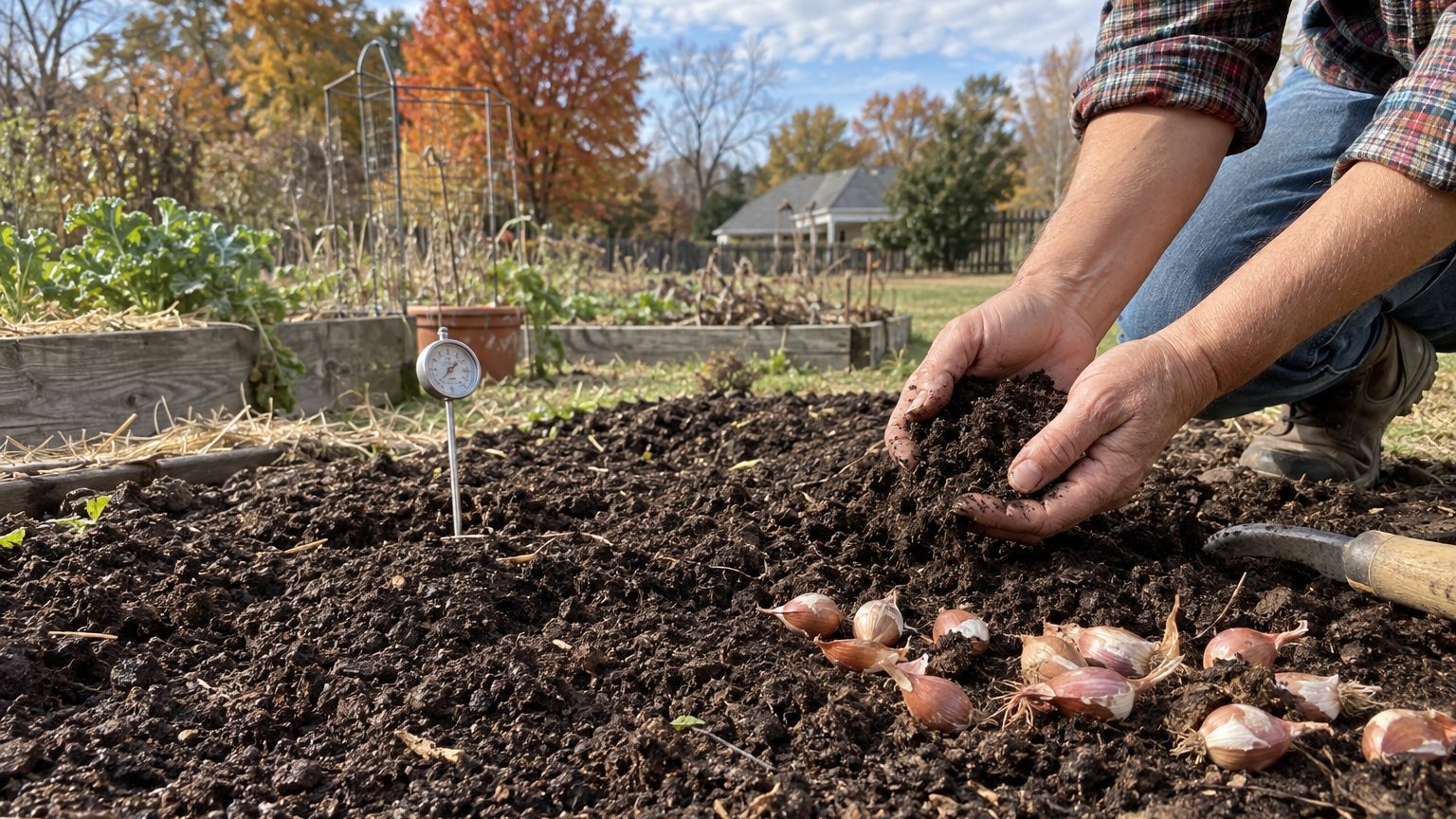

Plant shallots in Montana in spring, once the soil can be worked and has started to warm. Autumn planting is a gamble in colder valleys and a reasonable option only where winters are milder. The reference station here is Billings, with a last spring frost between April 29 and May 10. Billings is one of the state’s milder valleys, so treat its dates as a best case.
When the soil is warm enough in Montana
The date most gardeners want comes from NOAA’s 1991-2020 Climate Normals for Billings. The last spring freeze (32 F) falls between April 29 and May 10, taken from the 30-70% probability band. That is a probability, not a promise, and a late freeze can still land after the range.
Frost is only a proxy, though. Shallots respond to soil, not air, and soil lags behind the air. The ground warms after the frost risk has passed, not at the same moment. A bed can be frost-free for a week and still be cold and soggy at planting depth, which is where a set sits waiting. A soil thermometer pushed in a few inches tells you more than the calendar. Your state extension service can give the local planting threshold, which varies between a Billings garden and a high valley.
That caution about Billings matters. Mountain valleys elsewhere in Montana can see frost in any month. Gardeners in those places should treat April 29 to May 10 as a rough comparison point, not a date for their own bed. A neighbor’s long-standing planting habits are often a better guide than any normal.
Shallots are forgiving about cool weather once planted. Sets root in cool ground, and the green tops tolerate a light late frost better than tender vegetables do. The real risk is a bed that is wet, cold and heavy, where a set can rot before it roots. Wait for soil that crumbles in your hand rather than smearing.
Shallots share a lot of practice with garlic, and this site covers garlic in depth across its own national section. For autumn planting, curing, storing and allium rotation, use those garlic pages. What differs for shallots is mostly scale and habit. A set is a small bulb that multiplies into a cluster, so spacing has to leave room for the whole cluster, and the harvest is several bulbs per set. The general approach is laid out in Growing Shallots: One Bulb In, a Handful Out.
Curing deserves one firm note, because it touches food safety. Inspect every bulb before you store it:
- Check the neck, which should be dry and tight, not soft.
- Check the base, where any mold means the bulb goes out.
- Check for bruising or damp spots, which can hide rot from the outside.
A soft neck or a moldy base ends the question. A bulb that looks fine is not proof it is sound, and no page can promise a keeping time for your own harvest.
How long the season lasts here
The same Billings normals give a first fall freeze between October 1 and October 14. Both dates come from NOAA’s 1991-2020 normals, so the subtraction is straightforward. From May 10 to October 1 is 144 days. From April 29 to October 14 is 168 days. The frost-free window at Billings runs roughly 144 to 168 days, depending on how the freeze probabilities fall in a given year.
For a bulb crop that matters in a specific way. A window in this range is long enough for one planting to finish, with some margin. It does not comfortably allow a second, staggered sowing. That has consequences:
The spring planting is your planting. A late start cannot be fixed by a second try in midsummer, because bulbs need the long days of early summer to size up and then time to cure. Planting a second batch in June would leave you with small, late bulbs facing an October freeze, and many of the second-planting tops would still be green when the cold arrives.
That also changes the calculation on transplanting. Starting shallots from seed indoors buys weeks in a short season, and the shorter the window, the more those weeks are worth. But transplants carry a cost, which is the root check. Before any seedling goes in the ground, slide it out of its cell and look at the roots. White, branching roots holding the plug together mean it is ready. A tight, circling mat or a plug that falls apart means it will stall, and a stalled transplant in a 144-day window has no time to recover. Sets are simpler for most Montana gardeners, since they carry stored energy into the soil and skip the root question entirely.
If you want to try for a second sowing anyway, perhaps of green shallots to pull young, the succession sowing guide on this site walks through spacing intervals and what each sowing should be for. In a window this size, plan the later sowings as greens, not bulbs. And in colder valleys with a shorter window than Billings, even that is optional. Fewer frost-free days push everything toward the first planting and the earliest-maturing types.
Heat and water in Montana
This is the section where the figures matter most, and where I have to be straightforward. The verified data for this page do not include a count of days above 90 F or a summer rainfall total for Montana, so I will not quote either. A reference-station count would only describe one place anyway. What the data do show is a northern, cold-winter territory, and the hot-climate advice written for the South does not belong here. The questions that count are how cold winter gets and what that does to an autumn planting.
The mean daily minimum of the coldest month at Billings is 17.9 F (NOAA Climate Normals 1991-2020). That is an average of nightly lows, not a record, and the extremes are worse. The USDA Plant Hardiness Zone Map 2023 puts Montana across zones 3a to 6a, a wide range built on the average annual extreme minimum temperature. Billings sits at the milder end of what the state offers. Other parts of the territory differ, and many are much colder.
Shallots themselves are hardy in the ground. The trouble is the wet, not the cold. Where the soil freezes hard and stays wet through winter, autumn-planted sets are the ones at risk. They rot in cold, saturated ground, or frost heaving pushes them up and exposes them to drying wind. In those places spring planting is the safer call. In a milder winter, with well-drained soil and a layer of mulch, autumn planting rewards you with larger bulbs that are ready earlier, which is the whole reason people do it. For contrast, Growing Shallots in Oregon shows how a milder, wetter winter changes that tradeoff, and Growing Shallots in West Virginia shows a humid, freeze-and-thaw climate with its own set of problems.
Water is a matter of steadiness more than quantity. Shallots have shallow roots, so a bed that swings between bone dry and soaked gives you split, uneven bulbs. Keep moisture even while the tops grow, then ease off as they begin to fall over, so the bulbs can finish and cure. In a cool, damp summer, the tradeoffs differ. Expect more foliar mildew, slower ripening and more rot at the neck. Give plants room for air, avoid watering late in the day, and lift bulbs into dry conditions to cure.
Which shallots suit Montana
This page names no cultivar, and the reason is simple. The only recommendation that means anything is a variety that has been trialled in the place where you garden, and this page does not have those trial results. A name pulled from a seed catalog or another state’s list could fail in a Montana valley, and a gardener would find out only after a season. The right source is Montana State University Extension, which can point you to varieties that have actually performed in local conditions and to the county office nearest you.
What I can offer is reasoning by type, built on this territory’s facts. A season of 144 to 168 days at Billings, and shorter in colder valleys, favors the earliest-maturing types. Look for shallots described as early, because a bulb that is still sizing up when the first freeze arrives will be small and hard to cure. Growing from sets, not seed, also favors an earlier finish, since a set carries stored energy and has a head start.
The cold winter pushes the question toward winter hardiness. If you are considering autumn planting in a milder valley, ask the extension service specifically which types have overwintered in your area, not simply which grow well. Hardiness zones run from 3a to 6a across the state, so the answer in one valley can be wrong in the next.
Disease resistance moves up the list in years that run cool and damp, when mildew and neck rot show up. A type that holds its tops healthy and cures cleanly is worth more than one that grows large but stores poorly. Airflow matters as much as genetics, so spacing and weed control count.
For storing what you harvest, the garlic pages on this site cover curing and storage practice, and the same inspection rules apply: dry neck, sound base, no mold, no soft spots. Discard anything that fails.
Common questions
Can I plant shallots in Montana in the fall?
In milder valleys with well-drained soil, sometimes. Where the ground freezes hard and stays wet, autumn-planted sets often rot or heave, so spring is the safer choice. Ask your county extension office what has worked locally before committing a whole bed.
When is the last frost in Montana?
At Billings, the 32 F freeze probability band for the last spring freeze runs from April 29 to May 10 (NOAA NCEI 1991-2020 Climate Normals). Mountain valleys elsewhere in the state can frost in any month, so use your own area’s records.
How long is the growing season for shallots in Montana?
Using the Billings normals, the gap between the latest spring date (May 10) and the earliest fall date (October 1) is 144 days. Between the earliest spring date (April 29) and the latest fall date (October 14), it is 168 days. Colder valleys will have less.
Which shallot variety should I buy?
Ask Montana State University Extension for the varieties trialled near you. Choose early-maturing types for short seasons, and weigh winter hardiness and disease resistance if you plan to plant in autumn or expect a damp summer. Whatever you grow, a set that arrives soft or moldy should be returned or discarded.