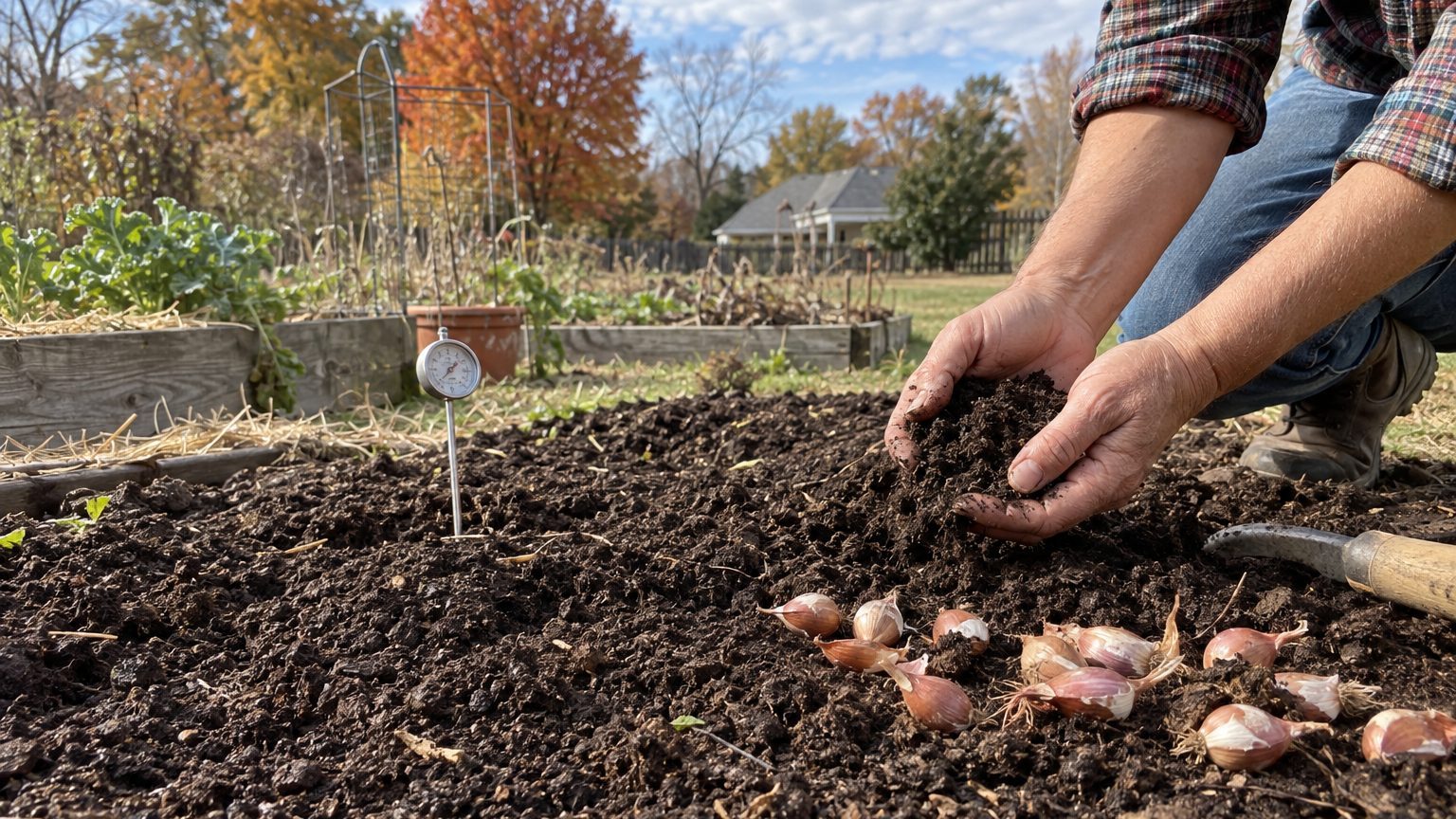

In western Oregon, plan on planting shallots in autumn or in early spring, and let the soil decide the exact day. The Portland-area window is long and mild by national standards. The state is not one climate, though. Central and eastern Oregon run on a very different calendar, and the choice between autumn and spring planting follows that split.
When the soil is warm enough in Oregon
The date most gardeners want is the last spring frost. For Portland, NOAA’s U.S. Climate Normals for 1991-2020 put it between March 6 and March 21, the band where the chance of a 32F freeze sits between 30 and 70 percent. That is a probability, not a promise, and a late cold snap can still arrive after the window closes.
Treat the frost date as a proxy, not the signal itself. Shallots respond to the soil, and soil warms after the frost risk has passed, not alongside it. A bed can sit cold and saturated for weeks after the last freeze. Planting into that mud is how sets rot before they root.
Reading the bed instead of the calendar
A bed that crumbles in your hand is ready. One that smears or holds a shiny ribbon of clay is not. Push a finger in to the second knuckle. If the soil feels cold and clammy and water pools in the hole, wait a week. A soil thermometer at planting depth, checked in the morning, takes the guesswork out of it. Raised beds and sloped ground usually come ready earlier than low pockets that collect water.
East of the Cascades, in the high desert, the season is far shorter and spring comes later. Gardeners in that part of the state may find the neighboring Growing Shallots in Idaho page a closer match for timing.
Autumn planting and what garlic pages already cover
Shallots share a lot with garlic, including autumn planting, curing, storage and allium rotation. The garlic section covers those practices in depth. What differs for shallots is mostly scale. A shallot set is smaller than a garlic clove and carries less reserve. In a cold, wet stretch it has less to fall back on. The general principles are in Growing Shallots: One Bulb In, a Handful Out. For hard-winter regions, Growing Shallots in Quebec shows how far the logic bends when the ground freezes solid.
How long the season lasts here
The same NOAA station gives a first fall frost between November 11 and November 27. Put that against the spring window and the frost-free stretch in Portland runs from about 235 days to about 266 days. The short end is March 21 to November 11. The long end is March 6 to November 27.
| Event (Portland, 1991-2020 normals) | Date range |
|---|---|
| Last spring 32F freeze (30-70% band) | March 6 to March 21 |
| First fall 32F freeze (30-70% band) | November 11 to November 27 |
| Frost-free window, shortest to longest | about 235 to 266 days |
That figure is useful only for what it allows. Shallots are not a race against the calendar in a window this long. A first sowing in early spring can finish well before fall frost. That leaves room for a second planting a few weeks later, which spreads the harvest instead of dropping it all in one week. It also leaves room to hold back a portion in case a wet spell ruins the first one.
The length also changes the value of transplanting. In a short-season climate, a head start indoors can be the difference between a full bulb and a thin one, and it justifies the root disturbance that transplants take. With a window this generous, that gamble is rarely needed in the Willamette Valley. Direct-set bulbs or well-hardened starts will have time to size up. Save indoor starting for seed-grown types or for a cold exposure that needs the extra weeks.
For how to stagger plantings, see the succession sowing guide on this site. The method is the same for shallots as for other alliums, with one adjustment. Later plantings give smaller bulbs, so use them for green shallots or kitchen use, not for the main storage crop.
A garden in the high desert or at elevation has a shorter frost-free span, and nobody should subtract that range from this table.
Heat and water in Oregon
Those numbers vary sharply between the coast, the valleys and the east side. Your county’s weather station, or Oregon State University’s local data, will give you the figure that fits your yard. Both depend on where you live, and the winter low matters more for the autumn-or-spring decision.
The winter low decides autumn or spring
At the Portland reference station, the mean daily minimum of the coldest month is 36.2 F. That is the average night, not the record low, and it sits above freezing. Individual nights still dip below 32 F, as the March and November frost dates show. But where winters run this mild, autumn-planted sets root in unfrozen ground and arrive in spring bigger and earlier than anything planted in March. That is the whole reason to plant in autumn.
The picture changes when the ground freezes hard and stays wet. Autumn sets in that kind of soil rot, or heave out of the ground as it freezes and thaws. In those places, spring is the safer call. The USDA Plant Hardiness Zone Map 2023 lists Oregon at 4a to 9b. That is a range for the whole state, built on a single variable, the average annual extreme minimum temperature. Mountain and high-desert gardens sit at the cold end of it. Check your own zone before you commit to autumn planting.
The reliable risk to plan for is dampness. In cool, damp summers, shallots tend toward foliar mildew, slow ripening and rot at the neck. Space bulbs so air moves between the rows, water at the soil line instead of over the foliage, and let the bed dry as the tops yellow and fall. Pull the bulbs on a dry spell if you can.
Curing is where food safety enters. Cure the bulbs somewhere airy and dry, and inspect each one before it goes into storage. A soft neck or a moldy base ends the question for that bulb. Discard it, because a bulb that looks sound on the outside is not proof it is sound inside. Check the bulbs yourself, on a regular schedule.
Which shallots suit Oregon
Choose by type, not by name. A variety name from the wrong region is the mistake a gardener notices first. The right place to find them is Oregon State University Extension, which can tell you what has performed in your county and what has not.
A few traits hold true for the western side of the state. The season is long, so you do not need the earliest-maturing type to beat the frost. Cool, damp conditions put disease resistance at the top of the list, ahead of size or flavor. A type that tolerates wet ground and holds its tops through humid weather will serve a Willamette Valley garden better than a showy one that sulks.
Two broad types are worth knowing. Shallots grown from sets, small bulbs planted whole, are the most common choice and suit both autumn and spring planting. Seed-grown types are started from seed and suit a gardener willing to start indoors. Both exist in many forms, and extension trial results tell you which of them thrive nearby.
Gardeners east of the Cascades face a shorter season, so the earliest-maturing types matter more there. Heat is a different problem: where summers run hot, give the roots shade and airflow, and mulch to keep the soil from baking.
Common questions
When should I plant shallots in Oregon?
West of the Cascades, either in autumn or in early spring once the bed is workable and not waterlogged. Portland’s last spring freeze falls between March 6 and March 21 (30-70% probability band, NOAA 1991-2020), but soil readiness matters more than the date. East of the Cascades, plant in spring.
Is autumn or spring planting better?
Autumn planting suits mild, well-drained winters, because the sets root before spring and produce larger, earlier bulbs. Spring is safer where the ground freezes hard and stays wet, since autumn sets can rot or heave.
Can I use the Portland dates anywhere in Oregon?
No. Portland is west of the Cascades. Central and eastern Oregon are high desert with a far shorter season, so check a nearby station or your extension office before borrowing these dates.
Which variety should I buy?
Ask Oregon State University Extension for the varieties trialled in your county. Only local trials say what grows well in your conditions. Look for disease resistance if your summers are cool and damp.