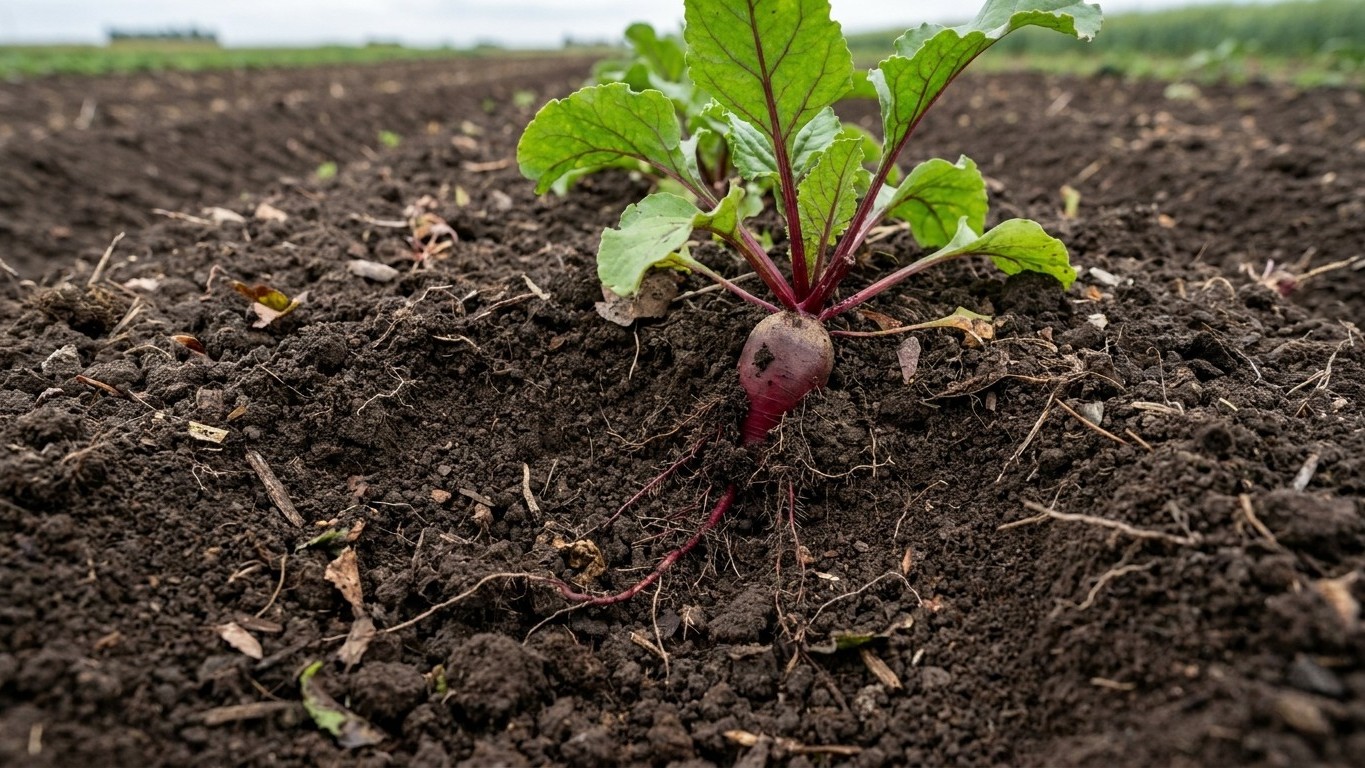

Mostly the weather and the cellar. Two failures are the most predictable in Ontario: thirst in the first six weeks, which sends young plants to flower, and heat above 85 F combined with thirst later, which turns the root woody. A third loss comes after harvest, when roots are stored too cold. This page carries no pest-by-pest calendar. It sticks to what the soil, the climate and the cellar can be tied to. For the whole crop plan, start with Growing Beets in Ontario.
The short answer
Start with the ground. Agriculture and Agri-Food Canada’s Canadian Soil Information Service maps the province’s soils, and the commonest soil order among the surface horizons is the Luvisol, at 39 percent of the mapped surface, with Gleysolic soils next. A Luvisol is a forest soil in which clay has moved down out of the surface layer, leaving the top lighter and the subsoil denser. The median surface measures out as loam to silt: 43 percent sand, 17 percent clay and 41 percent silt. Median pH is about 6.5 (slightly acid), organic matter runs about 4.3 percent, and the drainage class is well drained. That profile comes from 846 mapped surface horizons in the agricultural regions, so the far north is not represented.
Set that against what a beet wants. Utah State University Extension describes deep, sandy, well-drained soil rich in organic matter. Ontario’s median clears two of those bars, drainage and organic matter, and it is lighter than a clay. It is not sandy, though. With nearly as much silt as sand, it should hold moisture better than a true sand would, which cushions a dry week. The weak spot is depth. A beet is a taproot, and the denser subsoil that defines a Luvisol is where a root wanting to go deep may meet resistance. That is a tendency, not a verdict.
The organic matter figure also changes how you amend. At about 4.3 percent, the median is already well stocked, and the Extension guidance caps compost at no more than 1 inch of composted organic matter per 100 sq ft. More is not better. If you want to see what the root will actually meet in your own bed, the companion page on Beet Soil in Ontario: What the Root Will Meet goes deeper.
Treat all of this as a starting point. Ontario spans hundreds of soil series, and your garden may be nothing like the median. River bottoms, muskeg, and any ground a builder has scraped or filled will behave completely differently, and the 6.5 is the province’s median, not your pH. A soil test gives you your own number.
Then there is heat. The reference city here is Toronto, and the number of days a year it passes 90 F is not published in the verified figures behind this page, so I won’t guess at it. What matters more is that the source puts the woodiness trigger lower, at 85 F, and only when the plant is also short of water. Heat alone does not do it, and neither does thirst alone. They arrive together in a dry July.
The six weeks that decide it here
Beets are sown in place, so the clock runs from seeding. The usual window is 2 to 3 weeks before the last frost. At the Toronto Pearson station, Environment and Climate Change Canada’s climate normals put the average last spring frost on April 30. Counting back puts sowing at roughly April 9 to April 16, and the first six weeks then run to about May 21 to May 28.
That April 30 is a mean date, not a safe one. In one year out of two the last frost falls later. It is the midpoint of a window, and the station is one point in a province that is not one climate: northern and upland districts run weeks behind it. The normals also come from an older 30-year period than the US figures used elsewhere on this site, so don’t compare the two line for line. The When to Sow Beets in Ontario page treats the date question in full.
What does spring do in that stretch? Ontario’s spring swings. Cold nights and warm afternoons trade places, and a wet fortnight can be followed by a dry, windy one. A rainfall total for those weeks is not among the verified figures here, so take that as a description of pattern, not a measurement. It matters because the source says water stress in the first six weeks causes premature flowering. Bolting risk therefore sits in the dry spell, the week or ten days in May when seedlings are small, roots are shallow and the surface layer dries out. A well-drained loam sheds water faster than a heavy clay does, so a bed like that can go from damp to dusty quickly.
The first six weeks and the later heat are separate problems. Bolting is decided early, in the seedling and young-plant stage. Woodiness is decided late, as the root swells. If you sow in mid-April and count 60 to 80 days from seeding, the roots finish roughly between early June and early July, ahead of the worst heat. Sow a later round in May and the finish slides into the weeks when 85 F and dry soil are most likely to show up together. The six weeks decide whether the plant flowers. The weeks after decide whether the root is worth eating.
What goes wrong here
These are the failures this soil and climate make likely, each with its remedy.
- Bolting from early thirst. A dry May stalls young plants and triggers premature flowering. Keep the seedbed evenly moist through the first six weeks and check the soil a finger-depth down rather than trusting the surface.
- Woody roots from later heat. This is a separate failure: heat above 85 F combined with water stress. Water through hot, dry spells in the swelling stage, and time sowings so roots finish before midsummer if you can.
- Over-amending. With organic matter already near 4.3 percent in the median soil, piling on compost gains little. Stay at or under 1 inch of composted organic matter per 100 sq ft.
- A dense layer below. A Luvisol’s subsoil can be denser than the top. Loosen the bed deeply before sowing, and dig a test hole to see what your roots will meet.
- Wet or disturbed ground. Gleysolic soils, the second most common order, form under wet conditions, and scraped or filled lots drain unpredictably. If water stands after rain, build the bed up or choose another spot.
- Storing too cold. Colder is not better here. USDA Agricultural Handbook 66 says that at 32 to 34 F more black spot and rot occur than at slightly higher temperatures. Topped roots belong at 33 to 36 F and 98% relative humidity, and pits and cellars should stay between 31 and 41 F.
- Leaving the tops on. Bunched beets with leaves keep only 10 to 14 days at 32 F and above 98% relative humidity. Top them first for storage.
- Storing the small ones. Large roots keep much better because they lose water and shrivel more slowly. Eat the small roots first and keep the big ones.
Common questions
Is Ontario soil good for beets?
The median profile is promising: well drained, loam to silt, with organic matter around 4.3 percent. It is not the deep, sandy ideal, and a Luvisol’s denser subsoil may limit root depth. Your garden may differ a lot from the median, so a soil test and a test hole tell you more.
Can I treat April 30 as the safe date?
No. It is the average last frost at the Toronto Pearson station, and in one year out of two the last frost comes later. Northern and upland districts run weeks behind. Use it as the midpoint of a window, then watch your own forecast.
Are bolting and woody roots the same problem?
They are not. Water stress in the first six weeks causes premature flowering. Heat above 85 F with water stress later makes the root woody. One happens to young plants, the other to swelling roots, so “keep it watered” is not a single fix for both.
Should I store beets as cold as possible?
No. Topped roots do best at 33 to 36 F and 98% relative humidity, because 32 to 34 F brings more black spot and rot. Keep the big roots for storage, eat the small ones first, and remember that the source doesn’t publish a pest calendar for this crop, so this page doesn’t offer one.