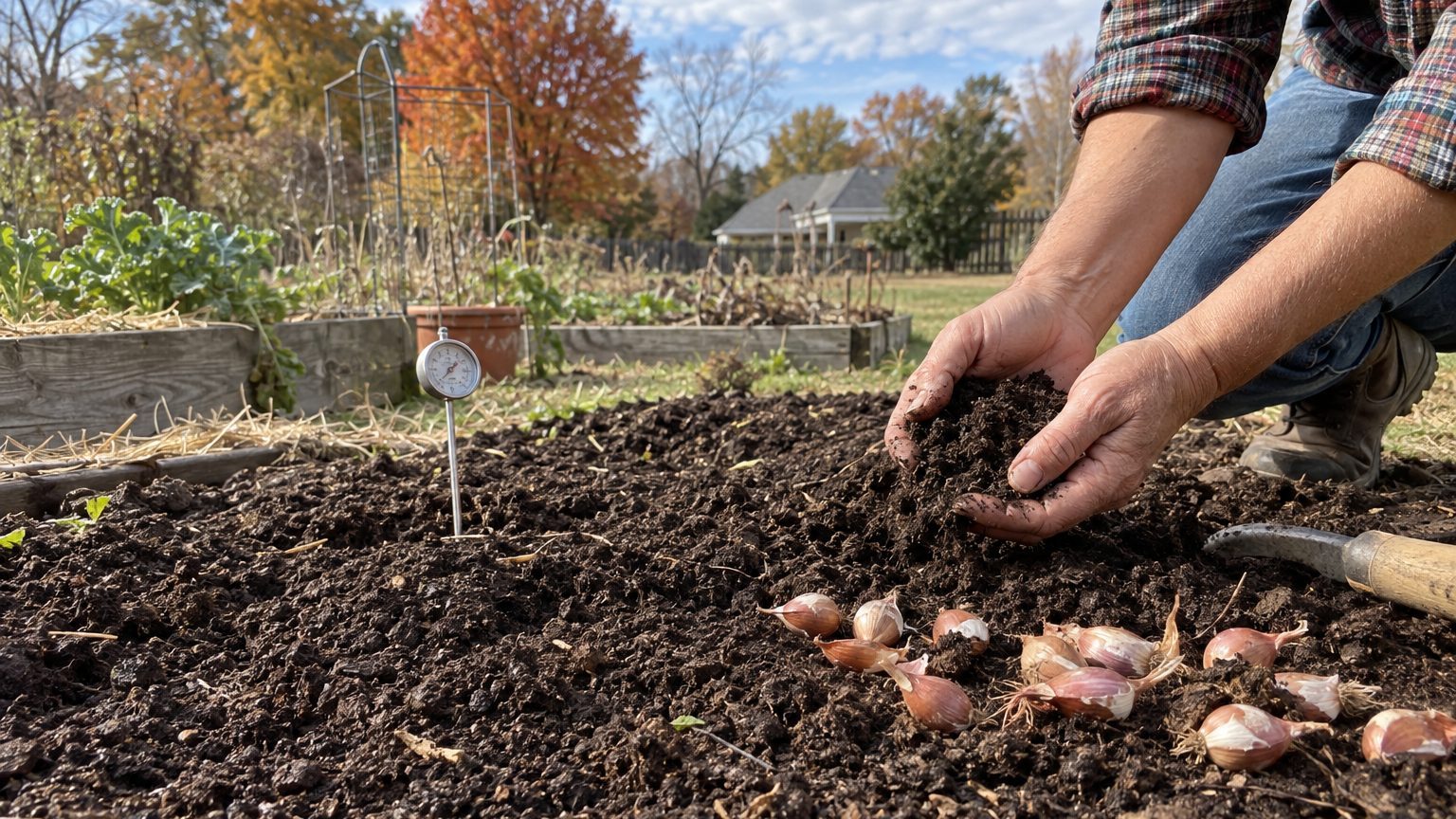

Spring planting is the safe default for growing shallots in West Virginia, and the calendar anchor is the last freeze: April 9 to April 23 at the Charleston reference station. Autumn planting can pay off in valleys with mild winters, but it carries real risk on higher, colder ground. Your elevation matters more than your county line, and the sections below show how to read it.
When the soil is warm enough in West Virginia
NOAA’s 1991-2020 Climate Normals put the last spring freeze (32 F, in the 30 to 70 percent probability band) between April 9 and April 23 at station USW00013866 in Charleston. A late cold snap in the first week of May is always possible.
Charleston also sits in a river valley. Higher ground across the state freezes noticeably earlier in fall, and it usually runs later in spring too, so a gardener in the mountains should shift every date toward the cold end.
Frost is a proxy, soil is the test
Frost date is only a stand-in. Shallots respond to the soil, and the soil warms and drains after the frost risk ends, not at the same moment. A bed that is thawed but still cold and saturated will hold a set without growing it. Roots stall, the bulb sits in wet ground, and rot gets a head start.
The practical test costs nothing. Grab a handful of soil from planting depth and squeeze it. If it forms a slick ball that stays glued together, wait. If it crumbles when you poke it, you are in business. A soil thermometer helps, but the squeeze test catches the problem that matters most in West Virginia’s clay-heavy and often wet ground.
Shallots are normally grown from sets (small bulbs), and some types are grown from seed or from transplants. Sets go in shallow, with the tip just showing, and each one multiplies into a cluster. For the types that have been trialed where you live, ask West Virginia University Extension.
Shallots share a lot with garlic. Autumn planting, curing, storage and allium rotation all work much the same way, so the garlic section of this site covers those practices in detail. The differences for shallots are mostly in the planting: they go in shallower than garlic cloves and give you a cluster instead of a single head. The basics are in Growing Shallots: One Bulb In, a Handful Out.
Curing is where food safety enters. Lift the crop when the tops fall over and dry, then cure it somewhere airy and out of the rain. Inspect every bulb. A soft neck or a moldy base ends the question: that bulb does not go into storage, however good the rest of it looks. Looking sound is not proof of being sound.
How long the season lasts here
Both dates come from the same Charleston station and the same NOAA normals. The last spring freeze falls between April 9 and April 23, and the first fall freeze between October 18 and November 1. Pair them four ways and the freeze-free window runs from roughly six months at its tightest to nearly seven at its loosest.
| Pairing | Freeze-free window |
|---|---|
| April 23 to October 18 (shortest) | 178 days |
| April 9 to October 18 | 192 days |
| April 23 to November 1 | 192 days |
| April 9 to November 1 (longest) | 206 days |
Those are calendar days at one valley station. Bulb formation responds to day length and heat as well, so a long window does not shorten the crop. What it does is give you room to work.
That room buys two things. The first is a staggered second sowing. With a window this long, a main planting at the soil-ready date and a second a few weeks behind it will both have time to size up, which spreads the harvest and gives you a hedge against one bad stretch of weather.
The second is transplanting. Where a season is short, setting out transplants is a gamble, because a check on the roots (white and firm is good, brown and slimy is not) costs you days you cannot spare. Here the slack lets you start seedlings or sets under cover in late winter, inspect the roots, and set them out once the soil passes the squeeze test. A failed transplant can be replaced.
Move north or up in elevation and that margin shrinks. The Charleston numbers do not describe a ridge-top garden in the eastern highlands, where the window may be several weeks shorter at both ends. If you garden there, treat the shortest pairing above as your best case. For comparison, Growing Shallots in Kentucky covers a neighboring state with a longer, warmer run.
Heat and water in West Virginia
Look up the normals for the station nearest you through NOAA, or ask your county extension office. The winter side decides the autumn-versus-spring question.
The winter low
The mean daily minimum of the coldest month at Charleston is 26.1 F, per the NOAA NCEI 1991-2020 Climate Normals. That is the average night in the coldest month, not a record low. It sits below freezing but not deep below, which means the ground in the valleys freezes and thaws repeatedly through winter instead of locking up solid.
That cycle is the danger for autumn-planted sets. Repeated freezing and thawing in wet soil can push shallow bulbs up out of the ground (heaving) and leave them sitting in cold water (rot). The USDA Plant Hardiness Zone Map (2023 edition) lists the state as 5a to 7a, built on the average annual extreme minimum. The colder end of that range belongs to higher country.
So the call splits by site. On well-drained soil in a milder valley, autumn planting is reasonable, and a mulch layer over the bed buffers the freeze-thaw swings. The reward is a larger, earlier bulb, which is what autumn planting is grown for. On heavy wet clay, in a frost pocket, or at elevation, spring is the safer call. Autumn-planted sets that fail cost you the whole season, while spring sets that go in a few weeks late cost you very little. Charleston’s first fall freeze falls between October 18 and November 1, and higher elevations come earlier, so anchor an autumn planting to your own local frost.
The summer side is about moisture more than heat. West Virginia is humid, and a humid, leafy-wet summer favors fungal disease in alliums: downy mildew, leaf blights, and slow ripening when tops stay wet. The garden practices that answer this are plain ones. Space the plants for airflow, water at the soil line in the morning instead of over the foliage in the evening, and keep allium crops off the same bed year after year. The rule is the same for shallots.
Which shallots suit West Virginia
The right answer here is a type, not a name. A cultivar that thrives in a drier state can sulk in Appalachian humidity. The only recommendation that counts comes from West Virginia University Extension, which can tell you what has been grown and tested in your region.
You can narrow the field to a few criteria:
- Disease resistance first. A humid climate puts mildew and leaf disease at the top of the list, so look for types described as tolerant of wet foliage.
- Earlier-maturing types for higher elevations, where the freeze-free window is shortest.
- Types that hold up through a cold winter, if you plan to plant in autumn in a zone 5 or colder site.
- Seed-grown or set-grown, depending on how much space and time you have. Sets are the simpler route for a first season.
A valley garden near Charleston, with a window of 178 to 206 days, has more freedom than a ridge garden. It can try an autumn planting of a cold-tolerant type alongside a spring planting of an earlier one, which turns a single bed into a small trial. Keep notes on planting date, spacing and what rotted or rusted. Those notes will teach you more than any variety list, and they are what you would bring back to your county extension agent.
Missouri sits at the other end of the humid Midwest-to-Appalachia spread, and Growing Shallots in Missouri shows how a different winter and summer shift the same decisions.
Common questions
Can I plant shallots in autumn in West Virginia?
Yes, in milder valleys with well-drained soil, and the planting should go in before the ground freezes. At Charleston the first fall freeze falls between October 18 and November 1, and higher elevations freeze earlier. On heavy, wet or high ground, freeze-thaw heaving and rot make spring planting safer.
Should I plant shallots by the last frost date?
Use it as a rough guide, not a trigger. The last spring freeze at Charleston falls between April 9 and April 23, but the soil warms and drains after that. Plant when a handful of soil from planting depth crumbles instead of sticking in a wet ball.
How do I know a cured shallot is safe to store?
Inspect each bulb for a dry, tight neck and a firm base. A soft neck or a moldy base ends the question, so discard that bulb. A bulb that looks fine is not guaranteed sound, so check stored bulbs regularly.
Which shallot variety should I grow here?
Ask West Virginia University Extension which types have been trialed in your part of the state, since a ridge-top and a river valley can differ by weeks in season length.