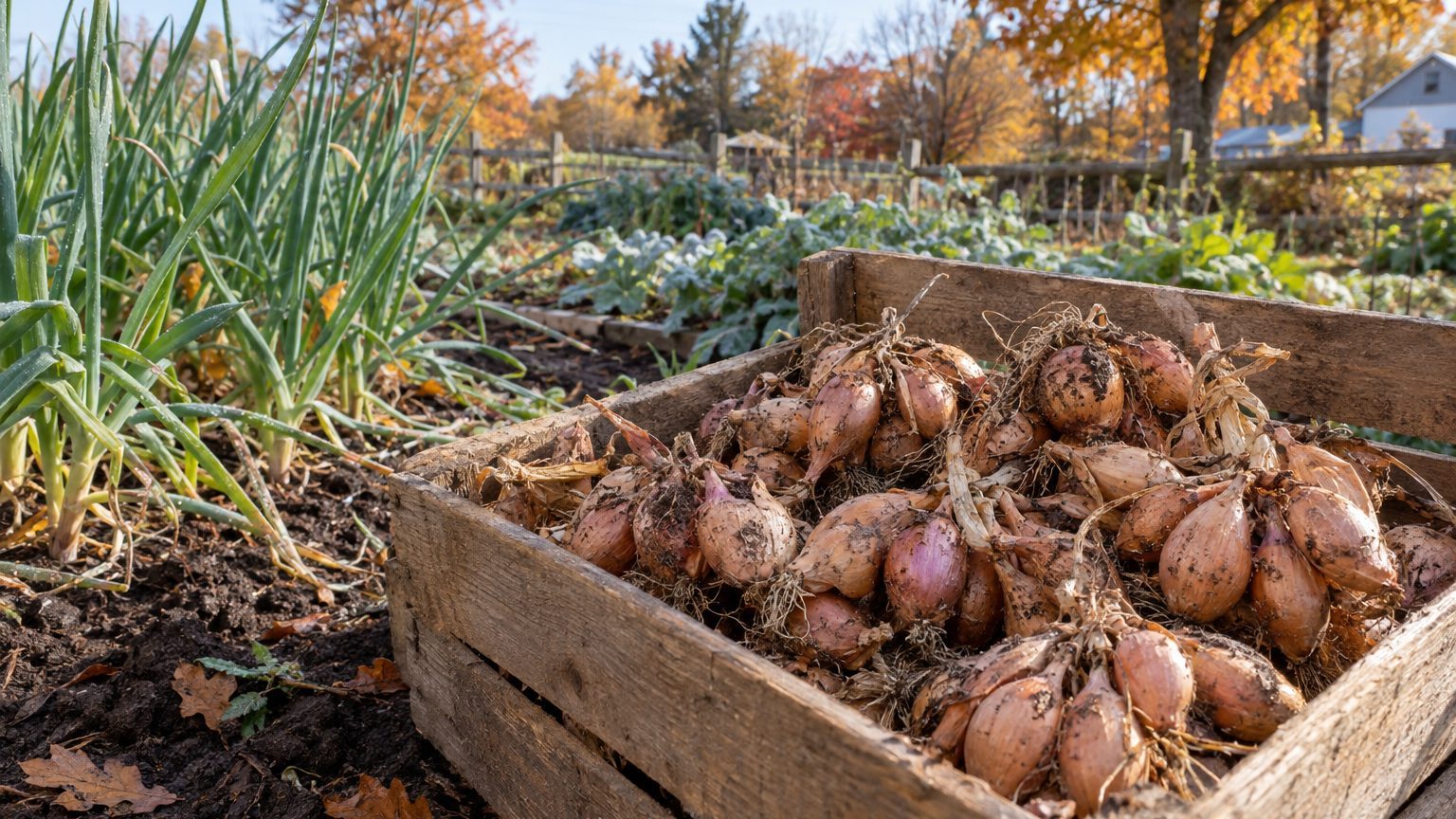

The best shallots for South Dakota are the ones that finish before hard freeze and can survive winter if they have to sit through one. That means spring-planted bulb sets or seed-grown shallots started indoors. Type matters more than cultivar name here, and this page has no county trial data to rank named varieties. What follows covers the decision, what fails, and how to check it locally.
The short answer for South Dakota
Choose spring-planted sets first, transplanted seed-grown shallots second, and treat fall planting as a gamble you cushion with mulch. The reason is arithmetic. At the reference station (the Sioux Falls airport weather station), NOAA’s 1991-2020 Climate Normals put the 32°F freeze probability band for the last spring freeze at April 29 to May 9. For the first fall freeze, the band runs September 24 to October 4.
Those dates are not promises. Each one is a probability of a 32°F freeze, taken from the 30 to 70 percent band. Inside that window a freeze is neither unlikely nor certain, which is why a May 1 planting can still meet a hard night. Between the two windows sits a little under five months, and shallots have to size up, mature, and cure inside that stretch.
Type by type
Shallots come in two broad routes, bulb sets (the multiplier type, where one clove becomes a cluster) and true seed. Their fit for this state differs a lot.
| Type | Fit for South Dakota | Main risk |
|---|---|---|
| Spring-planted bulb sets | Best default | Planting late leaves little time to size up |
| Seed-grown, started indoors | Good if started early | Weeks of indoor light and hardening off required |
| Fall-planted bulb sets | A gamble, better in milder areas | Winterkill and frost heave |
| Seed sown directly outdoors | Poor | Too little season to make full bulbs |
Why sets win
A set already holds a mature bulb’s stored energy. Planted as soon as the soil can be worked, it puts up leaves in cool weather and has the whole season to build a cluster. Seed-grown plants start from nothing, so they need a head start under lights. Both routes work, but the set asks less of you.
One caution on the numbers: the airport figures describe a city. Suburban and rural gardens usually see the last spring frost later and the first fall frost earlier, often by one to two weeks, and more at elevation. For exact timing, see When to Plant Shallots in South Dakota.
What will not work here
Direct-sowing shallot seed in the garden is the clearest failure. With a frost-free stretch of a little under five months at the reference station, and less in many rural spots, seed sown outdoors in May produces slender plants that are still small when the first fall freeze band arrives on September 24. They may make a few usable green shoots, but not a bulb worth storing.
Fall planting without protection fails next. The coldest month averages a daily minimum of 8.5°F at the reference station. That is the typical cold night, not the worst one. USDA hardiness zones are built on the average annual extreme minimum, and this state spans zones 3b to 5b, so the cold snaps in some counties are well below what 8.5°F suggests. A bulb set in October with no mulch sits near the surface, where repeated freezing and thawing can push it up and expose the roots. Mulch several inches deep helps, but it only improves the odds, and in the colder parts of the state it may not be enough.
Late spring planting is a quieter problem. Shallots form bulbs in response to lengthening days, so a set that goes in during June has far less time to build leaf area before bulbing begins. The bulbs come out small. Gardeners who wait for rural soil to dry out in a wet spring, then plant three weeks later than the airport dates suggest, often get a crop of marble-sized shallots.
The opposite mistake also happens. Planting on the first day of the airport window, April 29, works poorly in a rural garden where the last freeze may be one to two weeks later. Shallots tolerate light frost, but cold, waterlogged soil can rot sets before they root. Transplants raised indoors are tougher to keep alive if they are set out soft and unhardened into a hard freeze.
The last failure shows up at harvest. Shallots need tops that fall over and bulbs that cure in dry conditions. With the earliest fall freeze band starting September 24, slow-maturing types that are still green in late September get caught mid-growth and cure poorly. If a catalog lists days to maturity, favor shorter numbers, and count backward from the fall window, not forward from the spring one.
What changes across South Dakota
There is no single South Dakota garden. Under the USDA Plant Hardiness Zone Map (2023 edition, built on 1991-2020 normals), the state runs from zone 3b to 5b. That is a spread of two full zones inside one border, so any one answer would be wrong for part of the state. The reference city sits in the southeast corner, so its dates are a starting point for that region, not a statewide rule.
A gardener in the northern counties should shift toward the cautious end of everything on this page. Plant sets in spring, skip fall planting unless you are willing to lose the bed, and pick types that mature early. Dates for last spring frost slide later and the first fall freeze arrives sooner, so the growing window narrows from both ends. Seed-grown shallots become harder to justify because the indoor head start must be longer while the outdoor season is shorter.
Elevation works the same way. Higher ground, including the Black Hills, tends to freeze later in spring and earlier in fall than the airport station. Cold air also pools in low spots and valleys, so two gardens a few miles apart can differ by more than a week.
Gardeners in the southeast, closer to the reference station, have the most room. Spring-planted sets are still the default, but fall planting with heavy mulch becomes a reasonable experiment on a small bed, not on the whole crop. Our broader guide to Growing Shallots in South Dakota covers soil, spacing, and curing for every region.
Which zone are you in? This page will not guess. Look up your location on the USDA Plant Hardiness Zone Map and read the zone for your own spot, then adjust: colder than 4b, lean cautious; warmer, you have a bit more room.
Where to check this for your own county
Your state extension service holds the local knowledge this page cannot. South Dakota State University Extension is the land-grant extension service for the state. Start there and look for two things: a planting calendar for your county or region, and any varieties that have been trialled near you.
The calendar matters because extension publishes dates by crop. Shallots may not have their own page, so check for onion and garlic guidance, since their timing and cold tolerance are close cousins. If the site lists a regional or county office, call or email and ask what has done well locally. Staff there often know which neighborhoods frost early and which sites hold snow cover.
The variety trials matter even more. A trial reports what actually grew, matured, and stored in your area, which no frost table can tell you. If your county has none, ask for results from the nearest region with similar zone and elevation.
A county recommendation beats a state one, and this page is the state one. It rests on a single airport station, a zone range of 3b to 5b, and general shallot biology. It has no local trial data and does not rank named cultivars. Treat it as the frame, and let the county office fill in the picture.
Checking this against your own garden
Your garden’s own signals outrank every date here. Three are worth watching, and none needs equipment.
Soil warmth by feel. In spring, push a hand into the bed. Workable soil crumbles instead of forming a wet ribbon. If it still feels cold and heavy on your fingers, wait. A bed that reaches this state a week before your neighbor’s has good drainage and sun, so you can plant earlier there.
The first male flowers. The catkins on willows and cottonwoods open in early spring in many places. Watch the trees closest to your yard, not the ones in town. If they open earlier than usual, your spot is running warm. If they lag, plan for a later start. This is a local clue, not a calibrated rule, but it travels with your site.
The first true leaves. On seedlings started indoors, the first true leaves signal that a plant is ready for hardening off. On sets in the ground, the first green shoots show how fast your bed wakes up. If they appear later than the extension calendar suggests, your microclimate is cooler than the county average.
Jot the dates in a notebook. After two seasons, your own observations will tell you more than the airport station can.
Common questions
Can I plant shallots in fall in South Dakota?
Sometimes. It works best in the milder southeast, with a thick layer of mulch. Across a state that spans zones 3b to 5b, it is a gamble, and in the north it is a poor bet. Try a small bed before committing a whole crop.
Are seed-grown shallots better than sets here?
Neither is better in every case. Sets are simpler and give bigger bulbs sooner. Seed-grown plants cost less per plant and offer more variety choices, but need indoor lights and weeks of care before they go outside.
Which shallot variety should I buy?
This page has no county trial data, so it will not name a winner. Choose by type, favor shorter days to maturity, and ask your extension office what has been trialled near you.
Will the Sioux Falls frost dates work for my garden?
Only as a rough guide. The April 29 to May 9 spring window and the September 24 to October 4 fall window are probability bands at an airport station. Suburban and rural gardens typically freeze later in spring and earlier in fall, often by one to two weeks, and more at elevation.