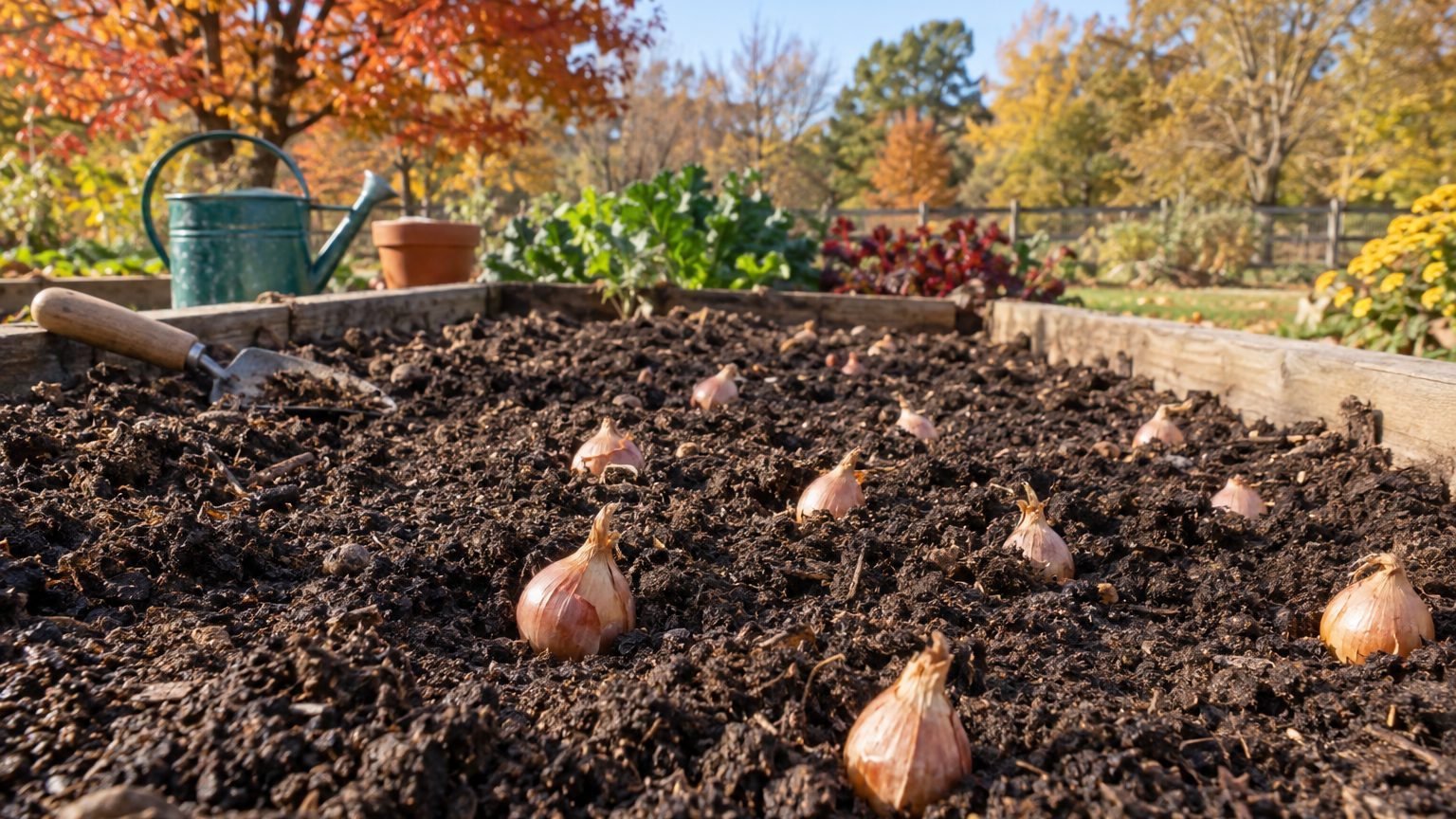

Plant shallots in South Dakota in early spring, as soon as the soil can be worked, or in fall so the cloves overwinter under mulch. Spring is the safer default for most of the state. The dates below come from one reference city, though, and a garden out in the country runs later in spring and earlier in fall. Treat them as a starting line, not a deadline.
The short answer for South Dakota
Spring planting is the default
At the reference city, the last spring frost falls between April 29 and May 9. The first fall frost falls between September 24 and October 4. Both ranges come from NOAA’s 1991-2020 Climate Normals for the Sioux Falls airport station, and both are probabilities of a 32°F freeze. They mark the stretch where that chance sits in the 30 to 70 percent band, so neither the early nor the late end is a promise.
Shallot cloves tolerate light frost once they are in the ground, so spring planting does not wait for the last-frost range to pass. It waits for workable soil: crumbly in your hand, not sticky, not frozen below the surface. In many years that arrives before April 29. Shallots start forming bulbs as days lengthen, so cool weeks spent building roots early pay off, and a late start cannot be fully made up. Read April 29 to May 9 as the point where hard freezes become unlikely, which is when you can pull row cover off an early planting.
Fall planting is a bet with a bigger payoff
Fall planting aims to get roots down while the green top stays small. It happens after the first-frost range of September 24 to October 4 has opened, in the weeks before the ground locks up. A few inches of straw or shredded leaves, applied once the soil begins to freeze, keeps freeze-thaw cycles from heaving the cloves out. Fall-planted shallots often finish earlier and larger, but you accept winter loss in exchange. The mean daily minimum of the coldest month is 8.5°F, and that is an average of the lows, so some nights run well below it.
One caution applies to every date here. These are reference-city figures, not a state-wide guarantee. Suburban and rural gardens typically see the last spring frost later and the first fall frost earlier, often by one to two weeks, and more at elevation. For the full crop picture, start with Growing Shallots in South Dakota.
What will not work here
Early fall planting and bare ground
Planting in late summer or the first days of September fails. Soil is still warm, the cloves sprout, and the tender top is killed by the first hard freeze, which can arrive as early as the September 24 end of that range. A bulb that spent its reserves on leaves has little left for winter.
Bare soil fails too. With an average coldest-month low of 8.5°F and open prairie wind, unmulched shallots are the ones that heave and dry out. In the colder northern parts of the state, even a mulched fall planting is a gamble, so plant only a portion of your stock in fall and hold the rest for spring.
Late planting and the slowest bulbs
The growing season is the gap between the last spring frost range and the first fall frost range, and in the country it shrinks by one to two weeks at each end. Cloves that go in after mid-May lose root-building time, and any variety that needs a long run to mature runs out of calendar before September. Seed-grown shallots, which have to be started indoors early, face the same squeeze. When you compare types, days to maturity matter more here than flavor, and The Best Shallots to Grow in South Dakota sorts them accordingly.
Borrowed calendars fail quietly. A planting schedule written for a milder state puts fall planting later than a South Dakota ground freeze allows, and a spring schedule from the same source starts too late for a state with a short season. Planting by date alone also fails in a cold, wet April, when cloves set into saturated soil rot instead of rooting. This page has no rainfall or summer heat figures, so it cannot hand you a watering schedule. Water by the soil in front of you, not by the calendar.
What changes across South Dakota
A spread of five half-zones
The USDA Plant Hardiness Zone Map (2023 edition, built on 1991-2020 normals) places South Dakota in zones 3b to 5b. That is five half-zone steps, from 3b through 4a, 4b and 5a to 5b, so there is no single answer for the state. The system rests on one variable, the average annual extreme minimum temperature. It tells you how hard winter can hit and nothing about season length or summer.
That distinction matters for shallots. Two gardens in the same zone can have frost dates two weeks apart, and the zone cannot tell you which is which. Use it to judge winter survival and mulch depth, and use frost dates to judge timing.
What to shift north and at altitude
A gardener in the cold north or in the higher country of the Black Hills should push the whole calendar later in spring, plant in spring rather than fall, and mulch more heavily if fall planting is attempted at all. Shorter seasons also push the choice toward quicker-maturing types. A gardener in the warmer southeast has more room: spring planting can start a little earlier, and fall planting has better odds. The reference city sits in that warmer corner, which is one more reason its dates run early for most of the state.
To see where your own place falls, look it up on the USDA map by ZIP code. This page will not guess it for you.
Where to check this for your own county
What to look for
South Dakota State University Extension is the state’s land-grant extension service, and it is the right next stop. Look for three things. First, a local planting calendar, ideally one written for shallots, or failing that for garlic (fall-planted) and onions (spring-planted), which follow the same logic. Second, the frost dates they use and which weather station those dates came from. Third, any varieties trialled in your county or a neighboring one, since a bulb that did well in a research plot a few counties over beats a catalog promise.
This page does not have a South Dakota shallot calendar from the extension service to cite. The extension calendar in its source list covers a lawn grass in another state, so it was left out rather than stretched to fit.
Why a county answer beats this one
A county recommendation beats a state one, and this page is the state one. It draws on a single reference station and a hardiness map that spans five half-zones. A county agent knows your local frost pockets, your soil, and which fall planting dates held up last winter. When the extension answer and this page disagree, go with the extension.
Checking this against your own garden
Three things to watch
Your own observations outrank every date above, and three are easy to track without instruments:
- Soil by feel. Grab a handful from the bed. If it crumbles and does not smear or clump into a wet ball, it is workable. A bed that reaches that point two weeks before your neighbor’s has warmer, better-draining soil.
- Male catkins on nearby trees. When cottonwoods, willows or similar trees start shedding pollen from their male flowers, spring has turned the corner locally. Note the date each year.
- First true leaves. Watch the first green shoots on chives or on fall-planted shallots. Early growth on a south-facing wall tells you about your warm microclimate, and slow growth in a low corner marks a frost pocket.
Keep a record
Write down the dates of all three, plus your last freeze in spring and first in fall. After two or three seasons you will have a calendar tuned to your yard that no state page can match.
Common questions
Can I plant shallots in South Dakota in the fall?
Yes, in the weeks after the first fall frost range (September 24 to October 4 at the reference city) and before the ground freezes hard, with mulch over the bed. It is riskier in the north and at elevation.
Is it too late to plant shallots after the last frost?
Not too late, but the clock is running. Cloves planted after the April 29 to May 9 range have less time to root, so choose quicker-maturing types and plant promptly.
Do the frost dates on this page apply to my garden?
They apply to the reference city. Rural and suburban gardens usually see the last spring frost later and the first fall frost earlier, often by one to two weeks, and more at elevation.
What does the 3b to 5b zone range mean for shallots?
It means winter severity varies a lot across the state, so there is no single recommendation. Check the USDA map for your location, and ask your extension office about local planting dates.