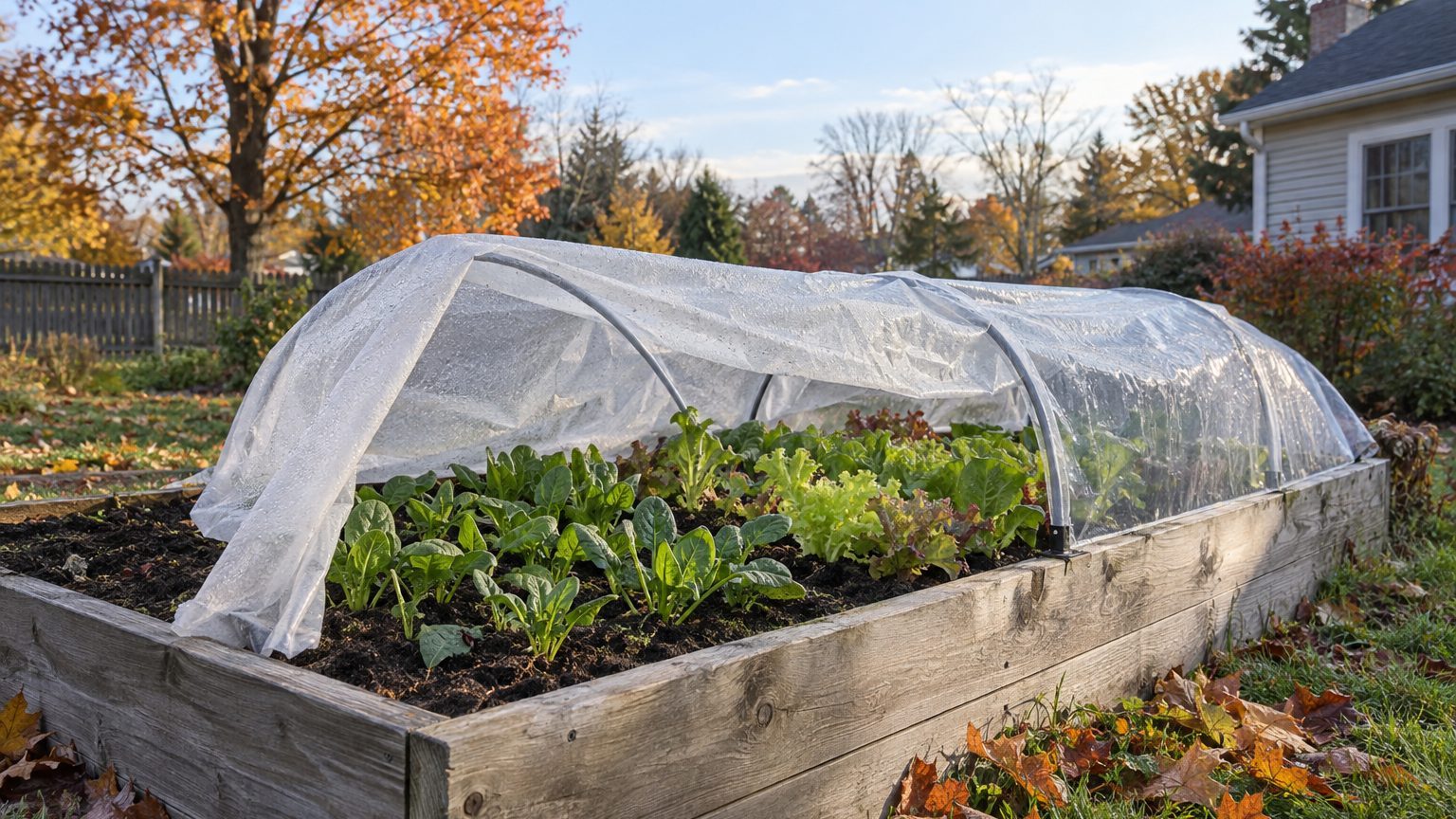

In the Philadelphia area, season extension can begin in late March and run into mid-November. That is a window of roughly 213 to 232 days between the last and first 32F freezes. Pennsylvania is a wide state, though, and the date on the calendar matters less than the temperature of your soil. A cover stretches both ends of the season. It does not erase them.
When the soil is warm enough in Pennsylvania
The date most gardeners want is the last spring freeze. For Philadelphia, NOAA’s NCEI U.S. Climate Normals 1991-2020 put it between March 29 and April 6. That range is the 30 to 70 percent probability band for a 32F freeze at station USW00013739. It is a probability, not a promise, and a freeze after April 6 can still happen in any given year. Philadelphia is also the mildest corner of the state. The northern tier and the Alleghenies run two to four weeks later in spring, so a gardener in Erie, Potter or Somerset County should push every date in this article back accordingly.
Frost is a proxy, though. Season extension is really waiting for warm soil, and soil lags the air. Ground that spent winter near freezing takes weeks to shed that cold, which means it warms after the frost risk ends, not along with it. Seeds sown into cold, wet soil sit and rot, and transplants stall with their roots in ground that cannot feed them. A mild week in mid-March says very little about what is happening four inches down.
What a cover does with the heat it finds
A cover works by holding heat that is already there. During the day the soil absorbs sun. At night it radiates that heat back out, and a layer of fabric, plastic or glass over the bed slows its escape. The air under the cover stays still instead of being swept away by wind. A second layer, such as fabric laid inside a hooped tunnel, creates another pocket of still air. The gain is real, but it varies with the material, the night, the wind and whether the ground was warm to begin with.
The worst nights are the clear, calm ones, when the soil radiates hardest. Those are the nights a gardener is most tempted to trust the cover completely. Don’t. A cover shifts the limit of what a crop can take; it does not make the crop frost-proof. A hard enough freeze goes through any passive structure, and a bed can be lost in one night. (Everything on this site is passive. Nothing here involves a heater, lamp or flame inside a covered structure, because fire and carbon monoxide are risks no gardener needs.)
Warm the ground before you plant. Lay plastic or a low tunnel over the bed for a week or two ahead of sowing, then check the soil with a thermometer at planting depth in the morning, when it is at its coolest. Seed packets list minimum germination temperatures, and those numbers are a better guide than the date.
Any closed structure needs ventilation, and this is a matter of keeping the crop alive. A closed cold frame in spring sun can cook its contents within an hour, even when the morning was near freezing. Prop the lid on any sunny day and close it again in late afternoon. For the broader logic behind covers, see Extending the Season: What a Cover Buys, and What It Cannot.
How long the season lasts here
Philadelphia’s first fall freeze comes between November 5 and November 16 (same NOAA NCEI normals, same probability band). Count from the latest spring date to the earliest fall one and you get 213 days. Count from the earliest spring date to the latest fall one and you get 232. So the frost-free window at this station runs about seven months, and roughly a month of that spread comes from nothing more than which year you happen to be gardening in.
| Philadelphia (NOAA NCEI 1991-2020) | Earliest | Latest |
|---|---|---|
| Last spring 32F freeze | March 29 | April 6 |
| First fall 32F freeze | November 5 | November 16 |
| Length of window | 213 days (April 6 to November 5) | 232 days (March 29 to November 16) |
What that length allows
Length matters because of what fits inside it. A window this long leaves room for a second sowing of many crops. A spring planting of lettuce, peas or radishes can be followed by a summer sowing of beans or a fall planting of greens. The fall planting is where a cover earns its place, since it carries those crops past the first hard freeze.
Move toward the northern tier and the arithmetic tightens. Spring starts two to four weeks later, and the fall freeze tends to arrive sooner. I do not have a measured fall date for those areas, so I won’t guess one. For gardeners there, the first sowing may be the only one for slow crops. Transplanting also becomes a harder call. A transplant buys weeks, but it takes a root check, a setback while the roots re-establish. In a long window that setback costs little. In a short one it can eat the head start you were chasing.
For planning the second and third sowings, the succession sowing guide on this site lays out spacing and timing. Work back from your own first fall freeze, not from Philadelphia’s.
Heat and water in Pennsylvania
The brief for this page calls for the count of days above 90 F and the summer rainfall total. I do not have either figure from a verified source for this territory, and a count at one reference station would not describe the whole state anyway. So I won’t print a number. What I can say is that Pennsylvania’s challenge with extended seasons is rarely scorching heat. Summers are humid, and the northern and higher parts of the state run cooler. A cool, damp summer brings its own problems: powdery and downy mildew, slow ripening, and leaf disease that spreads when foliage stays wet. If you want local heat and rainfall numbers, Penn State Extension is the place to ask.
Light and cold set the real limit
For fall and winter, the governing facts are light and cold together. Latitude sets the date when daylight drops below what a crop needs to keep growing. Philadelphia sits at 39.87 degrees north, and that figure belongs to the city, not to the whole state. A gardener near the northern border sits several degrees higher, so the date arrives sooner. Check your own latitude and a sunrise-sunset table for your town. After that date, a cover holds a crop alive rather than growing it. A bed of hardy greens under fabric in December is being stored, not produced.
The coldest month decides how much structure you need. At Philadelphia the mean daily minimum of the coldest month is 26.0 F (NOAA NCEI Climate Normals 1991-2020). That is a typical night low, not a record. Nights below freezing are routine, but deep cold is not the usual winter pattern there. In that setting a light fabric over a hoop can carry hardy crops through much of the cold season, while tender crops and the deepest weeks of winter call for a framed structure with a rigid cover.
The USDA Plant Hardiness Zone Map (2023, built on 1991-2020 normals) places Pennsylvania across zones 5a to 7b. That range is built on one variable, the average annual extreme minimum, and it spans the whole state. A gardener in a 5a pocket of the Alleghenies is working with a very different winter from one in a 7b corner of the southeast. Where the northern tier gets colder than Philadelphia’s figure, expect framed structures to matter earlier and fabric alone to stop being enough sooner.
Which season extension suit Pennsylvania
Choose by type, and let the territory’s facts do the narrowing. In the northern tier and the Alleghenies, where spring comes later and the window is shorter, the earliest-maturing types of each crop make sense. A crop that finishes quickly gets in before the fall freeze and light loss close the window. In the southeast the window is long enough that maturity speed matters less than whether the crop tolerates the cold you will ask it to endure.
Humidity changes the order of priorities. In a state where damp summers and wet foliage invite mildew and leaf disease, disease resistance is the first criterion for any crop you plan to carry into fall. Airflow and spacing come next. Where heat does build, as it can in the southeast, types that tolerate it, with shade and mulch at the root, hold up better. Whichever you pick, a closed structure still needs venting every sunny day. A closed frame that cooks a bed in an hour does not care how resistant the variety was.
This page does not name a single cultivar, and that is deliberate. The varieties that perform in Pennsylvania are the ones trialled here, in your kind of soil and your kind of summer, and I do not have those trial results. A name pulled from a national catalog would be a guess dressed up as advice. Penn State Extension is your state’s land-grant extension service. Its county offices and publications reflect local trials, and that is the recommendation worth acting on.
For structure, match the cover to the cold you expect. Light fabric suits the shoulder seasons and hardy crops. A framed structure with a rigid cover suits deeper cold. Neither one makes a crop frost-proof. Gardeners comparing climates can see how the same question plays out in Extending the Growing Season in Colorado and Extending the Growing Season in Illinois.
Common questions
Can I plant before the last frost date if I use a cover?
Sometimes, with limits. A cover holds heat and shifts the limit a little, but the gain varies with the night, the wind and the warmth of the soil underneath. Hardy crops tolerate the risk better than tender ones. Warm the soil first and treat a cover as a margin, not a guarantee.
Is the March 29 to April 6 date true for all of Pennsylvania?
No. It is the Philadelphia range, from NOAA NCEI’s 1991-2020 normals. The northern tier and the Alleghenies run two to four weeks later in spring. Check with your county’s Penn State Extension office for a date closer to home.
Do I have to vent a cold frame in cool weather?
Yes, whenever the sun is out. A closed frame in spring sun can overheat within an hour even on a cold morning. Prop the lid on sunny days and close it again in the late afternoon so the soil’s stored heat stays in for the night.
Can I heat a hoop house or cold frame to be safe on the coldest nights?
No. Heaters, lamps and candles inside a covered structure carry real fire and carbon monoxide risks, and this site does not recommend them. Rely on passive measures: warm soil, still air, a second layer of fabric and choosing hardy crops.