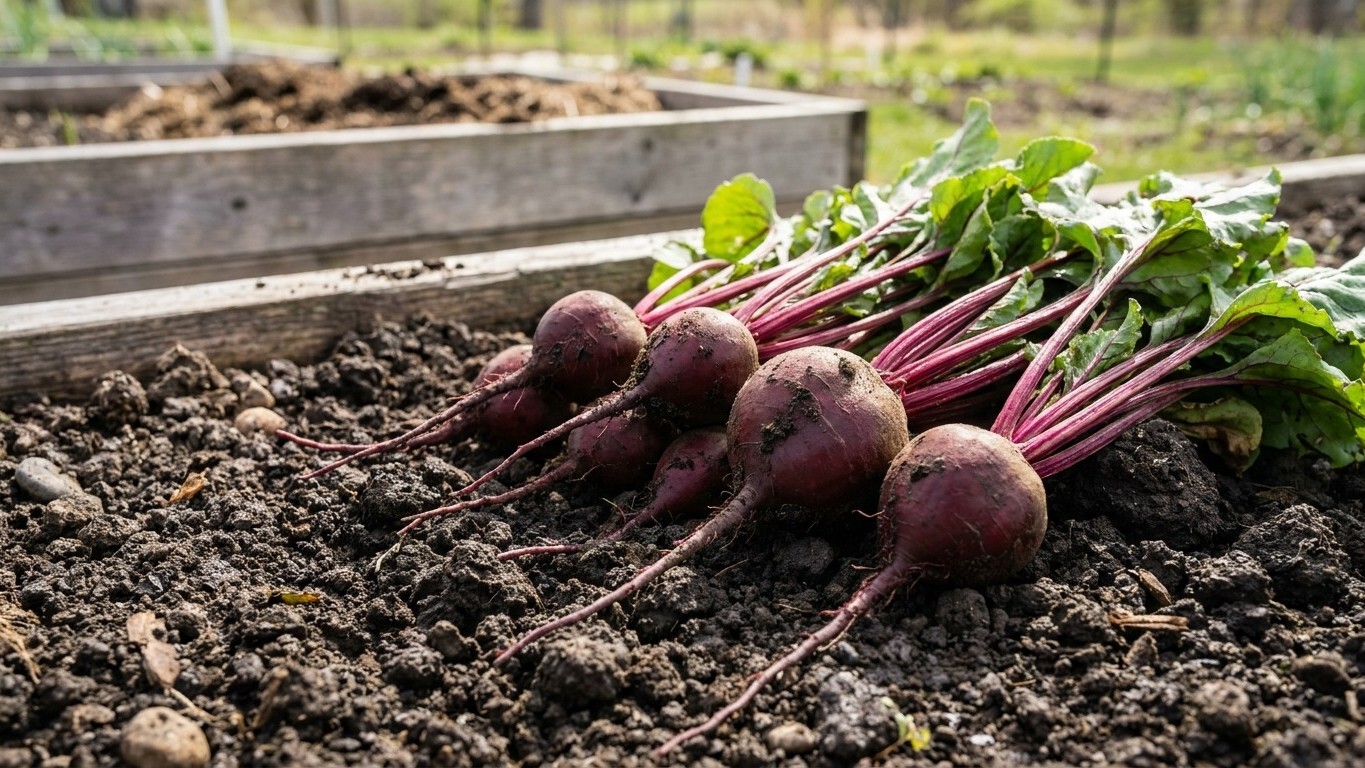

For spring sowings in Delaware, expect to pull beets from roughly mid-May into mid-to-late June. That is 60 to 80 days counted from seeding, since beets are sown in place and never transplanted. Pull them before heat and dry soil turn the roots woody. Once they are out of the ground, top them right away and store them at 33 to 36 °F. The standard instinct to chill root crops as close to freezing as possible works against beets.
The short answer
Start with the ground. Delaware’s official state soil is the Greenwich series, an Ultisol, which is an old, heavily weathered and leached soil that runs naturally acid and low in nutrients. USDA’s representative values for its surface layer read 48 percent sand, 9 percent clay and 43 percent silt (a loam to silt texture), with surface pH about 6.0 and organic matter about 1.7 percent. It is well drained. Those are records for the mapped surface horizon of the major components of the series, not a reading from a worked garden bed, and the pH is not your pH.
Utah State University Extension describes the beet’s ideal as deep, sandy, well-drained soil rich in organic matter, amended with no more than 1 inch of composted organic matter per 100 sq ft. Set the Greenwich beside that list and the match is mixed. Drainage passes, and the low clay content (9 percent) means the ground is loose enough for a root to swell. Organic matter is the weak spot. At 1.7 percent, the soil sheds water quickly and holds little in reserve. For a beet, that translates into a thirsty seedling bed during any dry spell.
Delaware spans hundreds of soil series, and this one is a starting point rather than a diagnosis. A bed near the Nanticoke or in a low area of Sussex County can behave nothing like it, and any yard a builder has scraped or filled will differ again. Use the Greenwich as a rough guide to what ground in this region tends to do: drain, run a bit acid, and stay lean on organic matter. Then get a soil test for your own numbers. Our page on Beet Soil in Delaware: What the Root Will Meet goes deeper on what to do with the results.
Heat is the second half of the answer, and here an honest gap needs stating. The number of days a year the reference station passes 90 F is not published in the verified figures for this page, so no count appears here. What the source does give is the threshold that matters for beets: heat above 85 F combined with water stress makes the root woody. That is a different failure from bolting, which comes from thirst early in life. Woodiness is a late-season problem, and it is why a root left in the ground into a hot Delaware June tends to disappoint even if it grew well in May.
So the practical rule is to sow early enough that the roots size up in cool weather, and pull them before the heat arrives. For general growing guidance across the season, see Growing Beets in Delaware.
The six weeks that decide it here
The reference airport station puts the last spring frost between April 3 and April 14, a band covering the 30 to 70 percent probability of a 32 F freeze. Sowing 2 to 3 weeks before that lands seed in the ground between roughly March 13 and March 31. Count 60 to 80 days from there and the harvest window opens around mid-May and runs to about the third week of June.
Those first six weeks of a beet’s life are the ones the source flags. Water stress during that stretch causes premature flowering, which is bolting. Sown in the March window, a bed lives through its first six weeks from late March to early May, through the middle of a Delaware spring. That season tends to swing. Cool, damp stretches give way to warm, breezy, dry ones, sometimes within days of each other. No verified rainfall figure is carried here, so treat that as the general pattern rather than a forecast.
The bolting risk sits in the dry swings. A Greenwich-type soil drains well and holds little water at 1.7 percent organic matter, so a warm, dry week in April can leave the seed zone parched while the ground a few inches down is still cool. A beet that bolts sends up a flower stalk instead of fattening its root. Water stress is the trigger, so the guard is steady moisture through those first six weeks, not a generous soaking after the plants are already stressed.
One adjustment matters before you mark the calendar. The frost dates above come from an airport station. Suburban and rural gardens typically see the last spring frost later than that, often by one to two weeks, and more at elevation. Delaware is a low, flat state, but the gap between a paved airport and a cold-air-pooling backyard is real. Check your own county’s frost data, and shift the sowing window later by the same margin if your garden runs colder than the reference.
The six-week window also overlaps the season when pests find young beet foliage, which is covered in What Eats Beet in Delaware, and When. A bed that is stressed for water and chewed on at the same time loses ground fast, so watch both in the same weeks.
What goes wrong here
- Bolting from early thirst. A lean, well-drained soil dries out quickly during the first six weeks, and water stress then triggers premature flowering. Remedy: keep the seed bed evenly moist from sowing through the sixth week, and mix in composted organic matter, up to 1 inch per 100 sq ft, to give the soil more to hold. Go no higher than that figure.
- Woody roots from late heat. This is a separate problem. Heat above 85 F with water stress makes the root woody, and it hits roots that are still in the ground in June. Remedy: sow early, pull on schedule, and do not leave a row “to get bigger” into hot weather.
- Too much compost. Piling on organic matter to fix a lean soil overshoots the guidance. Remedy: stay at or under 1 inch of composted material per 100 sq ft, and let a soil test tell you what else is missing.
- Assuming your soil is the state soil. The Greenwich values are a mapped average for one series. Remedy: run your own soil test, particularly on filled or scraped ground, where the surface can be compacted and shallow. A beet wants depth, so loosen the bed well below the seed zone.
- Trusting airport frost dates. Gardens outside town often see the last freeze one to two weeks later. Remedy: check your county’s data and sow accordingly.
- Storing too cold. The USDA’s Handbook 66 says more black spot and rot occur at 32 to 34 °F than at slightly higher temperatures. Remedy: hold topped roots at 33 to 36 °F with humidity at 98 percent. In a pit or cellar, keep the range between 31 and 41 °F.
- Leaving the tops on. Bunched beets with leaves keep only about 10 to 14 days at 32 °F and high humidity. Remedy: top them as soon as they come out of the ground.
- Saving the wrong roots. Small roots lose water and shrivel faster than large ones. Remedy: eat the small beets first and put the big ones in storage.
Common questions
How long from seeding to pulling beets in Delaware?
Plan on 60 to 80 days counted from the day you seed. Beets are sown in place, so there is no transplant date to count from. For a March sowing, that puts harvest roughly between mid-May and the third week of June, depending on your sowing date and your garden’s local frost timing.
Is my garden soil the same as the Greenwich series?
Probably not exactly. Greenwich is Delaware’s official state soil, and its surface layer averages 48 percent sand, 9 percent clay and 43 percent silt with about 1.7 percent organic matter. But the state has hundreds of soil series, and filled or scraped ground differs completely. A soil test gives you your own pH and nutrient numbers.
Why is a colder storage spot worse for beets?
According to USDA Handbook 66, storage at 32 to 34 °F produces more black spot and rot than slightly warmer conditions. The target for topped beets is 33 to 36 °F at 98 percent humidity. Pits and cellars should stay between 31 and 41 °F. The margin is narrow, so a thermometer in the storage spot is worth having.
Which beets should I eat first and which should I store?
Eat the small ones first. Large roots keep much better because they lose water and shrivel more slowly. Top every beet right after pulling, since bunched beets with leaves last only 10 to 14 days. The big, topped roots are the ones to put away for longer storage.