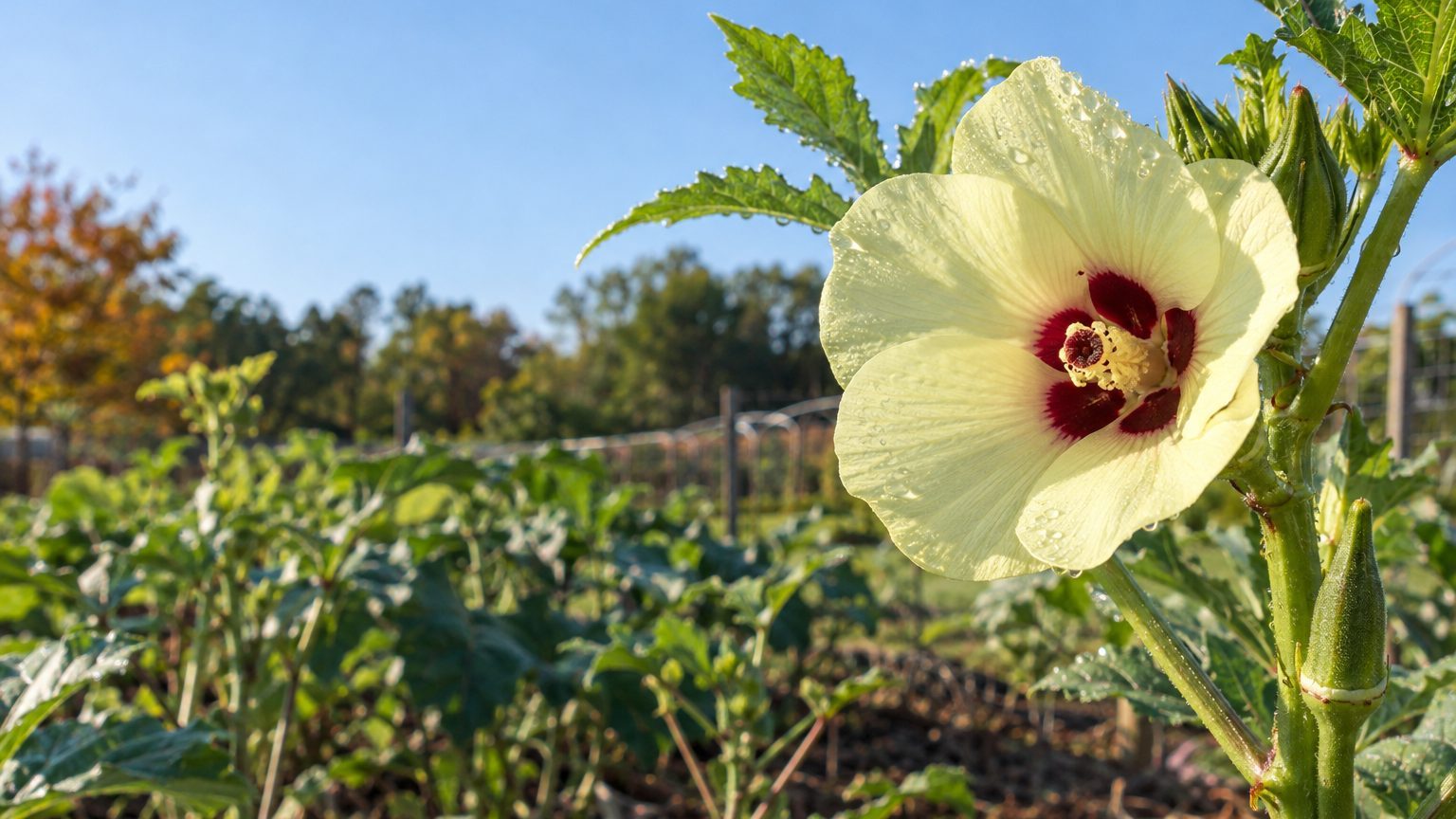

An okra flower opens once, usually in the morning, and it is finished by late afternoon. By the next day the petals are a crumpled wrap around a pod the size of a pencil stub. That short life is normal, and it explains why a plant can look covered in blooms on Monday and show none on Tuesday while the pods keep coming. The flower’s job is done in a few hours. Your job starts right after.
One day, start to finish
The blossom looks a lot like a hibiscus, and that’s no accident. Okra (Abelmoschus esculentus) belongs to the mallow family, alongside hibiscus, hollyhock, cotton and rose of Sharon. Five creamy yellow petals overlap in a cup about 2 to 3 inches across, and the base of each petal carries a deep maroon or crimson blotch that forms a dark eye in the center. A column of pollen-bearing anthers wraps around the style, with the sticky stigma at the tip.
Each flower grows from a leaf axil, the spot where a leaf meets the main stem. The plant sets one bud per node and works its way up as it grows, so the first flowers appear low on the stalk and later ones climb toward the top. Most plants begin flowering roughly 50 to 65 days after sowing, depending on variety and how warm the season has been. Cool springs push that date later.
Here is how a typical day goes. The bud swells for several days, then unfurls in the early morning as the air warms. Pollen is shed more or less as the petals open. By midday the flower starts to droop, and by evening the petals have twisted shut. Over the next day or two they dry up and fall away, often leaving a brown husk at the pod’s tip.
The pod does the hard work after that. In summer heat it grows fast, and picking size (typically 2 to 4 inches, depending on variety) arrives about four to six days after the flower opened. Warm weather speeds this up. A cool spell stretches it out. If you ever wonder how old a pod is, count the days since you last saw a bloom on that node.
Why the flowers don’t hang around
Gardeners tend to read a short-lived flower as a sign of something wrong. Here it’s the opposite. Okra evolved in hot climates, where a flower that sits open all day loses water fast, and a petal is an expensive structure to run in 95°F sun. Opening early, doing the pollination work during the cooler hours, and then shutting down is an efficient trade.
Plenty of other mallow-family plants do the same thing. Rose of Sharon blooms are spent in a day. So are many hibiscus. Daylilies get their name from the same trick, and the whole strategy depends on the plant making a fresh flower every morning rather than keeping old ones alive. A well-fed okra plant at peak season is a flower factory, with new buds queued up at nodes all the way up the stem.
Pollination is mostly handled in-house. Okra flowers are largely self-pollinating, meaning pollen from the anthers lands on the same flower’s stigma without help. Bees do visit, and they matter for cross-pollination between plants. Bees that specialize in mallows, such as the hibiscus bee found across much of the eastern U.S., are regular visitors, and honeybees and bumblebees stop by too. But a lone okra plant in a container on a third-floor balcony will still set pods. That reliability is a big part of why okra is considered an easy crop once the weather cooperates.
The pollen grains themselves are large and spiky, which makes them poor candidates for blowing around on the wind. They cling to whatever touches them. That’s another reason the work happens fast and mostly at close range, inside the flower or through a bee’s fur.
If the cycle sounds familiar, it should. Squash and cucumber blossoms also last a day or less. Okra is just less dramatic about it, since the flower doesn’t announce a failure. A pod simply appears or it doesn’t.
Reading the flowers: normal and not normal
The petals falling is routine. What deserves attention is the bud falling before it opens, or the whole flower dropping with a pod that never swells. If you see small green buds on the ground, or flowers that open and drop with nothing behind them, the plant is under stress. Our guide to okra flowers falling without setting pods walks through the causes in detail, but the usual suspects are short enough to list here:
- Heat extremes, with daytime highs pushing past the mid-90s and nights staying in the 80s, which can reduce pollen viability
- Cold snaps, with nights dipping into the 50s, which stall growth and cause buds to abort
- Drought stress or wildly uneven watering
- Too much nitrogen, which grows tall leafy plants with few pods
- Sucking insects such as stink bugs, which feed on buds and young pods
A quick test helps. Look at the node where a flower dropped. If a small green swelling is visible at the base, pollination worked and the pod is on its way. If the scar is flat and the stalk is yellowing, the plant gave up on that flower.
Ants on the buds
Ants crawling over okra buds alarm a lot of gardeners. Okra has small nectar-producing glands on its leaves and calyx (the green cup beneath the petals), and ants come for the sugar. They’re usually harmless. If you also see sticky residue and clusters of tiny insects, those are aphids, and the ants are farming them. That is a separate fix. Blasting the aphids with water or using insecticidal soap tends to settle both problems.
Timing of the first flower
Planting too early is the most common reason flowering comes late or sputters. Okra stalls when soil is cold, and plants set out in spring chill can sit for weeks before they get going. Waiting until soil reaches about 65 to 70°F and nights stay reliably warm pays off with faster growth. In the South, that can mean planting in April. Farther north, late May or early June is typical, and many growers use black plastic or start transplants in peat pots to get a head start. Details on timing and the rest of the season are in the main guide to growing okra, from heat to daily picking.
What to do with a one-day flower
The practical rhythm is simple. Flowers tell you where the pods will be, and the pods set the schedule. Since a pod can go from tender to woody in a couple of days once it passes about 4 inches (sooner for some varieties, later for others), a gardener who sees a bloom on Monday should expect to be harvesting at that node by the weekend. Checking the plants daily during peak summer is less of a chore than it sounds, because the work is a matter of minutes.
Flower color and shape are about the same across most varieties, so don’t expect the bloom to tell you which type you planted. A Clemson Spineless and a red-podded type such as Burgundy open similar yellow blossoms with dark centers. Plant size does differ, though. Dwarf types start flowering lower on shorter stalks and often earlier, which matters for short-season gardens and containers. The comparison of spineless, dwarf and red okra covers those differences.
If you save seed, the one-day window becomes a tool. Because the flower is mostly self-fertile but bees can still cross it with a neighbor, isolation matters. You can leave several hundred feet between varieties, or protect select flowers directly. The standard method is to tie a bit of string, a twist tie or a small bag around a bud the evening before it opens, so insects can’t get in. The next morning the flower pollinates itself inside, and you tag it with a bit of yarn so you remember which pod to leave alone. Let that pod stay on the plant until it turns brown, dries and begins to split, which often takes several weeks, then collect the seed.
Hand pollinating for yield isn’t necessary in most backyard gardens, but it can help in a greenhouse or on a screened porch where pollinators don’t reach. A small soft brush used between about 8 a.m. and late morning is enough. Touch the anthers, then dab the stigma. Skip the afternoon, when the flower is already closing and receptivity has dropped.
The flowers are edible, too. The petals have the same mild, slightly mucilaginous quality as the pods, and cooks sometimes scatter them over salads or use them as garnish. The catch is that every flower you pick is a pod you won’t have, so it’s best done sparingly, late in the season when plants are producing more than you can eat, or from a plant you’ve already decided to cut back.
One last detail for humid regions like the Gulf Coast and the Southeast. Spent petals sometimes stick to the tip of a small pod in damp weather, and a clinging, soggy petal can sit there for a day or two. It’s harmless in most cases. A gentle brush with a finger clears it and costs you nothing.