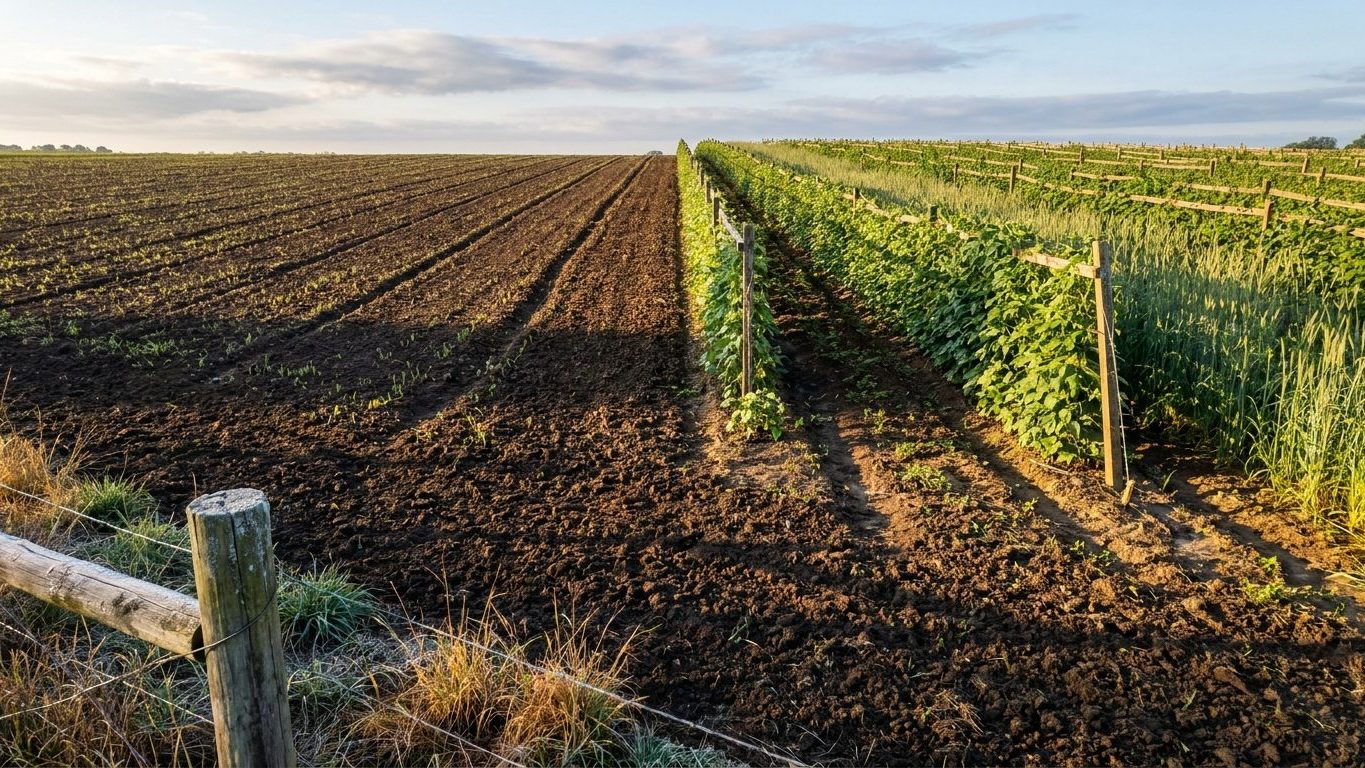

Montana gardeners sow cover crops twice a year: in spring, once the soil can be worked, and in late summer into early fall, ahead of the hard freezes. Fall is where most beds get the biggest payoff. The reference dates below come from Billings, one of the state’s milder valleys, so treat them as a best case, not a statewide rule.
The short answer for Montana
Sow spring cover crops from late April into mid-May, and fall cover crops from late summer up to the first days of October. Those two anchors, April 29 to May 10 in spring and October 1 to October 14 in fall, are the frost dates for Billings, the reference station for this page.
What those dates measure matters. They come from NOAA’s 1991-2020 Climate Normals and describe the band where the chance of a 32°F freeze sits between 30 and 70 percent (NOAA NCEI station data). They are not a promise that frost stops on May 10 or starts on October 14. Inside each band, a freeze is roughly a coin flip, and a hard freeze can arrive on either side of it.
How the window works in spring
Cold-hardy covers such as field peas and oats shrug off a light freeze, so they can go in as soon as the ground is workable, even while the spring band is still open. Frost-tender covers wait until after May 10, and a cautious gardener adds a few days. Buckwheat is the classic example: it grows fast but dies at the first freeze, so it belongs after the band closes.
How the window works in fall
Fall sowing runs the other way. The goal is a stand with some growth on it before the October 1 to 14 band, so the crop can root in and cover the soil. Winter-hardy cereal rye is the usual choice because it keeps working in cold soil. Billings has a coldest-month mean daily minimum of 17.9°F, and that figure, not the frost date, decides whether a crop survives winter or dies back. Covers that winterkill, like oats, leave a tidy mulch. Covers that overwinter, like rye, restart in spring and need to be cut or turned under.
| Sowing slot | Anchor in the Billings data | Type of cover that fits |
|---|---|---|
| Early spring | Ground workable, before or during April 29 to May 10 | Frost-tolerant: peas, oats |
| Late spring | After May 10 | Frost-tender, fast: buckwheat |
| Late summer | Several weeks before October 1 | Brassicas, rye, other hardy types |
| Early fall | Up to October 1 to 14 | Cereal rye |
For species-by-species choices, The Best Cover Crops for Montana picks up where this calendar stops.
What will not work here
The slow, heat-loving covers fail first. Between the end of the spring band on May 10 and the start of the fall band on October 1, Billings offers a little under five months, and that is the generous end of the state. Sorghum-sudangrass, cowpeas and similar warm-season covers want warm soil and a long run of nights without a chill. In Montana they sit through a cold spring, get a thin summer, and meet the first freeze before they have done much.
The second failure is the calendar copied from another state. A guide written for Missouri or Georgia will tell you to sow in September or October, which is fine there. In Montana the first freeze can arrive on October 1, and in higher valleys it can arrive earlier. A crop sown in “early fall” by a southern calendar may still be a seedling when the freeze comes. Hairy vetch and crimson clover are the usual casualties, since both need time to establish before cold sets in, and in the colder parts of the state they can struggle to survive winter even when they do establish.
Spring planting has its own trap. The NOAA data carries a warning that mountain valleys elsewhere in Montana can frost in any month. A gardener who sows tender buckwheat on May 15 because the Billings band closed on May 10 may lose the whole stand in a western valley, where a freeze in late spring or even June is possible. Billings dates describe Billings. They are a starting point everywhere else.
Then there is the winter minimum. A 17.9°F mean daily minimum for the coldest month sounds survivable, but it is an average of nights, and the real extremes run far colder. That is why zone-marginal covers fail in a hard winter after succeeding in a mild one. If a cover crop is only borderline hardy where you live, one bad January ends the experiment.
What changes across Montana
Montana spans USDA hardiness zones 3a to 6a, according to the 2023 USDA Plant Hardiness Zone Map (built on 1991-2020 normals). That is a spread of several full zones inside one state, so there is no single sowing date that fits everyone. The zone system rests on one variable only, the average annual extreme minimum temperature. It says how cold the worst night gets, which tells you what can overwinter. It says nothing about when frost arrives or how long your growing season runs.
For a reference point, Billings is one of the milder valleys, so its frost dates are the optimistic end. A reader in the north, at altitude, or in a cold mountain basin should shift in three directions:
- Sow fall covers earlier. The first freeze comes sooner, and the window for establishment closes sooner with it.
- Wait longer in spring. Tender covers should go in after your own last frost, not Billings’.
- Lean toward the hardiest types. Cereal rye and similar winter-hardy covers are safer bets than anything marginal.
The reverse holds for the warmer valleys, which gain a little room at both ends but not enough to change the rules.
To find where your own garden sits, use the USDA Plant Hardiness Zone Map and enter your ZIP code. Do not guess from a neighbor’s garden or a county average. Two sites a few miles apart can differ by half a zone or more once elevation and cold-air drainage come into play. The zone is only one piece of the answer, though. Pair it with your own first and last frost observations, which the next sections cover.
The Cover Crops for Montana Gardens overview explains how these choices fit into a full rotation, which helps when your zone limits the options.
Where to check this for your own county
The best next stop is Montana State University Extension, the state’s land-grant extension service. It runs offices at the county level, and the agents there know which sowing dates have worked on local soils and what has frozen out in recent years.
Look for two things on the extension site or through your county office. First, a local planting calendar: dates for your valley or county, not the state as a whole. Second, a list of cover crop varieties that have been trialled near you. Trial results matter more than seed-packet claims, because a variety that did well in a research plot in your county has already passed the test your garden is about to set.
A county recommendation beats a state one. This page is the state one, built on a single reference station (Billings) and a statewide zone range. It can tell you the shape of the calendar and the types that fit. It cannot tell you that the first hard freeze in your particular valley tends to land a week earlier than the NOAA band suggests, or that a given variety has failed three years in a row near you. An extension agent can.
Checking this against your own garden
Your own observation outranks every date on this page. Two signals cost nothing and need no equipment beyond a pair of hands.
Soil warmth by feel. In spring, push a bare hand into the bed. If the soil feels cold and damp and stays that way, tender covers will sulk or rot. If it feels neutral and crumbles, you are ready. A bed that warms earlier than your neighbor’s tells you your site is sheltered or south-facing. A bed that lags tells you the opposite, and you should shift every spring sowing later to match.
The first true leaves on seedlings. After the seed leaves, the first true leaves show a seedling has real root growth behind it. Watch how fast they appear on your cover crop, or on any early direct-sown crop. Quick true leaves point to warm, forgiving soil. Slow ones, especially in fall, warn that the stand may not be strong enough going into winter, and that next year you should sow sooner.
Write the dates down for a season or two. A scribbled note on the calendar, such as the first frost you noticed or the day the soil became workable, turns into a personal frost record more specific than any station average.
The Moon calendar is a separate, older custom: see when to plant cover crops by the moon, written as tradition rather than fact.
Common questions
Can I still sow a cover crop after the first fall frost in Montana?
You can, but the odds fall. Past the October 1 to October 14 band, seed may sit dormant or rot. Cereal rye is the usual choice if you sow late, and it may wait until spring to grow. Expect little ground cover before winter.
Is spring or fall better for cover crops here?
Fall suits most vegetable beds, because the garden empties out by late summer and the cover can protect bare soil through winter. Spring sowing works for fast, frost-tolerant crops, or for a short cover before a late planting. The short season leaves less room for slow covers in either slot.
Do the Billings frost dates apply to Bozeman, Missoula or Kalispell?
No. The dates here come from Billings alone, and this page does not have station figures for other Montana towns. Colder valleys and higher ground will differ, and mountain valleys can frost in any month. Your county extension office can supply local dates.
Does my hardiness zone tell me when to sow?
No. The USDA zone reflects the average annual extreme minimum temperature, so it tells you which crops can survive winter. Sowing dates depend on frost timing, which the zone does not measure. Use the zone to choose hardy types and the frost band, adjusted by your own observations, to set the date.